
Share your experience of business banking
Tell us where your business banks, whether you have applied for a loan and how satisfied you are. Your answers are combined with other people's and reported only as totals.
Start the business banking surveyAbout 5 minutes. No account needed. You can stop at any time.
What business banking covers
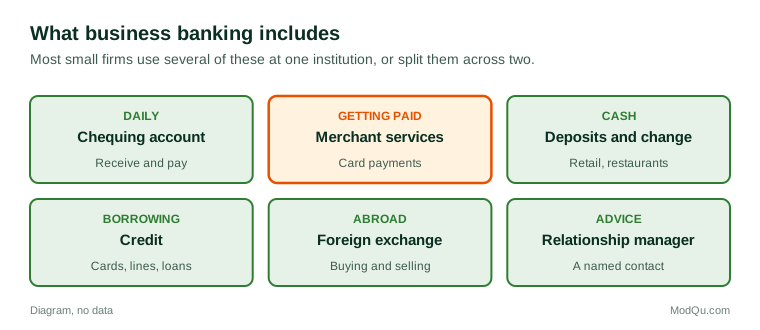
Business banking is the set of financial services a bank, credit union or other provider offers to businesses. For a small business it usually includes:
- A business chequing account for receiving payments and paying bills.
- Savings or investment accounts for cash not needed right away.
- Payment services: card terminals (merchant services), e-transfers, wire transfers, payroll deposits and pre-authorized payments.
- Cash services: deposits, night deposits, coin and change orders.
- Credit: business credit cards, lines of credit, term loans, equipment financing and commercial mortgages.
- Online and mobile banking with tools for multiple users and approvals.
- Foreign exchange for businesses that buy or sell abroad.
- Advice, often through a business advisor or relationship manager.
Keeping business and personal money in separate accounts is widely recommended by accountants because it makes records clearer and taxes easier to prepare. Incorporated businesses must keep their money separate from the owners'.
How businesses choose a bank
Many owners open a business account at the bank where they already bank personally. Others choose based on:
- Fees for the account, transactions, deposits and payments.
- Credit: whether the bank is willing to lend, and on what terms.
- Branch access for cash deposits, especially for retailers and restaurants.
- Online tools: user permissions, connections to accounting software and payroll.
- Industry knowledge: some banks have teams for farming, health professionals or other sectors.
- Relationship: having a named advisor who understands the business.
- Reputation and stability.
Example
A new consulting business with no cash sales opens its account at an online bank with low fees and a strong connection to its accounting software. Three years later, when it needs a line of credit, the owner finds the online bank offers only small credit limits and talks to a larger bank and a credit union about moving.
Fees and what businesses pay
Business accounts usually charge more than personal accounts. Common fees include:
- monthly account fees, often based on a package of transactions;
- per-transaction fees above the package limit;
- cash deposit fees, often charged per $1,000 deposited;
- fees for cheques, wires, stop payments and drafts;
- merchant service fees for card payments, set as a percentage of each sale plus fixed charges;
- fees for overdrafts and lines of credit.
Card processing fees are a major cost for many retailers and restaurants. In Canada, the federal government and major card networks have agreed to lower some fees for small businesses, and the Financial Consumer Agency of Canada oversees a code of conduct for the credit and debit card industry.
Example (hypothetical figures)
A café takes $25,000 a month in card payments. Its merchant fees average 2.1%, which is $525 a month. Its account package costs $45 a month, and it deposits $4,000 in cash a month at $2.50 per $1,000, which is $10. Its monthly banking cost is $580, or $6,960 a year, most of it from card fees.
Borrowing and access to credit
Small businesses borrow for many reasons: buying equipment, holding inventory, covering gaps in cash flow, renovating premises, buying a building or another business. Common forms of credit are:
- Business credit cards for everyday spending.
- Lines of credit, which can be drawn and repaid as needed.
- Term loans, repaid over a set period.
- Equipment loans and leases.
- Commercial mortgages for property.
- Government-backed loans, such as those under the federal Canada Small Business Financing Program, made through banks and credit unions.
Lenders usually look at the business's financial statements, cash flow, credit history, how long it has operated, the owner's personal credit and any assets offered as security. Many small business owners are asked to give a personal guarantee, which makes them personally responsible if the business cannot repay. This page describes borrowing in general; it is not financial advice.
When loan applications are turned down
New businesses, those with uneven income and those without assets to pledge often find it harder to borrow. When a bank says no, owners may try another bank or credit union, a government lender such as the Business Development Bank of Canada, online lenders, community loan funds, or personal borrowing. Some online lenders approve quickly but charge much higher rates. Owners who are declined can ask the lender to explain the reasons, which can help them prepare a stronger application later, for example with up-to-date financial statements, a cash flow forecast or a larger down payment.
Example
A two-year-old landscaping business applies for a $50,000 loan to buy a second truck. Its bank declines, citing two seasons of losses. The owner applies through a government-backed program at a credit union with a business plan showing booked contracts for the coming season, and is approved for $40,000 with a personal guarantee.
Satisfaction and switching
Business owners judge their bank by fees, access to credit, the quality of advice, speed of service, fraud protection and how easy daily banking is. Changes in staff, such as a trusted advisor leaving, can affect loyalty. Switching a business bank is harder than switching a personal one, because payroll, supplier payments, card terminals, loan agreements and accounting connections all have to move. Many businesses keep accounts at two institutions, for example a main bank and a credit union.
Example
A family-owned hardware store has banked at the same branch for 20 years. When its long-time advisor retires, the new advisor works from a regional office and calls only once a year. A credit union approaches the store with an offer of a local advisor and lower deposit fees. The owners open an account there for daily cash deposits but leave their mortgage and line of credit at the bank, saying moving the loans would take too much paperwork.
Trends and debates
Trends include more online and mobile business banking, fewer cash transactions, real-time payments, connections between banks and accounting software, and more non-bank providers of payments and lending. Debates include how much banks should charge for card payments, whether small businesses get fair access to credit compared with larger firms, and whether open banking rules will make it easier to switch. Questions businesses want answered include where small firms bank, what they pay, whether they have applied for credit and how satisfied they are.
Key terms
- Merchant servicesServices that let a business accept card payments.
- Line of creditBorrowing up to a limit, repaid and borrowed again as needed.
- Term loanA loan repaid over a fixed period with set payments.
- Personal guaranteeAn owner's promise to repay a business debt personally if the business cannot.
- SecurityAssets pledged to a lender in case a loan is not repaid.
- Relationship managerA bank employee assigned to look after a business client.
- Wire transferAn electronic transfer of money between banks, often for large or international payments.
- Open bankingA system that lets customers share their banking data securely with other providers.
Full glossary: commercial banking terms on EditingTests.com.
Business banking vocabulary test
How well do you know the language of this topic? Try 8 quick questions. Your score is shown straight away and is not saved.
What the business banking survey asks
This survey is part of ModQu's Business and Professional Services survey. The business banking part takes about five minutes and covers:
- Where your business banks, and why you chose it.
- What your business pays in banking and card fees, roughly.
- Whether you have applied for a business loan or line of credit, and what happened.
- How you handle cash, card and online payments.
- How satisfied you are with your bank, and what you would change.
- Whether you have switched banks or thought about it.
After that you can choose to continue with other short parts of the Business and Professional Services survey, such as small business owners or accounting and bookkeeping, or stop.
Ready to take part?
Your answers help show what people really think and do. Results are only ever reported as totals; no one can see your individual answers.
Start the surveyQuestions about this survey
Who can take part?
Small business owners.
Do I have to give my name?
No. You may be asked for your age group, region and similar details so results can be broken down, but not your name. ModQu never asks for passwords, card numbers or account numbers.
How are the results used?
Answers are combined into totals and percentages and published in ModQu reports. Individual answers are never shown.
Is the vocabulary test part of the survey?
No. It is optional and separate, and your score is not stored.