
Surveys · Foundations and history
George Gallup and the Birth of Scientific Opinion Polling
How an advertising researcher from Iowa turned opinion polling into a public institution, why his 1936 forecast made his name, what went wrong in 1948, and what his methods still teach.
Few people have shaped how the public thinks about measurement as much as George Gallup. In the 1930s he persuaded newspapers, politicians and ordinary readers that the views of an entire nation could be measured by interviewing a few thousand carefully chosen people. His name became a synonym for the opinion poll. His career also shows the limits of the methods he championed, and how survey research improved by learning from his mistakes.
From newspaper readers to advertising
Gallup trained as an applied psychologist at the University of Iowa, where his doctoral research in 1928 developed a method for measuring which parts of a newspaper people actually read. He went on to run research for the advertising agency Young & Rubicam in New York, testing which advertisements readers noticed and remembered. The work taught him that systematic interviewing of ordinary people could answer commercial questions far better than the opinions of editors and executives. In 1935 he founded the American Institute of Public Opinion in Princeton and began publishing a weekly syndicated newspaper column, "America Speaks," which reported what the public thought about the issues of the day (Igo, 2007).
Gallup applied the same methods to entertainment. His Audience Research Institute, set up in the late 1930s, tested film titles, stars and story ideas for Hollywood studios before films were made, an early form of the concept testing that market researchers still use (Ohmer, 2006).
The 1936 election
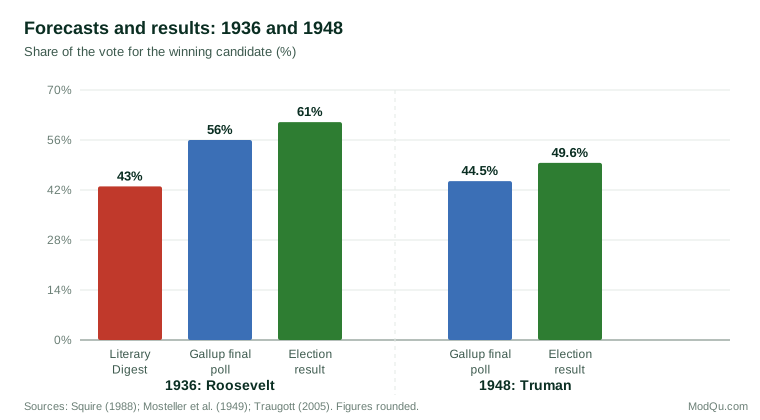
The presidential election of 1936 gave Gallup his reputation. The Literary Digest, which had called every election since 1916, mailed about ten million straw-poll ballots and predicted a win for Alfred Landon. Gallup interviewed a few thousand people chosen by quota so that the sample matched the electorate on region, sex, age and income. He forecast a clear victory for Franklin D. Roosevelt and, more boldly, published a prediction of what the Digest poll would show before it appeared, using a small sample drawn from the same kinds of lists the magazine used (Converse, 1987). Roosevelt won with about 61% of the vote. Gallup's estimate understated Roosevelt's share by several points, but he called the winner while the Digest failed badly (Squire, 1988). Archibald Crossley and Elmo Roper, using similar methods, also called the result correctly (Crossley, 1937).
Polling as a democratic tool
Gallup argued that polls did more than predict elections. In The Pulse of Democracy he and Saul Rae presented the poll as a way of giving ordinary citizens a continuous voice between elections, a "sampling referendum" that would let leaders know what the public wanted rather than relying on lobbyists and letter-writing campaigns (Gallup & Rae, 1940). Polls on issues such as social security, the military draft and public health became regular features of American newspapers, and similar institutes were founded in Britain, Canada and other countries.
Gallup also thought carefully about how questions should be asked. His "quintamensional plan" proposed asking about an issue in five steps: whether the respondent knew about it, what they thought about it in their own words, their specific views, the reasons for those views and how strongly they held them (Gallup, 1947). The plan reflected a concern that single agree-or-disagree questions could manufacture opinions that people did not really hold.
Not everyone was convinced. The sociologist Herbert Blumer argued that polls treated public opinion as the sum of individual answers, each counted equally, whereas real public opinion is formed through groups, organisations and debate, in which some voices carry more weight than others (Blumer, 1948). That critique still informs debates about what polls can and cannot tell us. A poll can say how many people hold a view; it cannot say on its own how intensely they hold it, how well informed they are, or whether the view will survive a public argument. Gallup's own quintamensional plan was partly an answer to this problem, since it tried to separate informed opinions from casual ones, but the short questions that suited newspaper columns rarely used it in full.
The 1948 failure
In 1948 Gallup, Crossley and Roper all forecast that Thomas Dewey would defeat President Harry Truman. Truman won by more than four points. A committee of the Social Science Research Council investigated and identified several causes: the pollsters stopped interviewing weeks before election day and missed late shifts towards Truman; they assumed undecided voters would split like decided ones; and quota sampling gave interviewers freedom to choose whom to interview, which produced samples that were more educated and better off than the electorate (Mosteller et al., 1949).
Gallup responded by changing his methods. His organisation moved towards probability-based area sampling, in which interviewers were sent to randomly selected locations rather than choosing respondents themselves, and it continued polling closer to election day. The 1948 report also changed how polls were presented. Pollsters began to stress that a poll describes opinion at the time it was taken, not a forecast of a future event, and to publish details of sample size and fieldwork dates alongside their results. Later evaluations of pre-election polls show that accuracy improved substantially in the following decades, although every election still tests the methods afresh (Traugott, 2005).
What Gallup's story teaches
Three lessons from Gallup's career remain relevant to anyone who commissions survey research. First, how a sample is selected matters far more than how big it is; a few thousand well-chosen respondents beat millions of self-selected ones. Second, even a good method has weaknesses that may stay hidden until conditions change, as quota sampling's did in 1948. Third, the meaning of a poll result depends on the question asked, so careful question design is as important as careful sampling.
Gallup died in 1984, and the organisation that bears his name continues to publish polls. His deeper legacy is the expectation, now taken for granted, that claims about what the public thinks should be backed by systematic evidence.
References
Blumer, H. (1948). Public opinion and public opinion polling. American Sociological Review, 13(5), 542–549. https://doi.org/10.2307/2087146
Converse, J. M. (1987). Survey research in the United States: Roots and emergence, 1890–1960. University of California Press.
Crossley, A. M. (1937). Straw polls in 1936. Public Opinion Quarterly, 1(1), 24–35. https://doi.org/10.1086/265035
Gallup, G., & Rae, S. F. (1940). The pulse of democracy: The public-opinion poll and how it works. Simon and Schuster.
Gallup, G. (1947). The quintamensional plan of question design. Public Opinion Quarterly, 11(3), 385–393. https://doi.org/10.1086/265864
Igo, S. E. (2007). The averaged American: Surveys, citizens, and the making of a mass public. Harvard University Press.
Mosteller, F., Hyman, H., McCarthy, P. J., Marks, E. S., & Truman, D. B. (1949). The pre-election polls of 1948: Report to the Committee on Analysis of Pre-Election Polls and Forecasts. Social Science Research Council.
Ohmer, S. (2006). George Gallup in Hollywood. Columbia University Press.
Squire, P. (1988). Why the 1936 Literary Digest poll failed. Public Opinion Quarterly, 52(1), 125–133. https://doi.org/10.1086/269085
Traugott, M. W. (2005). The accuracy of the national preelection polls in the 2004 presidential election. Public Opinion Quarterly, 69(5), 642–654. https://doi.org/10.1093/poq/nfi061