
Surveys · Foundations and history
The Origins of the Modern Survey: From Domesday Book to Digital Questionnaires
How the survey grew from royal inventories and poverty studies into a scientific method based on probability sampling, and how each new technology since has changed the way questions are asked.
Every time an organisation sends a questionnaire to its customers, it uses a method that took nine centuries to develop. The modern survey combines three ideas that arrived at different times: systematic counting, the study of social conditions through direct inquiry, and the use of a small random sample to learn about a large population. This article traces how those ideas came together and how each new technology since has changed the way survey questions are put to people.
Counting for the state
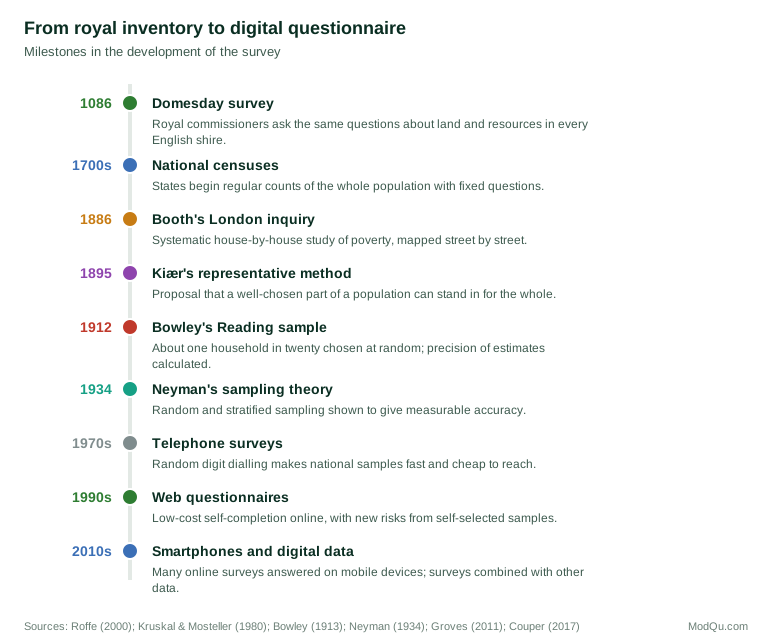
The oldest surveys were inventories made for rulers who wanted to know what they could tax or call to arms. The best known in the English-speaking world is the Domesday Book. At Christmas 1085 William the Conqueror ordered a survey of the land he had conquered, and commissioners travelled through the English shires in 1086 recording who held each estate, how many ploughs, mills and livestock it had, and what it was worth before and after the conquest (Roffe, 2000). The commissioners put the same questions to juries in every district, which made the answers comparable across the kingdom. That principle, a standard set of questions asked in the same way everywhere, is still the foundation of survey measurement.
Censuses developed from the same need. National censuses with fixed questions and regular timing appeared from the eighteenth century onwards, and by the nineteenth century statistical offices in Europe and North America were collecting and publishing population figures on a large scale (Desrosières, 1998). A census, however, counts everyone. It answers the question "how many?" well, but it is expensive, slow and limited to a few simple items.
The social survey
In the late nineteenth century reformers began to use direct inquiry to study social problems. Charles Booth's investigation of poverty in London, begun in 1886, combined school board visitors' knowledge of each household with street-by-street observation and produced colour-coded maps of the city's income levels (Booth, 1887). Seebohm Rowntree applied a similar approach in York in 1899 and defined a poverty line based on the cost of a minimum diet (Rowntree, 1901). These studies showed that careful, systematic fact-gathering could change public debate. They were still complete enumerations of the people studied, which made them slow and costly.
The idea of the representative sample
The intellectual breakthrough came from statisticians. In 1895 the Norwegian statistician Anders Kiær proposed to the International Statistical Institute that a well-chosen part of a population could stand in for the whole, which he called the "representative method." His proposal met strong resistance from statisticians who believed only a full count was trustworthy (Kruskal & Mosteller, 1980). The objection was reasonable at the time. Kiær chose his districts and households by judgement, so that the sample resembled the country on known characteristics, and nobody could say how far its results might stray from the truth. The debate over whether a part could ever replace the whole ran at international statistical meetings for three decades. What eventually settled it was not a better argument for judgement but a different method of selection, one that left the choice of units to chance.
Arthur Bowley moved the idea from argument to practice. In his 1912 survey of working-class households in Reading he selected about one household in twenty by a random procedure and calculated how precise the resulting estimates were likely to be (Bowley, 1913). This was one of the first social surveys to use random selection and to report its own margin of error.
The theoretical foundation followed in 1934, when Jerzy Neyman showed that random sampling, and stratified random sampling in particular, allowed the accuracy of estimates to be calculated, while "purposive" selection of supposedly typical units did not (Neyman, 1934). His paper also introduced confidence intervals to survey estimation. Within a decade statisticians at the United States Census Bureau had worked out the theory of multistage and cluster samples for national household surveys (Hansen & Hurwitz, 1943), and historical reviews written soon afterwards already described sampling as the normal method for official statistics (Seng, 1951; Smith, 1976).
Opinion polls and the golden age of interviewing
Market and opinion research brought the survey to a wider public. After the Literary Digest failed to predict the 1936 United States election from millions of mailed ballots, the much smaller samples of George Gallup and others established the credibility of the scientific poll (Converse, 1987). For the next three decades most serious surveys were carried out face to face by trained interviewers who visited homes selected through area probability samples. Groves (2011) calls the period from about 1930 to 1960 the era of invention, when the basic tools of sampling, questionnaire design and interviewing were created.
The same period turned questionnaire writing into a craft with rules. Survey organisations trained interviewers to read each question exactly as printed, to probe in neutral ways and to record answers without interpretation. Researchers also began to test the questions themselves, for example by giving two versions of a question to random halves of a sample and comparing the answers (Converse, 1987). These "split-ballot" comparisons showed that small changes in wording could shift results by many percentage points, a finding that still shapes how careful researchers write questions today. Businesses adopted the same methods to study consumers, and market research grew into an industry alongside academic and government surveys.
Telephone, then web
Each new communication technology has changed how surveys are done. When telephones reached nearly every household, random digit dialling allowed a national sample to be drawn and interviewed from a central office at a fraction of the cost of door-to-door interviews (Waksberg, 1978). Groves (2011) describes 1960 to 1990 as an era of expansion, in which the number of surveys grew rapidly in government, academia and business.
The internet arrived in the 1990s. Web questionnaires were cheap, fast and able to show images, video and interactive questions. Couper (2000) noted early that the ease of web surveys brought a risk: many were based on whoever chose to respond, not on a defined sample, and so repeated the problem of the Literary Digest. Since then response rates for traditional modes have fallen, smartphones have become a common device for answering surveys, and researchers increasingly combine survey answers with other digital data (Couper, 2017). Groves (2011) calls this third era one in which designed survey data must sit alongside large volumes of "organic" data produced by digital activity.
What has stayed the same
The tools have changed from quill pens to touchscreens, but the core questions of survey quality have been remarkably stable:
- Who could be included? The Domesday commissioners missed people who held no land; a web survey misses people who are not online. Coverage remains the first test of any survey.
- How were people chosen? Since Bowley and Neyman, a known, random selection process has been the basis for calculating how far a sample result can be trusted (Bethlehem, 2009).
- Were the questions asked the same way to everyone? Standard questions, asked consistently, are what make answers comparable, whether they are put by a royal commissioner or a web form (Dillman et al., 2014).
Conclusion
The modern survey is the product of slow accumulation rather than a single invention. State inventories supplied standardised questions, social reformers supplied the habit of direct inquiry, and statisticians supplied the mathematics that lets a few thousand answers describe millions of people. Each technology since has made surveys cheaper and faster, and each has raised again the oldest questions of who is counted and how. Understanding that history helps anyone who commissions or reads survey research to ask the right questions about the data in front of them.
References
Bethlehem, J. (2009). Applied survey methods: A statistical perspective. Wiley. https://doi.org/10.1002/9780470494998
Booth, C. (1887). The inhabitants of Tower Hamlets (School Board Division), their condition and occupations. Journal of the Royal Statistical Society, 50(2), 326–401.
Bowley, A. L. (1913). Working-class households in Reading. Journal of the Royal Statistical Society, 76(7), 672–701. https://doi.org/10.2307/2339708
Converse, J. M. (1987). Survey research in the United States: Roots and emergence, 1890–1960. University of California Press.
Couper, M. P. (2000). Web surveys: A review of issues and approaches. Public Opinion Quarterly, 64(4), 464–494. https://doi.org/10.1086/318641
Couper, M. P. (2017). New developments in survey data collection. Annual Review of Sociology, 43, 121–145. https://doi.org/10.1146/annurev-soc-060116-053613
Desrosières, A. (1998). The politics of large numbers: A history of statistical reasoning. Harvard University Press.
Dillman, D. A., Smyth, J. D., & Christian, L. M. (2014). Internet, phone, mail, and mixed-mode surveys: The tailored design method (4th ed.). Wiley.
Groves, R. M. (2011). Three eras of survey research. Public Opinion Quarterly, 75(5), 861–871. https://doi.org/10.1093/poq/nfr057
Hansen, M. H., & Hurwitz, W. N. (1943). On the theory of sampling from finite populations. The Annals of Mathematical Statistics, 14(4), 333–362. https://doi.org/10.1214/aoms/1177731356
Kruskal, W., & Mosteller, F. (1980). Representative sampling, IV: The history of the concept in statistics, 1895–1939. International Statistical Review, 48(2), 169–195. https://doi.org/10.2307/1403151
Neyman, J. (1934). On the two different aspects of the representative method: The method of stratified sampling and the method of purposive selection. Journal of the Royal Statistical Society, 97(4), 558–625. https://doi.org/10.2307/2342192
Roffe, D. (2000). Domesday: The inquest and the book. Oxford University Press.
Rowntree, B. S. (1901). Poverty: A study of town life. Macmillan.
Seng, Y. P. (1951). Historical survey of the development of sampling theories and practice. Journal of the Royal Statistical Society: Series A, 114(2), 214–231.
Smith, T. M. F. (1976). The foundations of survey sampling: A review. Journal of the Royal Statistical Society: Series A, 139(2), 183–204. https://doi.org/10.2307/2345174
Waksberg, J. (1978). Sampling methods for random digit dialing. Journal of the American Statistical Association, 73(361), 40–46. https://doi.org/10.1080/01621459.1978.10479995