
Research · Qualitative research
Focus Groups: When Group Discussion Produces Better Data
When focus groups produce better data than individual interviews and when they do not, covering the role of group interaction, group composition and size, the question route, moderation, online groups, analysis, the number of groups needed and the main limitations.
A focus group is a discussion among a small group of people, guided by a moderator, on a topic set by the researcher. It is one of the most familiar research methods, used for decades in marketing, politics, health and social research. It is also one of the most misused. Focus groups are often treated as a fast and cheap way to interview eight people at once. That view misses what makes them distinctive. Kitzinger (1994) argued that the defining feature of a focus group is the interaction between participants: people question one another, compare experiences, disagree and explain themselves in ways that reveal how views are formed and expressed in a social setting. When that interaction is what the research needs, focus groups produce data that individual interviews cannot. When it is not, they can produce worse data than interviews. This article explains how to tell the difference, and how to plan, run and analyse focus groups well.
Origins
The method grew out of the focused interview developed by Merton and Kendall (1946) to study audience responses to wartime radio programmes and films. Participants who had all experienced the same stimulus were interviewed, sometimes in groups, about their reactions, with the interviewer focusing on the specific elements that produced them. Market researchers adopted group discussions in the decades that followed, and Calder (1977) described three distinct uses in marketing: exploratory groups to generate ideas and hypotheses, clinical groups in which trained moderators interpret underlying motives, and phenomenological groups that let managers hear how consumers describe a product in their own words. From the 1980s, social and health researchers took up the method, emphasising its value for understanding shared meanings and community perspectives (Morgan, 1996; Wilkinson, 1998).
What group interaction adds
Focus groups produce several kinds of data that interviews do not. First, participants react to one another. One person's account prompts others to recall similar or contrasting experiences, often bringing out details that would not have emerged in a one-to-one conversation. Kitzinger (1995) noted that this can help people explore and clarify their views, particularly on topics they have not thought about in detail before.
Second, the group shows how people talk about a topic among themselves: the language they use, the jokes they make, the examples they reach for and the points on which they agree or argue. For a company trying to understand how customers describe a problem, or a public body trying to communicate with a community, this language is itself a finding.
Third, the group shows how views are negotiated. Participants may change their position in response to others, defend it under challenge or reveal assumptions they share. Morgan (1997) argued that this makes focus groups particularly useful for studying the range of views in a group and the reasons behind them, rather than for studying any individual in depth.
Fourth, groups can be less intimidating than individual interviews for some participants. People who would be uncomfortable alone with a researcher may speak more freely among peers, particularly when the group shares a characteristic or experience (Kitzinger, 1995).
When interviews are better
The same group dynamics can work against the research. Conformity is the most obvious risk. In classic experiments, Asch (1956) showed that many people will give an answer they can see is wrong rather than disagree with a unanimous group. In a focus group, a confident early speaker can shape what follows, and participants with minority views may stay silent. Janis (1972) described groupthink, in which the wish for agreement in a cohesive group overrides realistic appraisal of alternatives. Sunstein and Hastie (2015) describe how group discussion can amplify initial tendencies and suppress information that individual members hold, producing a more extreme or less informed consensus than the members would reach alone.
Smithson (2000) found that focus group talk tends to be dominated by certain voices and to reproduce accepted public views, which she called normative discourses, rather than private opinions. Hollander (2004) argued that what participants say depends on the social context of the group, including who else is present and which identities feel relevant, so that some experiences are never mentioned.
Groups also give each participant less time. In a 90-minute group of eight, each person speaks for perhaps eight to ten minutes. Guest, Namey, Taylor et al. (2017) randomly assigned participants to individual interviews or focus groups on the same topic and found that individual interviews generated a wider range of themes per participant. They also found that the groups did not inhibit discussion of sensitive topics, which in some cases were raised more often in groups. Fern (1982) found that focus groups generated fewer ideas than the same number of people interviewed individually.
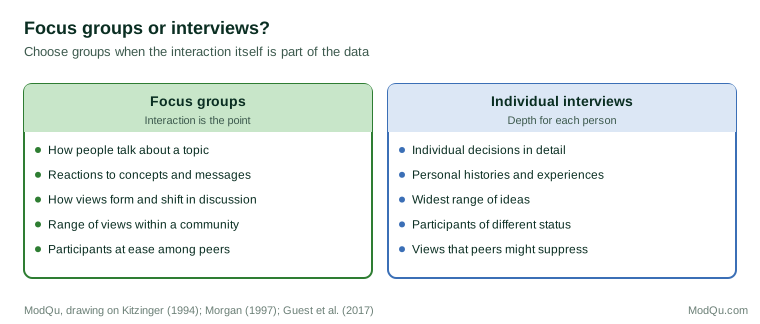
The lesson is that focus groups should be chosen for the interaction they produce, not to save time. If the aim is to understand individual decisions in detail, to explore personal or sensitive experiences that people would not share with peers, or to gather the widest possible range of ideas, interviews are usually better. If the aim is to understand shared meanings, the language a group uses, reactions to a concept or message, or how views form and change in discussion, focus groups are often better.
Group composition
Most focus group studies use groups whose members share a relevant characteristic, such as age, role, customer type or experience of a service. Krueger and Casey (2015) recommend homogeneity in characteristics that matter to the topic, because participants speak more freely with people like themselves, but enough variety within the group to produce different views. Mixing groups that differ in status, such as managers and their staff, or doctors and patients, usually inhibits the less powerful members.
Whether participants should know one another is debated. Strangers may speak more freely about some topics, while existing groups, such as colleagues or friends, reproduce the kind of conversation that happens naturally and may refer to shared experiences (Kitzinger, 1994). Fern (1982) found that acquaintanceship had little effect on the quantity or quality of ideas generated, so the choice should depend on the research aim.
Group size
Groups typically contain between six and ten participants. Krueger and Casey (2015) suggest five to eight for most non-commercial topics, noting that larger groups are hard to manage and leave less time for each person, while very small groups produce a narrower range of views. Commercial research has often used larger groups of eight to ten. Groups on complex or emotional topics, or with participants who have a great deal to say, work better at the smaller end of the range. Mini-groups of three or four are sometimes used with specialists or for sensitive subjects.
It is usual to recruit one or two more participants than needed, because some will not attend. Over-recruiting too heavily produces groups that are too large to discuss anything in depth.
Recruitment and practical arrangements
Recruitment is often the most time-consuming part of a focus group study. Participants are usually screened against criteria that define each group, such as recent purchase of a product, role in an organisation or a particular experience, using a short questionnaire. Barbour (2007) recommends that the sampling strategy be planned as carefully as in any qualitative study, with groups chosen to allow the comparisons the research needs, rather than filled with whoever is available. Professional respondents, people who attend many groups for the incentive, are a known problem in commercial research and are usually excluded by asking when participants last took part in research.
Practical arrangements also affect the data. The venue should be neutral and comfortable; a room in the client's offices or a setting associated with authority may inhibit discussion. Sessions usually last 90 minutes to two hours, including a short introduction. Seating in a circle or around a table, name cards and refreshments help participants settle. Participants should be told at the start how the session will be recorded and whether anyone is observing, and observers behind one-way mirrors or on video links should be disclosed.
How many groups?
Studies usually include several groups for each type of participant, because one group can be unusual. Guest, Namey and McKenna (2017) analysed data from a study of 40 focus groups and found that two to three groups were enough to identify about 80% of all themes, including the most common ones, and that three to six groups identified about 90%. Krueger and Casey (2015) recommend planning three or four groups per type of participant and continuing until new groups add little that is new.
When the study compares types of participant, such as users and non-users, or different regions, the number of groups multiplies quickly. A study with three segments and three groups each already requires nine groups, which is why careful thought about which comparisons truly matter is essential.
The question route
Focus groups follow a question route or discussion guide, usually shorter than an interview guide because each question is discussed by several people. Krueger and Casey (2015) describe a sequence of question types, shown below, that moves participants from easy, general questions to the key questions and then to a summary.
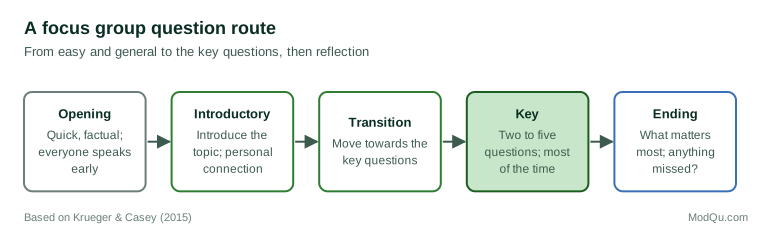
Opening questions are answered by everyone, quickly, to get each person speaking early. Introductory and transition questions bring the topic into focus and connect participants' experience to it. Key questions, usually two to five, take most of the time and produce most of the data. Ending questions ask participants to reflect on what has been said, to identify what matters most, and whether anything has been missed. A moderator may also summarise the main points and ask whether the summary is accurate.
Focus groups often use stimulus material, such as concept boards, advertisements, prototypes or short videos. Activities such as sorting cards, ranking options or writing down a first reaction before discussion help capture individual views before the group influences them, which partly addresses the conformity problem.
Moderation
The moderator's skill largely determines the quality of a focus group. Stewart and Shamdasani (2015) describe the moderator's task as keeping the discussion on topic while allowing it to flow naturally, ensuring that all participants contribute, and probing for detail and reasons without leading. Specific techniques include inviting quieter participants by name, acknowledging a dominant speaker's point and then asking others for different views, asking for examples when discussion becomes general, and explicitly inviting disagreement: "Does anyone see it differently?"
The moderator should remain neutral. Showing approval of some answers, or revealing the client's preferences, quickly shapes what the group says. An assistant moderator, where available, takes notes on who says what, records non-verbal reactions and manages practical matters, leaving the moderator free to concentrate on the discussion.
Online focus groups
Online groups are now common. Synchronous groups take place in real time, by video or text chat, and resemble in-person groups. Asynchronous groups take place on a discussion board over several days, with participants responding to questions and to each other when convenient. Stewart and Williams (2005) noted that online groups allow participants to take part from anywhere and may encourage more open discussion of some sensitive topics, but that they change the dynamics of discussion: text-based groups lack tone and non-verbal cues, and asynchronous groups lose the spontaneity of live talk while gaining time for reflection.
Video groups work best with smaller numbers, typically four to six, because it is harder to manage turn-taking on screen. Asynchronous boards can include more participants and are well suited to topics that benefit from reflection or to participants in different time zones.
Ethics in group settings
Focus groups raise ethical issues that do not arise in individual interviews. The researcher can promise to keep what participants say confidential, but cannot guarantee that other participants will do the same. Bloor et al. (2001) recommend that participants be told this clearly, asked to respect each other's privacy, and advised not to share anything they would not want repeated. Topics that could expose participants to embarrassment or harm if discussed in front of others may be better explored in individual interviews.
Discussion can also become distressing, particularly on personal or contentious topics. The moderator should be prepared to steer the conversation, to offer breaks, and to provide information about sources of support where appropriate. Group members may also disclose information about third parties, which should be handled with the same care as participants' own information.
Combining focus groups with other methods
Focus groups are often most useful as one part of a larger study. Morgan (1996) identified three common combinations. Groups can precede a survey, helping to identify topics and language for the questionnaire. They can follow a survey, helping to interpret its results. And they can run alongside individual interviews, with the groups capturing shared views and the interviews capturing individual experience in depth. In each case, the strengths of focus groups complement the strengths of the other method.
Analysis
Focus group data consist of transcripts, notes on interaction and any material produced during activities. Analysis follows the general principles of qualitative analysis, such as thematic analysis (Braun & Clarke, 2006), with one important addition: the unit of analysis is the group as well as the individual. Onwuegbuzie et al. (2009) set out several approaches to analysing focus group data, and emphasised that analysts should attend to the degree of consensus and dissent within each group, not only to what was said.
Kitzinger (1994) argued that analysis should pay explicit attention to interaction: how views were challenged, how participants built on each other's comments, and where agreement was reached or avoided. A theme mentioned by one participant and enthusiastically endorsed by others means something different from a theme raised by one person and ignored. Counting how many participants mentioned something can mislead, because in a group, later speakers are influenced by earlier ones. It is more useful to report how many groups raised a theme and how it was received.
Reports should describe the number, composition and size of the groups, the question route, the moderator and the method of analysis. The COREQ checklist includes items specific to focus groups (Tong et al., 2007).
Common misuses
The most common misuse is to treat focus group results as if they were survey data, reporting that "70% of participants preferred concept A". With a few groups of handpicked participants who influenced one another, such a figure has no meaning for the wider population. Focus groups can show which aspects of a concept people respond to and why; a survey or experiment is needed to show how many people would choose it.
A second misuse is to ask participants to predict their own behaviour. Participants readily explain what they would do, but their predictions are often poor, and people are frequently unable to report accurately why they behave as they do (Nisbett & Wilson, 1977). Asking about recent real experience, or observing reactions to real material, is more reliable.
A third misuse is to run groups with clients watching and to treat the most memorable comments as findings. Systematic analysis of transcripts, across all groups, protects against the influence of a vivid remark.
Focus groups in commercial research
In commercial research, focus groups are well suited to exploring how customers talk about a category, testing early concepts and messages, understanding reactions to packaging or advertising, and generating ideas for new products. A brief hypothetical example illustrates good practice. A utility company planning a new tariff runs six groups: two with young renters, two with families and two with retired homeowners. Each begins with participants writing down their first reaction to a description of the tariff, followed by discussion. The groups show that all three segments find the word "dynamic" alarming, and that families are most concerned about predictability. The company then tests revised wording in a survey to measure how many customers in each segment prefer each version. The focus groups supplied the language and the concerns; the survey supplied the numbers.
Conclusion
Focus groups are not a cheaper form of interview. Their value lies in group interaction, which reveals shared language, collective meanings and how views are formed and challenged. The same interaction can produce conformity, silence minority views and limit individual depth. Choosing focus groups when interaction is what the research needs, composing groups with care, following a structured question route, moderating skilfully and analysing the group as well as the individual all help the method deliver data that other methods cannot.
References
Asch, S. E. (1956). Studies of independence and conformity: I. A minority of one against a unanimous majority. Psychological Monographs: General and Applied, 70(9), 1–70. https://doi.org/10.1037/h0093718
Barbour, R. (2007). Doing focus groups. SAGE. https://doi.org/10.4135/9781849208956
Bloor, M., Frankland, J., Thomas, M., & Robson, K. (2001). Focus groups in social research. SAGE. https://doi.org/10.4135/9781849209175
Braun, V., & Clarke, V. (2006). Using thematic analysis in psychology. Qualitative Research in Psychology, 3(2), 77–101. https://doi.org/10.1191/1478088706qp063oa
Calder, B. J. (1977). Focus groups and the nature of qualitative marketing research. Journal of Marketing Research, 14(3), 353–364. https://doi.org/10.1177/002224377701400311
Fern, E. F. (1982). The use of focus groups for idea generation: The effects of group size, acquaintanceship, and moderator on response quantity and quality. Journal of Marketing Research, 19(1), 1–13. https://doi.org/10.1177/002224378201900101
Guest, G., Namey, E., & McKenna, K. (2017). How many focus groups are enough? Building an evidence base for nonprobability sample sizes. Field Methods, 29(1), 3–22. https://doi.org/10.1177/1525822X16639015
Guest, G., Namey, E., Taylor, J., Eley, N., & McKenna, K. (2017). Comparing focus groups and individual interviews: Findings from a randomized study. International Journal of Social Research Methodology, 20(6), 693–708. https://doi.org/10.1080/13645579.2017.1281601
Hollander, J. A. (2004). The social contexts of focus groups. Journal of Contemporary Ethnography, 33(5), 602–637. https://doi.org/10.1177/0891241604266988
Janis, I. L. (1972). Victims of groupthink: A psychological study of foreign-policy decisions and fiascoes. Houghton Mifflin.
Kitzinger, J. (1994). The methodology of focus groups: The importance of interaction between research participants. Sociology of Health & Illness, 16(1), 103–121. https://doi.org/10.1111/1467-9566.ep11347023
Kitzinger, J. (1995). Qualitative research: Introducing focus groups. BMJ, 311(7000), 299–302. https://doi.org/10.1136/bmj.311.7000.299
Krueger, R. A., & Casey, M. A. (2015). Focus groups: A practical guide for applied research (5th ed.). SAGE.
Merton, R. K., & Kendall, P. L. (1946). The focused interview. American Journal of Sociology, 51(6), 541–557. https://doi.org/10.1086/219886
Morgan, D. L. (1996). Focus groups. Annual Review of Sociology, 22, 129–152. https://doi.org/10.1146/annurev.soc.22.1.129
Morgan, D. L. (1997). Focus groups as qualitative research (2nd ed.). SAGE. https://doi.org/10.4135/9781412984287
Nisbett, R. E., & Wilson, T. D. (1977). Telling more than we can know: Verbal reports on mental processes. Psychological Review, 84(3), 231–259. https://doi.org/10.1037/0033-295X.84.3.231
Onwuegbuzie, A. J., Dickinson, W. B., Leech, N. L., & Zoran, A. G. (2009). A qualitative framework for collecting and analyzing data in focus group research. International Journal of Qualitative Methods, 8(3), 1–21. https://doi.org/10.1177/160940690900800301
Smithson, J. (2000). Using and analysing focus groups: Limitations and possibilities. International Journal of Social Research Methodology, 3(2), 103–119. https://doi.org/10.1080/136455700405172
Stewart, D. W., & Shamdasani, P. N. (2015). Focus groups: Theory and practice (3rd ed.). SAGE.
Stewart, K., & Williams, M. (2005). Researching online populations: The use of online focus groups for social research. Qualitative Research, 5(4), 395–416. https://doi.org/10.1177/1468794105056916
Sunstein, C. R., & Hastie, R. (2015). Wiser: Getting beyond groupthink to make groups smarter. Harvard Business Review Press.
Tong, A., Sainsbury, P., & Craig, J. (2007). Consolidated criteria for reporting qualitative research (COREQ): A 32-item checklist for interviews and focus groups. International Journal for Quality in Health Care, 19(6), 349–357. https://doi.org/10.1093/intqhc/mzm042
Wilkinson, S. (1998). Focus group methodology: A review. International Journal of Social Research Methodology, 1(3), 181–203. https://doi.org/10.1080/13645579.1998.10846874