
Research · Research design
Action Research: Studying Change While Making It
What action research is, its origins with Kurt Lewin, the cycle of planning, acting, observing and reflecting, its main variants, how it differs from conventional research, how its quality is judged, and how it is used in organisations.
Most research tries to study the world without changing it. Action research sets out to do both at once: it brings researchers and practitioners together to solve a practical problem, and it treats the process of solving it as a source of knowledge. A hospital ward trying to reduce patient falls, a school trying to improve attendance or a company trying to make a new information system work can each become the setting for action research, with staff and researchers jointly planning changes, trying them, studying the results and refining their approach. Reason and Bradbury (2008) describe action research as a participatory process concerned with developing practical knowing in the pursuit of worthwhile human purposes. This article explains where action research came from, how it works, its main forms, how its quality is judged and where it is most useful.
Origins
The term is usually traced to the social psychologist Kurt Lewin. In a 1946 article, Lewin argued that research which produced nothing but books would not be enough to address social problems such as discrimination, and he proposed instead research that compares the conditions and effects of different forms of social action and that leads directly to action (Lewin, 1946). He described a spiral of steps, each composed of planning, action and fact-finding about the result of the action.
Around the same time, studies of workplaces showed what this approach could achieve. Coch and French (1948) worked with a pyjama factory in Virginia where changes to working methods regularly led to falling output and resignations. Groups of workers who participated in designing the changes recovered their output much faster than groups who were simply told about them. At the Tavistock Institute in London, Trist and Bamforth (1951) studied the introduction of new mechanised mining methods in British coal mines and showed that the new technology had broken up small, self-managing work groups, with damaging effects on productivity and morale. Their work, developed with miners and managers, led to the idea of designing technology and work organisation together.
A second tradition grew from community development and adult education, especially in Latin America. Freire (1970) argued that people affected by social problems should be active participants in understanding and changing their circumstances, not passive objects of study. This tradition shaped what is often called participatory action research, which emphasises the knowledge and power of community members (Cornwall & Jewkes, 1995).
The action research cycle
Action research proceeds through repeated cycles. Kemmis and McTaggart (1988) described four moments: plan, act, observe and reflect. Susman and Evered (1978) proposed a five-phase version for organisations: diagnosing, action planning, action taking, evaluating and specifying learning.
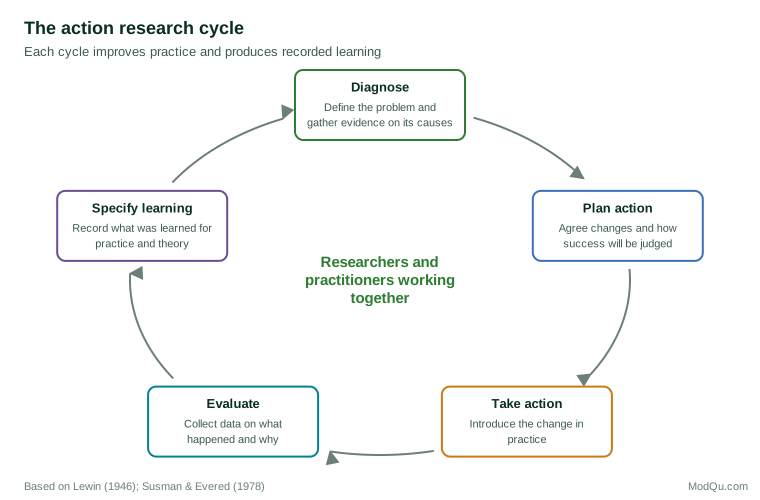
In the first cycle, participants diagnose the problem, gather evidence about its causes and plan a change. They implement the change and collect data on what happens, using whatever methods suit the question: interviews, observation, records, surveys or performance measures. They then reflect on the results, asking what worked, what did not and why. The reflection leads to a revised plan and a new cycle. Each cycle refines both the practical solution and the participants' understanding of the problem.
The cycles are what make action research a form of inquiry rather than simply problem-solving. Coghlan and Brannick (2014) stress that each cycle must include deliberate reflection on what has been learned, recorded in a way that others can examine, and that the inquiry includes reflection on the process of the research itself.
How action research differs from conventional research
Action research differs from conventional approaches in several ways.
- The researcher is a participant. In conventional research, the researcher tries to stay outside the situation being studied. In action research, the researcher works with practitioners and is part of the change. Greenwood and Levin (2007) describe this as co-generative inquiry, in which professional researchers and local stakeholders contribute different kinds of knowledge.
- The aim is both action and knowledge. Success is judged by whether the situation improves and whether something has been learned that is useful beyond it.
- The design evolves. Plans change in response to what is learned in each cycle, rather than being fixed at the start.
- Participants are co-researchers. Practitioners help define the problem, design the changes and interpret the results.
Argyris and Schön (1978) drew a related distinction between single-loop learning, which corrects errors within existing assumptions, and double-loop learning, which questions the assumptions themselves. Action research aims for the second: the reflection stage should examine not only whether an action worked but whether the problem was framed correctly in the first place. Schön (1983) described skilled professionals as engaging in "reflection-in-action", and action research can be seen as a disciplined, shared version of this.
Forms of action research
Action research takes several forms. Technical or practical action research, common in education and nursing, focuses on improving a specific practice, such as a teaching method or a clinical procedure. Organisational action research addresses problems within a company or public body, often with an external researcher working alongside managers and staff (Eden & Huxham, 1996). Insider action research is conducted by members of the organisation studying their own setting, which brings deep knowledge but also challenges of objectivity and role conflict (Coghlan & Brannick, 2014). Participatory action research, rooted in the Freirean tradition, emphasises community control over the research and its use.
Judging quality
Because action research does not follow the logic of the controlled experiment, its quality cannot be judged by the same criteria. Critics have argued that it is consulting under another name: change is made, but there is no control group and no way of knowing whether the change, rather than something else, produced the outcome. Baskerville and Wood-Harper (1996) acknowledged these concerns in information systems research, noting risks including lack of impartiality and difficulty in generalising.
Several sets of criteria have been proposed in response. Davison et al. (2004) set out principles for what they called canonical action research, including:
- an explicit agreement between researcher and client about the scope, roles and responsibilities;
- use of the cyclical process model;
- use of theory to guide the diagnosis and the planned actions;
- change through action, with evidence of what changed; and
- specification of learning through reflection, including its implications for theory and practice.
Herr and Anderson (2015) proposed several forms of validity for action research: outcome validity (whether the problem was resolved), process validity (whether the methods were sound and the evidence credible), democratic validity (whether all relevant stakeholders were involved), catalytic validity (whether participants' understanding changed) and dialogic validity (whether the findings stand up to critical review by peers).
Eden and Huxham (1996) emphasised that, for action research to contribute to knowledge, it must produce insights with implications beyond the specific situation, and must be explicit about what has been learned and how it relates to existing theory.
Strengths and limitations
Action research is well suited to situations in which the problem is complex, the people involved hold essential knowledge, and change is needed anyway. It produces findings that are grounded in real practice, often secures the commitment of those who must implement the change, and builds the capacity of participants to continue learning after the researchers leave. Stringer (2014) emphasises that it gives a voice to those who are often only the subjects of research.
Its limitations are equally real. Results are tied to a specific setting and set of people, so generalisation depends on careful description and theoretical reasoning. Because the researcher is involved in the change, there is a risk of seeing success where others would not. Projects can be lengthy and demanding of participants' time. And the dual role of researcher and change agent can create conflicts, for example when evidence suggests that a change favoured by the sponsoring manager is not working.
Ethical questions
Action research raises ethical questions that conventional studies do not. Because participants are also colleagues, it can be hard for them to decline to take part or to criticise a change that their manager supports. Because the design evolves, consent given at the start may not cover what the project later becomes. And because the researcher has a stake in the change succeeding, there is a risk of reporting selectively. Coghlan and Brannick (2014) recommend agreeing at the outset how data will be used, who will see it and how participants can withdraw, and revisiting these agreements as the project changes. Herr and Anderson (2015) add that insiders should be open about their dual role, and that reports should include the setbacks and disagreements as well as the successes.
Action research in organisations
Organisations often undertake change projects without treating them as opportunities to learn. Action research offers a disciplined alternative. A team introducing a new customer service process, for example, might begin by documenting the current process and its problems, agree on specific changes and measures of success, introduce the changes in one team, gather data on customer outcomes and staff experience, and review the results with the staff involved before extending or revising the changes. Each step is recorded so that the reasons for decisions, and what was learned, are available to others.
The approach can be combined with other methods. Measures collected before and after each cycle can be analysed quantitatively; staggered introduction across teams can provide a comparison; and interviews can explain why changes succeeded or failed. Used this way, action research turns routine organisational change into a source of evidence.
Conclusion
Action research links inquiry and change. Through repeated cycles of planning, acting, observing and reflecting, it allows researchers and practitioners to improve a situation while learning about it. It does not offer the causal certainty of an experiment, and its findings must be generalised with care. But for complex practical problems in which the people involved hold essential knowledge, and in which change must happen anyway, it offers a rigorous way to make the change and learn from it at the same time.
References
Argyris, C., & Schön, D. A. (1978). Organizational learning: A theory of action perspective. Addison-Wesley.
Baskerville, R. L., & Wood-Harper, A. T. (1996). A critical perspective on action research as a method for information systems research. Journal of Information Technology, 11(3), 235–246. https://doi.org/10.1080/026839696345289
Coch, L., & French, J. R. P., Jr. (1948). Overcoming resistance to change. Human Relations, 1(4), 512–532. https://doi.org/10.1177/001872674800100408
Coghlan, D., & Brannick, T. (2014). Doing action research in your own organization (4th ed.). SAGE.
Cornwall, A., & Jewkes, R. (1995). What is participatory research? Social Science & Medicine, 41(12), 1667–1676. https://doi.org/10.1016/0277-9536(95)00127-S
Davison, R., Martinsons, M. G., & Kock, N. (2004). Principles of canonical action research. Information Systems Journal, 14(1), 65–86. https://doi.org/10.1111/j.1365-2575.2004.00162.x
Eden, C., & Huxham, C. (1996). Action research for management research. British Journal of Management, 7(1), 75–86. https://doi.org/10.1111/j.1467-8551.1996.tb00107.x
Freire, P. (1970). Pedagogy of the oppressed (M. B. Ramos, Trans.). Herder and Herder.
Greenwood, D. J., & Levin, M. (2007). Introduction to action research: Social research for social change (2nd ed.). SAGE.
Herr, K., & Anderson, G. L. (2015). The action research dissertation: A guide for students and faculty (2nd ed.). SAGE.
Kemmis, S., & McTaggart, R. (Eds.). (1988). The action research planner (3rd ed.). Deakin University Press.
Lewin, K. (1946). Action research and minority problems. Journal of Social Issues, 2(4), 34–46. https://doi.org/10.1111/j.1540-4560.1946.tb02295.x
Reason, P., & Bradbury, H. (Eds.). (2008). The SAGE handbook of action research: Participative inquiry and practice (2nd ed.). SAGE.
Schön, D. A. (1983). The reflective practitioner: How professionals think in action. Basic Books.
Stringer, E. T. (2014). Action research (4th ed.). SAGE.
Susman, G. I., & Evered, R. D. (1978). An assessment of the scientific merits of action research. Administrative Science Quarterly, 23(4), 582–603. https://doi.org/10.2307/2392581
Trist, E. L., & Bamforth, K. W. (1951). Some social and psychological consequences of the longwall method of coal-getting. Human Relations, 4(1), 3–38. https://doi.org/10.1177/001872675100400101