
Research · Research design
Case Study Research: Design, Rigour and Generalisation
What a case study is, the main types of case design, how rigour is achieved through multiple sources of evidence and careful case selection, and how findings from one or a few cases can be generalised to theory.
A case study examines a single instance, or a small number of instances, of a phenomenon in depth and in its real-world context. The case might be an organisation, a product launch, a community, a policy decision or a crisis. Yin (2018) defines the case study as an empirical method that investigates a contemporary phenomenon in depth within its real-life context, especially when the boundaries between phenomenon and context are not clearly evident. Case studies are widely used in management, political science, education and health research, and they underpin much of what practitioners learn about how organisations actually work. They are also frequently criticised as anecdotal and impossible to generalise. This article explains how case studies are designed, what makes them rigorous, and in what sense their findings can be generalised.
When a case study fits
Yin (2018) argues that case studies are most suitable when the research asks "how" or "why" questions, when the researcher has little control over events, and when the focus is on a contemporary situation. A case study of how a retailer managed a failed product recall can trace the sequence of decisions, the information available at each point and the reasons people gave, something a survey of many retailers could not do. Gerring (2004) adds that case studies are strongest when the aim is to understand causal mechanisms rather than to estimate how large an effect is on average.
Stake (1995) distinguished three purposes. An intrinsic case study is undertaken because the case itself is of interest, such as a study of one company's turnaround. An instrumental case study uses a case to understand a broader issue. A collective case study examines several cases to understand a phenomenon more generally.
Types of case design
Yin (2018) classifies designs along two dimensions: whether the study includes one case or several, and whether each case is treated as a whole or broken into embedded units of analysis.
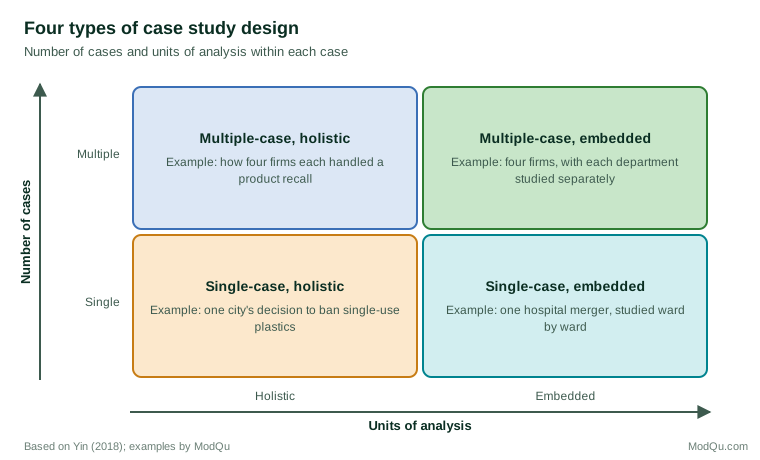
A single-case design is appropriate when the case is critical for testing a theory, unusual, typical, revealing because it was previously inaccessible, or studied over time. A multiple-case design follows a replication logic: each case is like a separate experiment, chosen either to produce similar results (literal replication) or contrasting results for predictable reasons (theoretical replication). Eisenhardt (1989) proposed that four to ten cases often provide a good basis for building theory, though the right number depends on the question.
Selecting cases
Cases in a case study are not selected to be statistically representative. They are selected for what they can teach. Seawright and Gerring (2008) set out several strategies, including typical cases that represent a common pattern, diverse cases that cover the range of variation, extreme cases with unusual values, deviant cases that contradict expectations, and most similar or most different pairs that allow comparison. Flyvbjerg (2006) emphasised the value of critical cases: if a theory fails in the case most favourable to it, it is unlikely to hold elsewhere. Case selection should be explained and justified, because it determines what the study can conclude.
Achieving rigour
Case studies are rigorous when the reasoning from evidence to conclusion is transparent and can be checked. Several practices support this.
- Multiple sources of evidence. Documents, archival records, interviews, direct observation and physical artefacts can be combined so that findings are corroborated by more than one source, a process known as triangulation (Yin, 2018).
- A case study database. Keeping the evidence organised and separate from the report allows others to inspect it.
- A chain of evidence. A reader should be able to trace each conclusion back to the evidence that supports it.
- Pattern matching and rival explanations. Comparing the observed pattern with the pattern predicted by a theory, and with patterns predicted by rival explanations, strengthens causal inference.
- Process tracing. George and Bennett (2005) describe how examining the sequence of events within a case can test whether the mechanism proposed by a theory actually operated.
Gibbert et al. (2008) reviewed case studies published in leading management journals and found that many reported far less about these procedures than they should, especially regarding internal and construct validity. Lincoln and Guba (1985) proposed parallel criteria for qualitative work, including credibility and transferability, that serve a similar purpose.
The question of generalisation
The most common criticism of case studies is that one case cannot be generalised. Yin (2018) responds that case studies generalise to theory, not to populations. This is analytic generalisation: a case is used to develop, test or refine a theory, and it is the theory that is then applied to other situations. Statistical generalisation, from a sample to a population, is the wrong standard.
Flyvbjerg (2006) went further, arguing that the belief that one cannot generalise from a single case is one of five misunderstandings about case research. He pointed out that a single carefully chosen case can falsify a general claim, and that much of science has advanced through the study of particular, well-chosen cases. Siggelkow (2007) noted that a single case can be highly persuasive if it shows something striking, such as one talking pig, which would be enough to overturn the belief that pigs cannot talk.
The study of the Cuban missile crisis by Allison (1971) illustrates the value of a single case. By examining one decision in great detail through three different models of government behaviour, Allison showed that each model explained different aspects of what happened, and the models became standard tools for analysing decisions far beyond that crisis.
Case studies in business research
In commercial settings, case studies are often used to understand why a particular outcome occurred: why a launch succeeded in one region and failed in another, why a key client left, or how a competitor built a new market. The same standards apply. A useful business case study states the question it addresses, explains why the case or cases were chosen, draws on several sources of evidence, such as internal documents, sales data and interviews with staff and customers, and considers explanations other than the one first proposed. Without these elements, a case study becomes a story that confirms what its author already believed.
Strengths and limitations
Case studies offer depth, context and an understanding of processes that other methods cannot easily provide. They are especially useful for exploring new phenomena, explaining surprising outcomes and generating hypotheses. Eisenhardt and Graebner (2007) argue that theory built from cases is often novel, testable and closely tied to evidence.
Their limitations are real. Findings depend on the researcher's judgement in selecting cases and interpreting evidence. Case studies cannot estimate how common something is or how large an effect is on average. And the depth that is their strength makes them time-consuming. They are therefore best used for the questions they answer well, and combined with other methods when the decision requires measurement across many cases.
References
Allison, G. T. (1971). Essence of decision: Explaining the Cuban missile crisis. Little, Brown.
Eisenhardt, K. M. (1989). Building theories from case study research. Academy of Management Review, 14(4), 532–550. https://doi.org/10.5465/amr.1989.4308385
Eisenhardt, K. M., & Graebner, M. E. (2007). Theory building from cases: Opportunities and challenges. Academy of Management Journal, 50(1), 25–32. https://doi.org/10.5465/amj.2007.24160888
Flyvbjerg, B. (2006). Five misunderstandings about case-study research. Qualitative Inquiry, 12(2), 219–245. https://doi.org/10.1177/1077800405284363
George, A. L., & Bennett, A. (2005). Case studies and theory development in the social sciences. MIT Press.
Gerring, J. (2004). What is a case study and what is it good for? American Political Science Review, 98(2), 341–354. https://doi.org/10.1017/S0003055404001182
Gibbert, M., Ruigrok, W., & Wicki, B. (2008). What passes as a rigorous case study? Strategic Management Journal, 29(13), 1465–1474. https://doi.org/10.1002/smj.722
Lincoln, Y. S., & Guba, E. G. (1985). Naturalistic inquiry. SAGE.
Seawright, J., & Gerring, J. (2008). Case selection techniques in case study research: A menu of qualitative and quantitative options. Political Research Quarterly, 61(2), 294–308. https://doi.org/10.1177/1065912907313077
Siggelkow, N. (2007). Persuasion with case studies. Academy of Management Journal, 50(1), 20–24. https://doi.org/10.5465/amj.2007.24160882
Stake, R. E. (1995). The art of case study research. SAGE.
Yin, R. K. (2018). Case study research and applications: Design and methods (6th ed.). SAGE.