
Research · Research design
Writing a Research Proposal: Structure and Persuasion
How to structure a research proposal, what each section must accomplish, how proposals persuade reviewers and clients, common reasons proposals fail, and how commercial research proposals differ from academic and grant proposals.
A research proposal is a document that asks someone to approve, fund or commission a study. It may be a doctoral student's plan submitted to a supervisory committee, a grant application to a research council or foundation, or a response to a client's request for a market research study. In each case, the proposal must do two things at once. It must describe a study clearly enough that the reader can judge whether it is sound, and it must persuade the reader that the study is worth doing, that it will work and that the people proposing it can deliver. Locke et al. (2014) describe the proposal as both a plan of action and an argument, and most weak proposals fail on one or the other. This article sets out the standard structure of a proposal, what each section needs to achieve, the principles that make proposals persuasive and the most common reasons they are rejected.
The proposal as an argument
It helps to think of a proposal as a chain of claims, each supported by evidence and each leading to the next. A problem exists and matters. Existing knowledge does not resolve it. A specific question, if answered, would help. The proposed method can answer that question. The study is feasible with the time, money and skills available. And the results will be useful to someone. If any link is weak, the whole argument fails, however strong the others are.
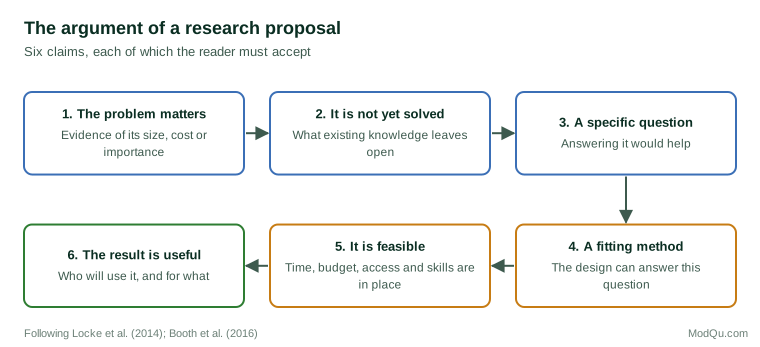
Booth et al. (2016) describe research writing as a conversation with readers who will ask, at each step, "so what?" and "how do you know?". A proposal should anticipate these questions. Punch (2016) recommends that writers be able to state the core of their proposal in a few sentences before writing the full document: what the study is about, what question it asks, how it will answer it and why that matters. If this summary cannot be written clearly, the full proposal will not be clear either.
The standard structure
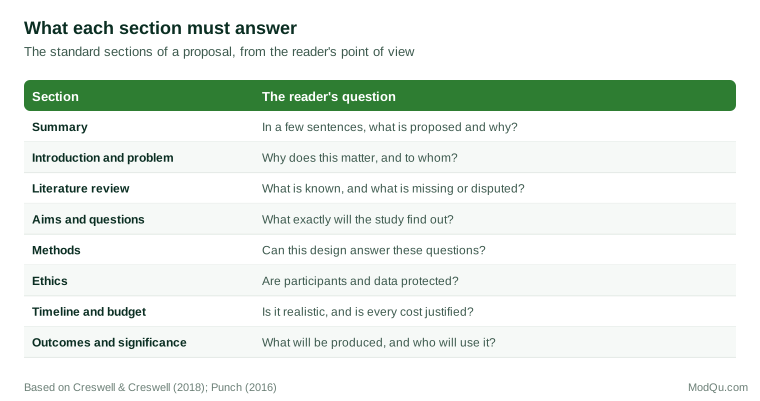
Proposals vary by field and by funder, and the funder's own guidelines always take priority. But most contain a recognisable set of sections (Creswell & Creswell, 2018; Punch, 2016).
Title and summary
The title should state the topic and, where possible, the question or approach. The summary, often limited to a few hundred words, is the most important part of the proposal, because many reviewers read it first and some read little else with care. It should state the problem, the aim, the method and the expected contribution, in plain language.
Introduction and statement of the problem
The introduction establishes why the study is needed. Swales (1990) described a common structure for research introductions, which he called "create a research space": establish that the territory is important, identify a gap or problem in it, and show how the present study occupies that gap. The problem should be specific. "Customer retention is important" is not a problem statement; "Retention among new subscribers fell from 78% to 64% over two years, and existing data do not show why" is.
Literature review
In a proposal, the literature review is not a comprehensive survey but a targeted argument. It should show what is already known, where the gaps or disagreements are, and how the proposed study will address them. Alvesson and Sandberg (2011) argue that the most interesting research questions often come not from filling gaps but from challenging the assumptions on which existing research rests, and a literature review that identifies such assumptions can make a stronger case for a study. Chalmers and Glasziou (2009) estimated that a large share of research effort is wasted, in part because studies are designed without adequate reference to existing evidence; a proposal that shows it has reviewed the evidence systematically addresses this concern directly.
Aims, questions and hypotheses
This section states precisely what the study will find out. Aims describe the overall purpose; research questions or hypotheses state the specific questions to be answered. They should be few, clear and answerable with the proposed methods. Leek and Peng (2015) emphasise the importance of being clear about what type of question is being asked, whether descriptive, exploratory, inferential, predictive or causal, because each requires different data and analysis.
Methods
The methods section is usually the longest and the most closely scrutinised. It should describe the research design, the population and sample, the data collection procedures and instruments, and the analysis plan, and it should justify each choice in relation to the research questions. Reviewers look for evidence that the design can actually answer the questions posed. For quantitative studies, this includes a justification of the sample size, often through a power analysis (Cohen, 1988). For qualitative studies, it includes an explanation of how participants or cases will be selected and how the analysis will ensure credibility (Maxwell, 2013). Sandelowski and Barroso (2003) note that qualitative proposals face a particular challenge: they must explain a flexible, emergent design convincingly to reviewers who may expect every detail to be fixed in advance.
Ethics
The proposal should identify ethical issues, such as consent, confidentiality, risks to participants and data protection, and explain how they will be managed. For studies involving human participants, ethics review is usually required before data collection can begin.
Timeline and budget
A realistic timeline, often presented as a chart of tasks against months, shows that the researcher has thought through the sequence of work. The budget should be linked to the activities described, with each cost justified. Reviewers are as wary of underestimated budgets, which suggest the work cannot be completed, as of inflated ones.
Expected outcomes and significance
The proposal should state what the study will produce, whether findings, publications, tools or recommendations, and who will benefit. Wisdom et al. (2015), reviewing advice on successful grant writing, found that clarity about the significance and potential impact of a study was among the most consistently emphasised elements.
References and appendices
The reference list shows the scholarly basis of the proposal. Appendices may include draft instruments, letters of support, detailed budgets or ethics documents.
Principles of persuasion
A proposal persuades by being clear, credible and relevant to the reader. Several principles help.
Write for the reader. Reviewers may be experts in the field or generalists on a panel; clients may be managers with no research training. The proposal should be written for its actual readers. Gitlin and Lyons (2014) emphasise reading the funder's priorities and evaluation criteria carefully and showing explicitly how the proposal meets each one.
Be specific. Vague proposals invite doubt. "We will interview a range of stakeholders" is weaker than "We will interview 24 store managers, selected to cover the four regions and three store formats". Specific plans signal that the researcher has thought through the work.
Show the fit between question and method. The strongest proposals make it obvious why the chosen method is the right one for the question. Locke et al. (2014) stress that every methodological choice should be traceable to the research question.
Acknowledge limitations and risks. Experienced reviewers know that no study is perfect. A proposal that acknowledges likely problems, such as low response rates or difficulty recruiting a particular group, and explains how they will be handled is more credible than one that ignores them.
Engage with other views. Graff and Birkenstein (2018) describe academic writing as a response to what others have said. A proposal that acknowledges competing explanations or approaches, and explains why its own is appropriate, shows command of the field.
Make it easy to read. Clear headings, short paragraphs, figures and tables help reviewers find what they need. Porter (2007) argues that many academics write proposals in the style of journal articles, building slowly towards the point, when reviewers need the main message stated early and plainly.
Common reasons proposals fail
Analyses of reviewer comments point to recurring problems (Denicolo & Becker, 2012; Wisdom et al., 2015).
- The problem is not clearly important. The proposal does not make a convincing case that the question matters.
- The question is too broad or vague. It cannot be answered by a single study, or it is unclear what an answer would look like.
- The method does not fit the question. For example, a cross-sectional survey is proposed to answer a causal question.
- The study is not feasible. The sample cannot be recruited, the timeline is unrealistic or the team lacks a necessary skill.
- The literature review is weak. Key work is missing, or the review describes studies without building an argument.
- The analysis plan is missing or superficial. The proposal describes data collection in detail but says little about how the data will be analysed.
- The writing is unclear. Reviewers cannot easily find the aims, the design or the expected outcomes.
The writing process
Proposals are rarely written well in a single pass. A practical sequence starts from the core and works outward.
Draft the core argument first. Write one paragraph that states the problem, the gap, the question, the method and the expected contribution. Krathwohl and Smith (2005) recommend testing this summary on colleagues before writing the full proposal: if they cannot restate the study accurately after reading it, the idea needs sharpening, not more words.
Write the methods early. It is tempting to begin with the literature review, but the methods section determines what the study can deliver, and drafting it early exposes problems with the question or the feasibility while they can still be fixed. The review can then be shaped to set up the study that will actually be done.
Build the timeline and budget from the methods. Each activity in the methods section, such as recruiting participants, translating instruments or transcribing interviews, should appear in the timeline and, where it costs money, in the budget. Inconsistencies between these sections are among the easiest problems for reviewers to spot.
Revise for the reader. Swales and Feak (2012) emphasise that academic writing must be adapted to its audience and purpose, and that careful attention to how information is ordered, from known to new and from general to specific, makes complex material easier to follow. In a proposal, this means placing the most important information at the start of each section and each paragraph, so that a reviewer skimming the document still grasps the argument.
Seek a critical reading. Before submission, ask someone who was not involved to read the proposal as a reviewer would, ideally using the funder's or client's own evaluation criteria. Their questions show where the argument is unclear or the evidence thin.
Pre-specification and transparency
Proposals increasingly serve a second purpose: they record in advance what a study intends to do, so that the final results can be compared with the plan. Nosek et al. (2018) argue that this kind of preregistration helps distinguish confirmatory research, which tests predictions specified in advance, from exploratory research, which generates new hypotheses from the data. In clinical research, the SPIRIT statement sets out the items a trial protocol should contain (Chan et al., 2013). Kaplan and Irvin (2015) found that after large clinical trials funded by the United States National Heart, Lung, and Blood Institute were required to register their primary outcomes in advance, the proportion reporting a significant benefit fell sharply, suggesting that pre-specification had reduced the selective reporting of favourable outcomes. A detailed proposal with a clear analysis plan serves the same purpose.
Commercial research proposals
Proposals for commercial research, such as responses to a client's request for a market study, follow the same logic in a compressed form. Gerin and Kapelewski (2011) note, in the context of grant writing, that reviewers reward proposals that make their task easy, and the same is true of clients. A commercial proposal typically contains:
- The business problem, restated in the client's terms, showing that the researcher has understood the decision the client faces.
- Research objectives, stated as the specific questions the study will answer.
- The approach, describing the method, sample and data collection, with a brief justification of why it suits the objectives.
- Deliverables, describing what the client will receive, such as a report, a presentation, a data file or a dashboard, and when.
- Timeline and cost.
- The team and relevant experience.
The key difference from an academic proposal is the emphasis on the decision the research will inform. Academic proposals are judged partly by their contribution to knowledge; commercial proposals are judged by whether they will help the client make a better decision, at an acceptable cost and on time. A commercial proposal that begins by restating the client's decision, and shows how each element of the study contributes to it, is usually more persuasive than one that begins with the method.
A checklist before submitting
Before a proposal is submitted, it is worth checking that:
- the summary states the problem, aim, method and contribution in plain language;
- the research questions are specific and answerable;
- every methodological choice can be traced to a research question;
- the sample size or case selection is justified;
- the analysis plan is described, not just the data collection;
- ethical issues are identified and addressed;
- the timeline and budget are realistic and linked to the activities;
- the funder's or client's guidelines and criteria have been followed exactly; and
- someone unfamiliar with the project has read it and can explain what it proposes.
Conclusion
A research proposal is a plan and an argument. It must show that a problem matters, that existing knowledge does not resolve it, that a specific question can be answered by a feasible method, and that the answer will be useful. Most proposals that fail do so because one of these links is weak or because the writing obscures them. Writing the core argument in a few sentences first, structuring the document around the reader's questions, being specific about methods and honest about risks, and following the funder's or client's guidelines closely give a proposal the best chance of success.
References
Alvesson, M., & Sandberg, J. (2011). Generating research questions through problematization. Academy of Management Review, 36(2), 247–271. https://doi.org/10.5465/amr.2009.0188
Booth, W. C., Colomb, G. G., Williams, J. M., Bizup, J., & FitzGerald, W. T. (2016). The craft of research (4th ed.). University of Chicago Press.
Chalmers, I., & Glasziou, P. (2009). Avoidable waste in the production and reporting of research evidence. The Lancet, 374(9683), 86–89. https://doi.org/10.1016/S0140-6736(09)60329-9
Chan, A.-W., Tetzlaff, J. M., Altman, D. G., Laupacis, A., Gøtzsche, P. C., Krleža-Jerić, K., Hróbjartsson, A., Mann, H., Dickersin, K., Berlin, J. A., Doré, C. J., Parulekar, W. R., Summerskill, W. S. M., Groves, T., Schulz, K. F., Sox, H. C., Rockhold, F. W., Rennie, D., & Moher, D. (2013). SPIRIT 2013 statement: Defining standard protocol items for clinical trials. Annals of Internal Medicine, 158(3), 200–207. https://doi.org/10.7326/0003-4819-158-3-201302050-00583
Cohen, J. (1988). Statistical power analysis for the behavioral sciences (2nd ed.). Lawrence Erlbaum Associates.
Creswell, J. W., & Creswell, J. D. (2018). Research design: Qualitative, quantitative, and mixed methods approaches (5th ed.). SAGE.
Denicolo, P., & Becker, L. (2012). Developing research proposals. SAGE.
Gerin, W., & Kapelewski, C. H. (2011). Writing the NIH grant proposal: A step-by-step guide (2nd ed.). SAGE.
Gitlin, L. N., & Lyons, K. J. (2014). Successful grant writing: Strategies for health and human service professionals (4th ed.). Springer Publishing.
Graff, G., & Birkenstein, C. (2018). "They say / I say": The moves that matter in academic writing (4th ed.). W. W. Norton.
Kaplan, R. M., & Irvin, V. L. (2015). Likelihood of null effects of large NHLBI clinical trials has increased over time. PLOS ONE, 10(8), Article e0132382. https://doi.org/10.1371/journal.pone.0132382
Krathwohl, D. R., & Smith, N. L. (2005). How to prepare a dissertation proposal: Suggestions for students in education and the social and behavioral sciences. Syracuse University Press.
Leek, J. T., & Peng, R. D. (2015). What is the question? Science, 347(6228), 1314–1315. https://doi.org/10.1126/science.aaa6146
Locke, L. F., Spirduso, W. W., & Silverman, S. J. (2014). Proposals that work: A guide for planning dissertations and grant proposals (6th ed.). SAGE.
Maxwell, J. A. (2013). Qualitative research design: An interactive approach (3rd ed.). SAGE.
Nosek, B. A., Ebersole, C. R., DeHaven, A. C., & Mellor, D. T. (2018). The preregistration revolution. Proceedings of the National Academy of Sciences, 115(11), 2600–2606. https://doi.org/10.1073/pnas.1708274114
Porter, R. (2007). Why academics have a hard time writing good grant proposals. Journal of Research Administration, 38(2), 37–43.
Punch, K. F. (2016). Developing effective research proposals (3rd ed.). SAGE.
Sandelowski, M., & Barroso, J. (2003). Writing the proposal for a qualitative research methodology project. Qualitative Health Research, 13(6), 781–820. https://doi.org/10.1177/1049732303013006003
Swales, J. M. (1990). Genre analysis: English in academic and research settings. Cambridge University Press.
Swales, J. M., & Feak, C. B. (2012). Academic writing for graduate students: Essential tasks and skills (3rd ed.). University of Michigan Press.
Wisdom, J. P., Riley, H., & Myers, N. (2015). Recommendations for writing successful grant proposals: An information synthesis. Academic Medicine, 90(12), 1720–1725. https://doi.org/10.1097/ACM.0000000000000611