
Investigation · Business and corporate investigation
Fraud Investigation: Detection, Evidence and Recovery
Fraud is deception for gain, and it is designed not to be found. This article explains how fraud comes to light, how investigators build evidence that will stand up, and how organisations recover what was taken.
Fraud differs from most other wrongdoing in one important respect: it is built to be hidden. A theft of goods leaves an empty shelf, but a well-designed fraud leaves records that appear normal. False invoices are approved, fictitious employees are paid, revenue is recorded for sales that never happened, and the accounts balance. Investigating fraud therefore means finding deception inside records that were made to look honest, proving who did it and how, and recovering the losses where possible.
This article follows a fraud investigation through its three main phases: detection, the building of evidence, and recovery. It draws on research on how frauds are discovered and on the methods that forensic accountants and fraud examiners use. A companion article examines the fraud triangle, the most widely used explanation of why people commit fraud.
What fraud is
Legal definitions vary, but most share the same core: a deliberate deception intended to obtain an advantage or cause a loss. In England and Wales, the Fraud Act 2006 defines fraud by false representation, by failing to disclose information when under a legal duty to do so, and by abuse of position, in each case with dishonest intent to make a gain or cause a loss. The offence is complete when the dishonest act is done, whether or not anyone is actually deceived or loses money.
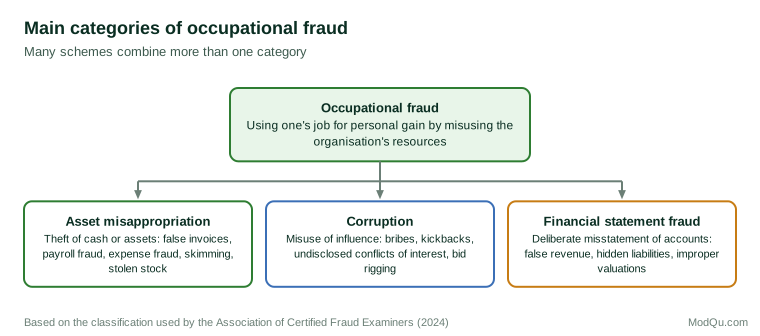
Within organisations, the Association of Certified Fraud Examiners classifies occupational fraud into three main categories, shown below. Asset misappropriation is by far the most common, but financial statement fraud, though rarer, causes the largest losses per case (Association of Certified Fraud Examiners [ACFE], 2024).
Phase one: detection
How fraud comes to light
Frauds are discovered in several ways: tips from employees, customers or suppliers; internal audit; management review; account reconciliation; automated monitoring; external audit; and sometimes by accident. In the cases reported to the ACFE (2024), tips were the most common means of initial detection by a wide margin, and more than half of those tips came from employees. Dyck et al. (2010), studying fraud at large United States companies, likewise found that employees, the media and industry regulators played a larger role in detection than external auditors.
Many frauds are never detected at all. Dyck et al. (2024), using the sudden demise of the accounting firm Arthur Andersen as a natural experiment that exposed its clients to fresh scrutiny, estimated that only about a third of corporate frauds are detected. The frauds that investigators see are therefore a biased sample of those that occur: they are the ones that were clumsy, unlucky or reported.
The role of auditors
External auditors are often assumed to be responsible for finding fraud. Auditing standards make clear that their role is narrower. International Standard on Auditing 240 requires auditors to obtain reasonable assurance that the financial statements are free from material misstatement, whether caused by fraud or error, and to maintain professional scepticism, but acknowledges that fraud involving collusion and forgery may not be detected (International Auditing and Assurance Standards Board [IAASB], 2009). Hogan et al. (2008), reviewing academic research on financial statement fraud, found that auditors' ability to detect fraud improves when they assess fraud risk explicitly and adapt their procedures accordingly.
Detection through data
Analytical methods have become central to fraud detection. Bolton and Hand (2002) review statistical techniques for detecting fraud in large datasets, from rules that flag specific patterns to models that learn what normal transactions look like and highlight those that do not fit. In accounting, tests based on Benford's law compare the distribution of leading digits in a set of numbers with the distribution expected in naturally occurring data; deviations can indicate invented figures, although they also have innocent causes (Nigrini, 2012).
At the level of whole companies, researchers have built models to identify financial statements that are likely to have been manipulated. Beneish (1999) developed a model using ratios such as unusual growth in receivables relative to sales, and Dechow et al. (2011) developed a score based on accruals, financial performance and off-balance-sheet activity that distinguishes firms later found to have misstated their accounts. These tools indicate where to look; they do not prove that fraud occurred.
Common analytical tests within organisations include:
- comparing supplier and employee records for shared addresses, telephone numbers or bank accounts;
- looking for duplicate invoices, invoices just below approval limits and sequential invoice numbers from a supplier;
- identifying payments made on weekends, holidays or outside normal processes;
- matching payroll records against human resources records to find employees who do not exist;
- examining journal entries made by unusual users, at unusual times or to unusual accounts.
Each test produces leads. Most will have innocent explanations, and the investigator's task is to separate those from the few that do not.
Phase two: building the evidence
Start with the documents
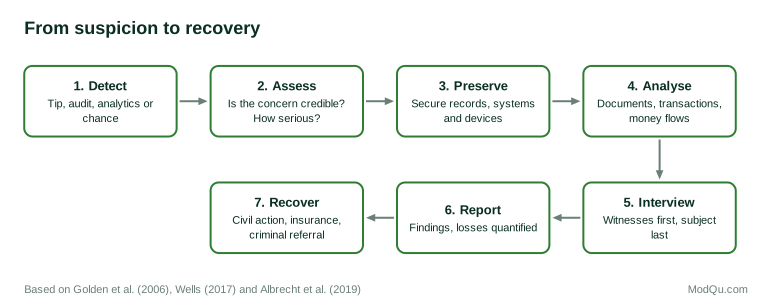
Fraud investigations differ from many other kinds of inquiry in that the decisive evidence is usually documentary. The false invoice, the altered bank statement, the email arranging a kickback and the journal entry that moved a loss off the books are all records. Fraud examination texts therefore stress working from the outside in: gathering and analysing documents and data first, interviewing neutral witnesses next, then those who may have been involved, and the main subject last (Wells, 2017; Albrecht et al., 2019). This order means that by the time the subject is interviewed, the investigator knows what the records show and can put specific evidence to them.
Preservation must come first. Once a suspect learns of an investigation, documents can be destroyed and electronic records altered. Investigators therefore secure accounting systems, email, shared drives and devices, often with the help of forensic technology specialists who create verified copies, before any approach is made to the people involved.
Follow the money
The core technique of financial investigation is tracing funds from their source to their destination. The investigator establishes where the money came from, through which accounts it passed and where it ended up, and documents each step with bank records, payment instructions and supporting documents. Golden et al. (2006) describe how forensic accountants reconstruct transactions and quantify losses, often building schedules that link each payment to the evidence supporting it.
When direct evidence of a fraud's proceeds is lacking, investigators may use indirect methods. The net worth method compares a person's increase in assets over a period with their known income; an unexplained excess may represent illicit gains. The expenditure method compares spending with known income. These methods were developed in tax and criminal cases and remain useful where records are incomplete.
Interviews
Interviews in fraud cases are used to obtain information from witnesses, to understand processes and controls, and to give the subject an opportunity to explain the evidence. Research on interviewing has shown that information-gathering approaches, which establish rapport and invite a full account before challenging it with evidence, produce more reliable information than accusatory methods, which press for confession and increase the risk of false admissions (Meissner et al., 2014). In a fraud case, the subject's explanation must also be tested: a claim that a payment was a legitimate fee, for example, can be checked against contracts, deliverables and the recollections of others.
Proving intent
Fraud requires dishonesty, which means that the investigation must establish not only that false records were created or money was diverted, but that the person did so knowingly. Intent is rarely admitted. It is usually inferred from patterns: repeated conduct, concealment, the creation of false documents, lies told when questioned, and the benefit the person received. Evidence that the person took steps to hide what they were doing is often the strongest indicator that they knew it was wrong.
Quantifying the loss
A fraud investigation must usually put a figure on the loss, for the board, the insurer, the court or the prosecutor. The figure should be built transaction by transaction, with each item linked to the evidence that shows it was fraudulent, rather than estimated from a sample and extrapolated, unless the court or insurer has agreed to that approach. Where some transactions are clearly fraudulent and others are uncertain, the report should show the two groups separately. Investigators should also record costs that flow from the fraud, such as the cost of the investigation itself and of correcting records, since these may be recoverable. An overstated loss undermines the credibility of the whole investigation; an understated one leaves money unrecovered (Golden et al., 2006).
Phase three: recovery
Civil remedies
Victims of fraud can bring civil claims to recover their losses, and civil courts have developed powerful tools for this purpose. In England and Wales, a freezing injunction, first granted in Mareva Compania Naviera SA v International Bulkcarriers SA (1975), prevents a defendant from moving or disposing of assets before trial. A search order, recognised in Anton Piller KG v Manufacturing Processes Ltd (1976), allows the claimant's lawyers to enter premises and seize evidence that would otherwise be destroyed. A disclosure order based on Norwich Pharmacal Co v Customs and Excise Commissioners (1974) can require third parties, such as banks, that have become innocently mixed up in wrongdoing to disclose information identifying wrongdoers or tracing assets. Similar remedies exist in many other jurisdictions.
These orders are often obtained without notice to the defendant, because notice would allow assets or evidence to disappear. Courts grant them only on strong evidence and require the applicant to give full and frank disclosure, including of points in the defendant's favour.
Criminal proceedings and confiscation
Organisations can refer frauds to the police or prosecutors. A criminal conviction can lead to a confiscation order: in the United Kingdom, the Proceeds of Crime Act 2002 allows courts to confiscate the benefit a convicted defendant obtained from crime, and to order compensation to victims. Criminal proceedings can be slow, and the organisation loses control of the timing and the evidence, so the choice between criminal referral, civil action or both depends on the circumstances.
Insurance and internal measures
Many organisations hold crime or fidelity insurance that covers losses caused by employee dishonesty. Insurers typically require prompt notice and proof of the loss, which makes a well-documented investigation essential. Recovery can also come from offsetting amounts owed to the fraudster, such as unpaid salary or pension contributions, subject to employment law.
After the investigation: prevention
Every fraud reveals a weakness. Fraud risk management guidance stresses that investigations should feed into the organisation's assessment of fraud risk and its controls (Committee of Sponsoring Organizations of the Treadway Commission [COSO] & ACFE, 2016). The internal control framework issued by COSO (2013) identifies the components of effective control, including the control environment, risk assessment and monitoring, and a fraud investigation typically shows which of these failed. Investigators should report how the fraud was possible, why it was not detected sooner, and what would prevent a repetition.
In the United Kingdom, the Economic Crime and Corporate Transparency Act 2023 created an offence under which large organisations can be liable if an employee or agent commits fraud intended to benefit the organisation and the organisation did not have reasonable fraud prevention procedures. This gives organisations a further reason to treat the lessons of each investigation seriously.
Why fraud persists
Fraud theory has developed considerably since Cressey (1953) interviewed imprisoned embezzlers and identified the combination of a non-shareable financial problem, an opportunity and a rationalisation. Dorminey et al. (2012) trace how later models added the role of capability, the influence of organisational culture and the differences between individual and collusive fraud. Across these models, one point is constant: opportunity is the factor organisations control most directly. Investigations that identify and close the opportunities that made a fraud possible do more to prevent future losses than any single prosecution.
Conclusion
Fraud investigation brings together analysis of records, tracing of money, careful interviewing and knowledge of the law. Its success depends on preserving evidence early, building the case from documents before confronting people, proving intent through patterns of conduct, and using civil and criminal remedies to recover losses. Because so many frauds are never detected, the knowledge gained from those that are should be used to strengthen the controls, monitoring and reporting channels that will catch the next one sooner.
References
Albrecht, W. S., Albrecht, C. O., Albrecht, C. C., & Zimbelman, M. F. (2019). Fraud examination (6th ed.). Cengage Learning.
Anton Piller KG v Manufacturing Processes Ltd [1976] Ch 55 (CA).
Association of Certified Fraud Examiners. (2024). Occupational fraud 2024: A report to the nations.
Beneish, M. D. (1999). The detection of earnings manipulation. Financial Analysts Journal, 55(5), 24–36. https://doi.org/10.2469/faj.v55.n5.2296
Bolton, R. J., & Hand, D. J. (2002). Statistical fraud detection: A review. Statistical Science, 17(3), 235–255. https://doi.org/10.1214/ss/1042727940
Committee of Sponsoring Organizations of the Treadway Commission, & Association of Certified Fraud Examiners. (2016). Fraud risk management guide.
Committee of Sponsoring Organizations of the Treadway Commission. (2013). Internal control: Integrated framework.
Cressey, D. R. (1953). Other people's money: A study in the social psychology of embezzlement. Free Press.
Dechow, P. M., Ge, W., Larson, C. R., & Sloan, R. G. (2011). Predicting material accounting misstatements. Contemporary Accounting Research, 28(1), 17–82. https://doi.org/10.1111/j.1911-3846.2010.01041.x
Dorminey, J., Fleming, A. S., Kranacher, M.-J., & Riley, R. A., Jr. (2012). The evolution of fraud theory. Issues in Accounting Education, 27(2), 555–579. https://doi.org/10.2308/iace-50131
Dyck, A., Morse, A., & Zingales, L. (2024). How pervasive is corporate fraud? Review of Accounting Studies, 29(1), 736–769. https://doi.org/10.1007/s11142-022-09738-5
Dyck, A., Morse, A., & Zingales, L. (2010). Who blows the whistle on corporate fraud? The Journal of Finance, 65(6), 2213–2253. https://doi.org/10.1111/j.1540-6261.2010.01614.x
Economic Crime and Corporate Transparency Act 2023, c. 56 (UK).
Fraud Act 2006, c. 35 (UK).
Golden, T. W., Skalak, S. L., & Clayton, M. M. (2006). A guide to forensic accounting investigation. Wiley.
Hogan, C. E., Rezaee, Z., Riley, R. A., Jr., & Velury, U. K. (2008). Financial statement fraud: Insights from the academic literature. Auditing: A Journal of Practice & Theory, 27(2), 231–252. https://doi.org/10.2308/aud.2008.27.2.231
International Auditing and Assurance Standards Board. (2009). International Standard on Auditing 240: The auditor's responsibilities relating to fraud in an audit of financial statements. International Federation of Accountants.
Mareva Compania Naviera SA v International Bulkcarriers SA [1975] 2 Lloyd's Rep 509 (CA).
Meissner, C. A., Redlich, A. D., Michael, S. W., Evans, J. R., Camilletti, C. R., Bhatt, S., & Brandon, S. (2014). Accusatorial and information-gathering interrogation methods and their effects on true and false confessions: A meta-analytic review. Journal of Experimental Criminology, 10(4), 459–486. https://doi.org/10.1007/s11292-014-9207-6
Nigrini, M. J. (2012). Benford's law: Applications for forensic accounting, auditing, and fraud detection. Wiley.
Norwich Pharmacal Co v Customs and Excise Commissioners [1974] AC 133 (HL).
Proceeds of Crime Act 2002, c. 29 (UK).
Wells, J. T. (2017). Corporate fraud handbook: Prevention and detection (5th ed.). Wiley.