
Insights · The insight function
Collaborative Insight Generation in Team-Based Analytical Environments
How teams generate insight together, covering what research says about information sharing, brainstorming, dissent and psychological safety, the evidence from many-analyst studies, and practical ways to structure collaborative analysis.
Most insight work is done by teams. Analysts, researchers, designers and business specialists bring different data, methods and knowledge to a shared question. In principle, a team should produce better insight than any of its members alone, because it combines more information and more perspectives. In practice, groups often fall short of that potential. Research on group performance explains why, and points to ways of organising collaborative analysis so that the team adds to the work of individuals rather than subtracting from it.
The promise of the group
Combining independent judgements usually improves accuracy. Larrick and Soll (2006) showed that averaging the estimates of two people is typically more accurate than the estimate of the better individual chosen at random, because their errors partly cancel out, yet most people underestimate the value of averaging. Woolley et al. (2010) found evidence for a "collective intelligence" factor that predicted how well groups performed across a range of tasks. It was only moderately related to the intelligence of individual members and more strongly related to the social sensitivity of members and to how evenly they took turns in conversation. How a team works together therefore matters as much as who is in it.
Why groups fall short
Several problems reduce the value of group work.
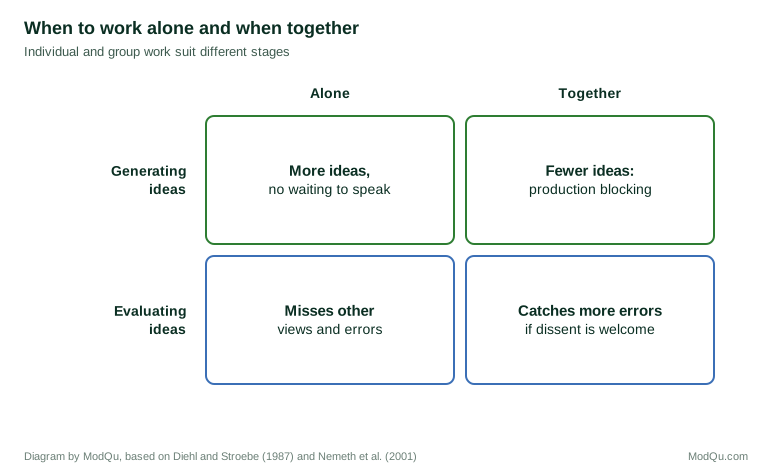
The first is the failure to share unique information. Stasser and Titus (1985) found that group discussions focused on information that all members already held and largely neglected information known to only one member, even when that unique information pointed to a better decision. Mesmer-Magnus and DeChurch (2009) confirmed in a meta-analysis that information sharing predicted team performance, and that sharing unique information mattered most. For insight teams, this means that the observation only one analyst has noticed is the one most likely to be lost.
The second is production blocking in idea generation. Diehl and Stroebe (1987) showed that brainstorming groups produced fewer ideas than the same number of people working alone, mainly because members had to wait their turn to speak and forgot or suppressed ideas while waiting. Paulus and Yang (2000) found that group idea generation could be improved by having people write ideas down and then share them, combining individual generation with group exposure to others' ideas.
The third is premature agreement. Janis (1982) described groupthink, in which cohesive groups under pressure suppress doubts and converge on a view without adequate scrutiny. Kerr and Tindale (2004) reviewed research on group decision making and noted that groups often amplify the biases of individual members rather than correcting them, especially when members share the same initial preference.
The conditions for good collaboration
Psychological safety is a basic condition. Edmondson (1999) found that teams whose members believed it was safe to take interpersonal risks, such as admitting mistakes or raising concerns, engaged in more learning behaviour, which in turn predicted performance. In an analytical team, psychological safety allows a junior analyst to say that a result looks wrong or that a favoured hypothesis is not supported.
Dissent is a second condition. Nemeth et al. (2001) found that authentic dissent, from someone who genuinely held a minority view, stimulated more original thinking in groups than a devil's advocate assigned to argue the opposing side. Teams benefit from including people who see the problem differently, not only from role-playing disagreement.
Hackman (2002) argued that effective teams need a compelling direction, a clear structure and a supportive context. For insight teams, a compelling direction means a clear question tied to a decision. A clear structure means defined roles and a process for moving from individual work to shared conclusions.
What many-analyst studies show
Collaboration also reveals how much analytical choices matter. Silberzahn et al. (2018) gave the same data set and research question, whether football referees gave more red cards to players with darker skin, to 29 teams of analysts. The teams used a wide range of reasonable methods and reached a range of answers. Most found a positive effect, but estimates varied considerably and some teams found no significant effect. The study showed that a single analysis can hide substantial uncertainty arising from choices that are defensible but different. A team that compares several independent approaches to the same question learns how robust its conclusion is.
Many-analyst designs need not be expensive. Two analysts working separately on an important question, each documenting their choices, can reveal whether a conclusion depends on a particular way of cleaning the data or defining a measure. If both reach the same answer by different routes, confidence increases. If they disagree, the disagreement itself is useful, because it shows where the evidence is weak and what further work would settle the question.
Roles in an insight team
Teams also benefit from clear roles. A question owner keeps the work tied to the decision it is meant to inform. Analysts explore the data and methods. A reviewer, who has not done the analysis, checks the reasoning and looks for alternative explanations. A communicator turns the conclusions into a form that decision makers can use. One person can hold more than one role in a small team, but the reviewer role works best when it is held by someone other than the analyst, because people find it hard to see the weaknesses in their own work. Rotating the reviewer role also spreads skills across the team and reduces the risk that criticism is seen as personal.
Tools for collaborative analysis
Software can support or hinder collaboration. Heer and Agrawala (2008) set out design considerations for collaborative visual analytics, including ways for team members to share views of the data, annotate findings, divide work and build on each other's discoveries. Isenberg et al. (2011) reviewed research on collaborative visualisation and distinguished between people working together at the same time and place and people working at different times or locations. Shared notebooks, annotated dashboards and common repositories of findings help teams avoid repeating work and make the reasoning behind each conclusion visible to others.
An example
A retail insights team is asked why sales of a new product range are below forecast. Rather than starting with a group meeting, the team lead asks four analysts to spend a day working independently: one examines sales by store, one reviews customer comments, one compares prices with competitors and one looks at stock availability. Each writes a one-page note of findings before the group meets. In the meeting, each note is presented in turn, and the lead asks specifically for observations that no one else has mentioned. The stock analyst's note shows that the range was frequently out of stock in its first weeks, which none of the others had seen. The group then tests this explanation against the other evidence and agrees on a conclusion, recording the alternative explanations it rejected and why.
Common mistakes
Common mistakes include starting with an unstructured group discussion, which encourages the loudest or most senior voice to set the direction. Another is treating agreement as evidence that a conclusion is right. A third is failing to record who found what and why alternatives were rejected, so that the reasoning cannot be reviewed later. A fourth is building teams of people with similar backgrounds, which reduces the range of information and perspectives available.
Practical steps
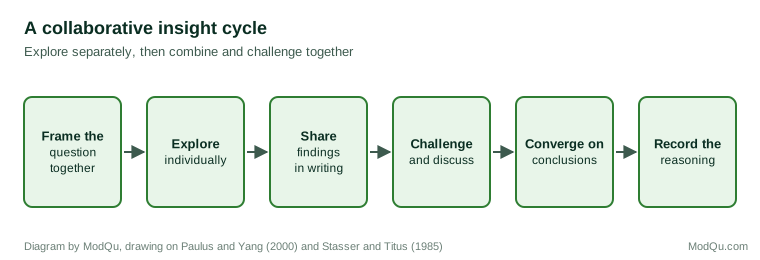
Teams can improve collaborative insight generation by framing the question together, then having members explore independently before sharing. Findings should be shared in writing before discussion, so that unique information is visible. Leaders should invite dissent explicitly, speak last and ask for observations that only one person has made. Where the question is important, two or more analysts can approach it independently and compare results. Finally, teams should record their conclusions together with the evidence and the alternatives considered.
Conclusion
Groups can produce better insight than individuals, but only if they are organised to share unique information, generate ideas without blocking each other and challenge conclusions before accepting them. The research suggests a simple rule: generate and explore separately, then combine and challenge together, in a climate where people feel safe to disagree.
References
Diehl, M., & Stroebe, W. (1987). Productivity loss in brainstorming groups: Toward the solution of a riddle. Journal of Personality and Social Psychology, 53(3), 497–509. https://doi.org/10.1037/0022-3514.53.3.497
Edmondson, A. (1999). Psychological safety and learning behavior in work teams. Administrative Science Quarterly, 44(2), 350–383. https://doi.org/10.2307/2666999
Hackman, J. R. (2002). Leading teams: Setting the stage for great performances. Harvard Business School Press.
Heer, J., & Agrawala, M. (2008). Design considerations for collaborative visual analytics. Information Visualization, 7(1), 49–62. https://doi.org/10.1057/palgrave.ivs.9500167
Isenberg, P., Elmqvist, N., Scholtz, J., Cernea, D., Ma, K.-L., & Hagen, H. (2011). Collaborative visualization: Definition, challenges, and research agenda. Information Visualization, 10(4), 310–326. https://doi.org/10.1177/1473871611412817
Janis, I. L. (1982). Groupthink: Psychological studies of policy decisions and fiascoes (2nd ed.). Houghton Mifflin.
Kerr, N. L., & Tindale, R. S. (2004). Group performance and decision making. Annual Review of Psychology, 55, 623–655. https://doi.org/10.1146/annurev.psych.55.090902.142009
Larrick, R. P., & Soll, J. B. (2006). Intuitions about combining opinions: Misappreciation of the averaging principle. Management Science, 52(1), 111–127. https://doi.org/10.1287/mnsc.1050.0459
Mesmer-Magnus, J. R., & DeChurch, L. A. (2009). Information sharing and team performance: A meta-analysis. Journal of Applied Psychology, 94(2), 535–546. https://doi.org/10.1037/a0013773
Nemeth, C., Brown, K., & Rogers, J. (2001). Devil's advocate versus authentic dissent: Stimulating quantity and quality. European Journal of Social Psychology, 31(6), 707–720. https://doi.org/10.1002/ejsp.58
Paulus, P. B., & Yang, H.-C. (2000). Idea generation in groups: A basis for creativity in organizations. Organizational Behavior and Human Decision Processes, 82(1), 76–87. https://doi.org/10.1006/obhd.2000.2888
Silberzahn, R., Uhlmann, E. L., Martin, D. P., Anselmi, P., Aust, F., Awtrey, E., Bahník, Š., Bai, F., Bannard, C., Bonnier, E., Carlsson, R., Cheung, F., Christensen, G., Clay, R., Craig, M. A., Dalla Rosa, A., Dam, L., Evans, M. H., Flores Cervantes, I., ... Nosek, B. A. (2018). Many analysts, one data set: Making transparent how variations in analytic choices affect results. Advances in Methods and Practices in Psychological Science, 1(3), 337–356. https://doi.org/10.1177/2515245917747646
Stasser, G., & Titus, W. (1985). Pooling of unshared information in group decision making: Biased information sampling during discussion. Journal of Personality and Social Psychology, 48(6), 1467–1478. https://doi.org/10.1037/0022-3514.48.6.1467
Woolley, A. W., Chabris, C. F., Pentland, A., Hashmi, N., & Malone, T. W. (2010). Evidence for a collective intelligence factor in the performance of human groups. Science, 330(6004), 686–688. https://doi.org/10.1126/science.1193147