
Insights · The insight function
The Contribution of Boundary Spanners to Cross-Functional Insights
How boundary spanners, the people who connect different groups inside and outside an organisation, help create and spread insight, covering research on gatekeepers, structural holes, knowledge boundaries and boundary objects, and practical ways to support boundary-spanning work.
Many of the most useful insights in an organisation arise where different kinds of knowledge meet. A product manager learns from a service engineer why customers abandon a feature. A market researcher sees that a pattern in survey data matches something the finance team has noticed in returns. A sales manager realises that a competitor's new pricing explains a change in customer complaints. In each case, the insight depends on someone who moves between groups, understands enough of each to see the connection and can carry the idea across.
These people are known as boundary spanners. They link their own group with other groups inside the organisation or with the outside world. This article reviews research on boundary spanning, explains why boundary spanners are especially valuable for insight work, describes the difficulties they face and sets out ways organisations can support them.
What boundary spanners do
Aldrich and Herker (1977) described two main functions of boundary-spanning roles. The first is information processing: boundary spanners filter, interpret and pass on information from the environment to the people inside the organisation who need it. The second is external representation: they present the organisation to outsiders and manage its relationships with them. Both functions involve translation. Information from outside rarely arrives in a form that internal groups can use directly, and the spanner must select what matters and express it in terms the receiving group understands.
Allen (1977) studied how engineers in research and development laboratories obtained technical information. Allen found that most of them relied on colleagues rather than on journals or external sources, and that a small number of individuals, whom Allen called technological gatekeepers, were much more connected to outside information than their colleagues. Gatekeepers read more of the technical literature, had more contacts outside the organisation and were consulted frequently by others. Information from outside reached most engineers through these few people.
Tushman (1977) studied boundary roles in the innovation process and found that the number of people in boundary-spanning roles varied with the type of work. Units doing work that depended heavily on outside information had more boundary spanners. Tushman and Scanlan (1981) then showed that effective boundary spanners needed two kinds of connection: strong communication links within their own unit and strong links to outside areas. Being well connected externally was not enough. A person who knew the outside world well but was poorly connected internally could not pass information on, and a person who was well connected internally but not externally had nothing new to pass on.
Why boundary spanners matter for insight
Insight often requires combining knowledge that sits in different places. Research on social networks explains why boundary spanners are in a good position to make such combinations.
Granovetter (1973) argued that weak ties, connections between people who do not know each other well, are especially valuable for obtaining new information. Close contacts tend to know the same things, while weak ties connect people to different social circles and therefore to information they would not otherwise hear. Burt (2004) extended this idea with the concept of structural holes: gaps between groups that have little contact with each other. In a study of managers in a large electronics company, Burt found that managers whose networks spanned structural holes were more likely to have their ideas judged valuable by senior managers. People who bridged separate groups were exposed to different ways of thinking and could see combinations that people inside a single group could not.
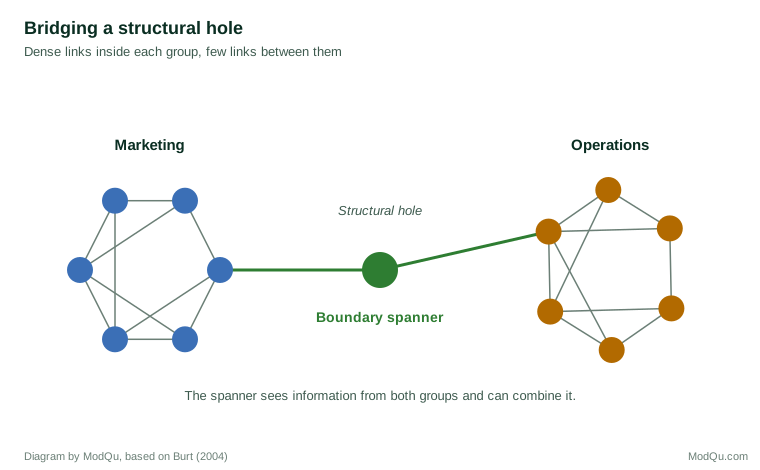
Reagans and McEvily (2003) studied knowledge transfer in a research and development firm and found that two features of a person's network made it easier to transfer knowledge. Cohesion, meaning that a person's contacts were connected to each other, increased willingness to invest time in helping others. Range, meaning that a person's contacts spanned different knowledge areas, improved the ability to convey complex ideas to people with different backgrounds. People with wide-ranging networks had more practice in explaining things to those who did not share their assumptions.
Hansen (1999) added an important qualification. In a study of new product development projects, Hansen found that weak ties between business units helped project teams search for useful knowledge but made it harder to transfer complex knowledge, which required strong ties. Boundary spanners therefore need different kinds of relationships for different tasks: broad, light connections to discover what others know, and deeper relationships to move complicated knowledge across.
Kinds of knowledge boundary
Not all boundaries are the same. Carlile (2004) distinguished three kinds of knowledge boundary, each requiring a different kind of work.
At a syntactic boundary, the groups share a common language and the main task is to transfer information accurately, for example by agreeing on common definitions and data formats. At a semantic boundary, the groups use different interpretations of the same words or data, and the task is to translate meanings so that each group understands what the other means. At a pragmatic boundary, the groups have different interests, and new knowledge from one group may threaten the knowledge or position of another. Here the task is to transform knowledge: both groups must be willing to change what they know and do.
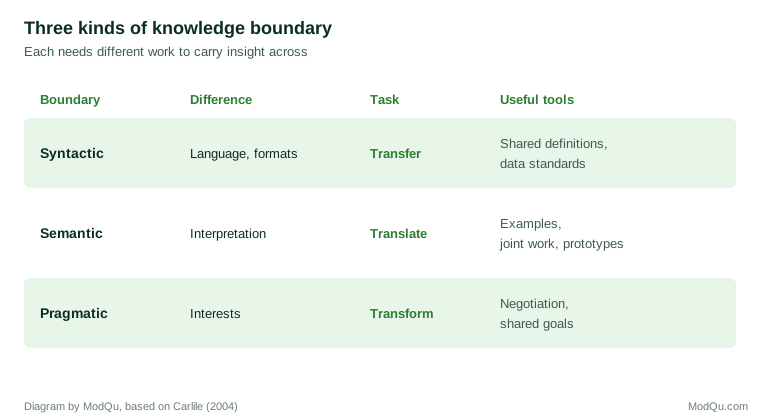
For insight work, the distinction is practical. A finding that sales are falling in one region crosses a syntactic boundary easily if both teams use the same definition of sales. A finding that customers see the brand as "old-fashioned" crosses a semantic boundary, because the marketing team and the product team may mean different things by the phrase. A finding that the company's most profitable product is losing relevance crosses a pragmatic boundary, because it challenges the interests of the team responsible for that product. Each requires different skills from the person carrying it.
Dougherty (1992) studied new product development in large firms and found that people in different departments lived in different "thought worlds". Technical staff, sales staff and planners focused on different aspects of the market and the product, and each saw the others' concerns as less important. Successful innovation required ways of combining these different views. Bechky (2003) studied engineers, technicians and assemblers in a manufacturing company and found that misunderstandings across occupational groups were resolved when people worked with concrete, shared objects, such as physical machines and drawings, which helped them build a common understanding.
Boundary objects
Star and Griesemer (1989) introduced the concept of boundary objects: objects that are flexible enough to be used differently by different groups but stable enough to keep a common identity across them. In their study of a natural history museum, specimens, maps and standardised forms allowed amateurs, professional scientists and administrators to cooperate despite having different goals. Carlile (2002) applied the idea to product development and found that effective boundary objects included shared repositories, standardised forms, models and maps that allowed people from different functions to specify and learn about their differences and dependencies.
In insight work, boundary objects include customer personas, journey maps, prototypes, segmentation schemes and shared dashboards. A well-built customer journey map, for example, lets the service team see where calls originate, the product team see which features cause confusion and the marketing team see where expectations are set. Each group uses the map for its own purposes, yet all are looking at the same representation of the customer. A boundary spanner often creates or curates these objects.
Communities of practice and tacit knowledge
Much of the knowledge that boundary spanners carry is tacit. Nonaka (1994) distinguished between explicit knowledge, which can be written down, and tacit knowledge, which is rooted in experience and hard to express. Tacit knowledge moves mainly through conversation, observation and shared work, which is why it travels with people rather than through reports. Brown and Duguid (1991) argued that much learning in organisations takes place in communities of practice, groups of people who do similar work and share stories about problems and solutions. These communities often cut across formal departments, and the knowledge they hold may never appear in official documents. A boundary spanner who belongs to more than one community can carry practical understanding from one to the other.
Cross and Sproull (2004) studied the information relationships of people in a consulting firm and found that people sought more than answers from their colleagues. They also sought help in framing problems, references to other sources and validation of their plans. Boundary spanners provide all of these, which is part of why they are sought out. Griffin and Hauser (1996) reviewed research on the integration of research and development with marketing and found that closer integration was generally associated with greater success in new product development. They identified several ways of achieving it, including co-location, personnel movement between functions, informal social systems and formal integrating roles, all of which create or support boundary spanners.
Spanning boundaries as a team
Boundary spanning is also a team-level activity. Ancona and Caldwell (1992) studied new product teams and identified different kinds of external activity. Ambassador activities involved representing the team to senior managers and securing resources. Task coordination involved working with other groups on technical and design issues. Scouting involved general scanning for ideas and information. Teams that engaged in ambassador and task-coordination activities performed better, while teams that only scouted widely did not. Marrone (2010) reviewed later research and concluded that team boundary spanning was generally associated with better performance, but that it also placed heavy demands on individual members and could lead to overload.
Market research as a boundary function
Market and customer insight is itself a boundary-spanning function. Researchers stand between customers and the organisation and between the data and the people who make decisions. Deshpandé and Zaltman (1982) found that managers were more likely to use market research when they trusted the researchers and when there was more interaction between researchers and the managers who used their work. Moorman et al. (1992) found that trust between providers and users of market research affected how much the research was used, and that trust depended on factors such as the perceived integrity and sincerity of the researcher.
The implication is that insight teams cannot rely only on the quality of their analysis. They must build relationships across the organisation so that their findings are understood and trusted. Researchers who understand how a product team thinks, or who spend time with the sales force, are better able to frame findings in terms that those groups can use.
Barriers and costs
Boundary spanning is difficult. Szulanski (1996) studied the transfer of best practices within firms and found that the main barriers were not motivational but related to knowledge: the recipient's lack of absorptive capacity, ambiguity about why the practice worked and difficult relationships between source and recipient. Cohen and Levinthal (1990) defined absorptive capacity as an organisation's ability to recognise the value of new external information, assimilate it and apply it, and argued that it depends on prior related knowledge. A boundary spanner can carry an insight across, but the receiving group needs enough background to understand it.
Levina and Vaast (2005) studied information systems projects and distinguished between people nominated to boundary-spanning roles and people who actually engaged in boundary spanning in practice. The two groups did not always coincide. Formal appointment did not guarantee effective spanning, and some of the most effective spanners held no formal role. The work depended on legitimacy with both sides, which had to be earned rather than assigned.
Boundary spanners also face personal costs. They may be seen as not fully belonging to either group, their work is often invisible because it consists of conversations and introductions, and the demands on their time can be heavy (Marrone, 2010). If organisations do not recognise and reward this work, the people best at it may stop doing it or leave.
An example
A consumer electronics company noticed rising returns of a new pair of headphones. The quality team found no manufacturing faults. The customer service team recorded the most common complaint as "poor fit". The product team interpreted this as a sizing problem and began designing a larger ear cushion.
An insights analyst who had previously worked in customer service and had good contacts in the product team listened to a sample of recorded service calls. The analyst found that many customers who complained of poor fit were also struggling to pair the headphones with their phones and were wearing them incorrectly because the instructions showed the wrong orientation. The analyst brought a few recordings and a marked-up copy of the instructions to a meeting with the product and packaging teams. Seeing the evidence together, they agreed to change the instructions and add a simple orientation mark to the headphones. Returns fell substantially in the following months.
The insight depended on someone who could understand the language of customer service, knew how product designers thought and could create a shared object, the marked-up instructions and recordings, that helped both teams see the same problem.
Common mistakes
Organisations commonly assume that information will flow across boundaries automatically once it is stored in a shared system. In practice, much important knowledge moves through people. A second mistake is appointing boundary spanners on paper without giving them the time, access or legitimacy to do the work. A third is measuring only individual or team output, which makes boundary-spanning work invisible. A fourth is overloading a few well-connected individuals until they become bottlenecks. A fifth is ignoring pragmatic boundaries: treating a finding that threatens a group's interests as a communication problem, when it actually requires negotiation and a shared goal.
Practical steps
Organisations that want to benefit from boundary spanners can take several steps. They can identify the people who already connect groups, for example through network analysis or by asking who people turn to for information, and recognise their contribution. They can create rotations, joint projects and shared spaces that allow people to build relationships across functions. Insight teams can embed researchers with the groups they serve for part of their time, so that they learn the language and concerns of those groups. They can invest in good boundary objects, such as shared customer journey maps and common definitions, that allow different groups to work from the same picture. And they can protect boundary spanners' time, sharing the load among several people rather than relying on one.
When an insight crosses a boundary, the person carrying it should ask what kind of boundary it is. If it is syntactic, agree on definitions. If it is semantic, use concrete examples and joint work to build shared meaning. If it is pragmatic, involve the affected groups early and frame the insight in terms of shared goals.
Conclusion
Cross-functional insights depend on people who connect groups that would otherwise remain separate. Research on gatekeepers, weak ties and structural holes shows that such people have access to a wider range of information and are better placed to see new combinations (Allen, 1977; Burt, 2004; Granovetter, 1973). Research on knowledge boundaries shows that carrying insight across groups requires different work depending on whether the gap is one of language, meaning or interest (Carlile, 2004). Organisations that recognise boundary spanning as real work, build the boundary objects that support it and share the load among several people are more likely to turn scattered knowledge into insight that changes decisions.
References
Aldrich, H., & Herker, D. (1977). Boundary spanning roles and organization structure. Academy of Management Review, 2(2), 217–230. https://doi.org/10.5465/amr.1977.4409044
Allen, T. J. (1977). Managing the flow of technology: Technology transfer and the dissemination of technological information within the R&D organization. MIT Press.
Ancona, D. G., & Caldwell, D. F. (1992). Bridging the boundary: External activity and performance in organizational teams. Administrative Science Quarterly, 37(4), 634–665. https://doi.org/10.2307/2393475
Bechky, B. A. (2003). Sharing meaning across occupational communities: The transformation of understanding on a production floor. Organization Science, 14(3), 312–330. https://doi.org/10.1287/orsc.14.3.312.15162
Brown, J. S., & Duguid, P. (1991). Organizational learning and communities-of-practice: Toward a unified view of working, learning, and innovation. Organization Science, 2(1), 40–57. https://doi.org/10.1287/orsc.2.1.40
Burt, R. S. (2004). Structural holes and good ideas. American Journal of Sociology, 110(2), 349–399. https://doi.org/10.1086/421787
Carlile, P. R. (2002). A pragmatic view of knowledge and boundaries: Boundary objects in new product development. Organization Science, 13(4), 442–455. https://doi.org/10.1287/orsc.13.4.442.2953
Carlile, P. R. (2004). Transferring, translating, and transforming: An integrative framework for managing knowledge across boundaries. Organization Science, 15(5), 555–568. https://doi.org/10.1287/orsc.1040.0094
Cohen, W. M., & Levinthal, D. A. (1990). Absorptive capacity: A new perspective on learning and innovation. Administrative Science Quarterly, 35(1), 128–152. https://doi.org/10.2307/2393553
Cross, R., & Sproull, L. (2004). More than an answer: Information relationships for actionable knowledge. Organization Science, 15(4), 446–462. https://doi.org/10.1287/orsc.1040.0075
Deshpandé, R., & Zaltman, G. (1982). Factors affecting the use of market research information: A path analysis. Journal of Marketing Research, 19(1), 14–31. https://doi.org/10.1177/002224378201900102
Dougherty, D. (1992). Interpretive barriers to successful product innovation in large firms. Organization Science, 3(2), 179–202. https://doi.org/10.1287/orsc.3.2.179
Granovetter, M. S. (1973). The strength of weak ties. American Journal of Sociology, 78(6), 1360–1380. https://doi.org/10.1086/225469
Griffin, A., & Hauser, J. R. (1996). Integrating R&D and marketing: A review and analysis of the literature. Journal of Product Innovation Management, 13(3), 191–215. https://doi.org/10.1111/1540-5885.1330191
Hansen, M. T. (1999). The search-transfer problem: The role of weak ties in sharing knowledge across organization subunits. Administrative Science Quarterly, 44(1), 82–111. https://doi.org/10.2307/2667032
Levina, N., & Vaast, E. (2005). The emergence of boundary spanning competence in practice: Implications for implementation and use of information systems. MIS Quarterly, 29(2), 335–363. https://doi.org/10.2307/25148682
Marrone, J. A. (2010). Team boundary spanning: A multilevel review of past research and proposals for the future. Journal of Management, 36(4), 911–940. https://doi.org/10.1177/0149206309353945
Moorman, C., Zaltman, G., & Deshpandé, R. (1992). Relationships between providers and users of market research: The dynamics of trust within and between organizations. Journal of Marketing Research, 29(3), 314–328. https://doi.org/10.1177/002224379202900303
Nonaka, I. (1994). A dynamic theory of organizational knowledge creation. Organization Science, 5(1), 14–37. https://doi.org/10.1287/orsc.5.1.14
Reagans, R., & McEvily, B. (2003). Network structure and knowledge transfer: The effects of cohesion and range. Administrative Science Quarterly, 48(2), 240–267. https://doi.org/10.2307/3556658
Star, S. L., & Griesemer, J. R. (1989). Institutional ecology, "translations" and boundary objects: Amateurs and professionals in Berkeley's Museum of Vertebrate Zoology, 1907–39. Social Studies of Science, 19(3), 387–420. https://doi.org/10.1177/030631289019003001
Szulanski, G. (1996). Exploring internal stickiness: Impediments to the transfer of best practice within the firm. Strategic Management Journal, 17(S2), 27–43. https://doi.org/10.1002/smj.4250171105
Tushman, M. L. (1977). Special boundary roles in the innovation process. Administrative Science Quarterly, 22(4), 587–605. https://doi.org/10.2307/2392402
Tushman, M. L., & Scanlan, T. J. (1981). Boundary spanning individuals: Their role in information transfer and their antecedents. Academy of Management Journal, 24(2), 289–305. https://doi.org/10.2307/255842