
Insights · The insight function
Insight Prioritization Frameworks Based on Impact and Feasibility
How insight teams can decide which findings to act on and which questions to pursue, using impact and feasibility matrices, weighted scoring, value of information and portfolio thinking, together with the judgement biases that distort prioritisation and ways to reduce them.
Insight teams usually have more findings than the organisation can act on, and more questions than they can answer. A customer study might produce twenty recommendations; a quarterly review of data might reveal a dozen opportunities. Not all of them deserve equal attention. Some promise large benefits at modest cost; others are interesting but would change little. Choosing well among them is one of the most consequential tasks an insight function performs, because the value of insight work depends on whether the most important findings are acted on.
This article describes frameworks for prioritising insights according to their impact and feasibility. It covers simple two-by-two matrices, weighted scoring models, value-of-information analysis and portfolio approaches, and it explains the judgement biases that can distort any of them.
Two questions at the heart of prioritisation
Most prioritisation frameworks rest on two questions. How much difference would acting on this insight make? And how easily could the organisation act on it? The first concerns impact: the size of the potential benefit, the number of customers or the amount of revenue affected and the strategic importance of the outcome. The second concerns feasibility: the cost, time, skills, technology and organisational support needed to act.
A third question is often implicit but just as important: how confident are we that the insight is correct? A finding based on a large, well-designed study deserves more weight than one based on a handful of interviews, even if both point to the same opportunity. Many frameworks combine impact, feasibility and confidence, either explicitly or by adjusting the estimated impact for uncertainty.
The impact and feasibility matrix
The simplest framework places each insight on a grid with impact on one axis and feasibility on the other. This divides insights into four groups. High-impact, high-feasibility insights are often called quick wins and should usually be acted on first. High-impact, low-feasibility insights are major projects that need planning and investment. Low-impact, high-feasibility insights are minor improvements that can be made when resources allow. Low-impact, low-feasibility insights can usually be set aside.
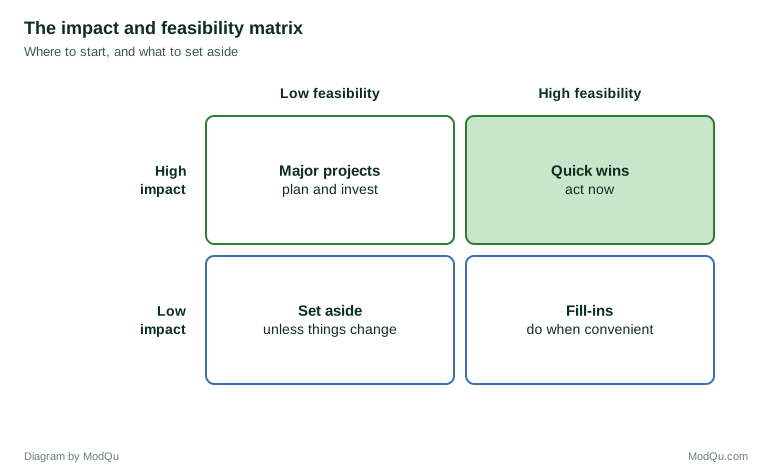
The matrix has clear strengths. It is easy to explain, it makes trade-offs visible and it encourages a team to discuss each insight in the same terms. Its weaknesses are also clear. Placing items on the grid requires judgements that are often made quickly and without evidence. The boundaries between quadrants are arbitrary, so small differences in judgement can move an item from one group to another. And the matrix says nothing about dependencies between insights or about the overall balance of the portfolio.
Weighted scoring models
Weighted scoring models extend the matrix by breaking impact and feasibility into several criteria, scoring each insight on each criterion and combining the scores using weights that reflect their importance. Typical criteria include revenue potential, cost savings, customer satisfaction, strategic fit, cost of implementation, time to implement, technical risk and the strength of the evidence.
Product teams have popularised simple versions of this approach, such as scores that combine the reach of a change, its impact per person, the team's confidence in the estimates and the effort required. More formal methods come from decision analysis. Keeney (1992) argued that decisions should begin by identifying what the organisation values, and that alternatives should be evaluated against those values rather than against whatever criteria happen to be convenient. Edwards and Barron (1994) developed simplified methods for multi-attribute evaluation that make weighting practical without requiring complex calculations. Saaty (1990) described the analytic hierarchy process, which derives weights from a series of pairwise comparisons between criteria and between options.
Simple weighting schemes often work surprisingly well. Dawes (1979) showed that linear models with equal or even arbitrary positive weights often predicted outcomes better than the intuitive judgements of experts, because they applied the same criteria consistently to every case. Gigerenzer and Gaissmaier (2011) reviewed research on simple decision rules and found that in uncertain environments, simple heuristics can match or outperform complex models. The lesson for prioritisation is that the main benefit of a scoring model comes from making criteria explicit and applying them consistently, not from fine-tuning the weights.
Expected value and uncertainty
Impact estimates are rarely single numbers. An insight might lead to a large gain if customers respond as hoped, a small gain if they respond weakly and a loss if the change has unintended effects. Decision analysis handles this by estimating the probability and value of each outcome and combining them into an expected value. Clemen and Reilly (2014) describe how decision trees can lay out the possible outcomes of each option so that a team can compare options on the same basis and see which uncertainties matter most.
Teams do not need precise probabilities for this approach to help. Even rough estimates of a low, likely and high outcome reveal whether an insight's value depends on a single optimistic assumption. Two insights with the same headline estimate can look very different once their ranges are shown: one may have a narrow range and a reliable benefit, the other a wide range in which a loss is plausible. A simple practice is to ask, for each insight, what would have to be true for it to be worth acting on, and how confident the team is that those conditions hold.
Value of information
Prioritisation applies not only to insights that are ready for action but also to questions the team might investigate. Here, the concept of the value of information is useful. Howard (1966) showed how to calculate the expected value of information: the amount by which better information would improve a decision, weighted by the probability of each outcome. Information has value only if it could change a decision, and its value is greatest when the decision is important and current uncertainty is high.
Hubbard (2014) argued that organisations often measure what is easy rather than what is valuable, and that the variables with the highest information value are frequently ones nobody is measuring. Hubbard recommended estimating the value of information before commissioning research, which often shows that a small amount of research on the most uncertain variable is worth more than a large study of something already well understood. For an insight team, this means asking of each proposed study: which decision would it inform, how likely is it to change that decision, and how much is the decision worth?
Portfolio thinking
Prioritising insights one at a time can produce an unbalanced set. A team that always chooses quick wins may never undertake the larger projects that create lasting advantage. A team that only pursues major projects may produce little visible value for long periods.
Research on new product development offers a useful parallel. Cooper (1990) described stage-gate systems, in which projects pass through a series of review points where they are evaluated against explicit criteria and either continued, stopped or held. Cooper et al. (1999) studied portfolio management practices and found that firms with better performance used explicit, formal portfolio methods, balanced their portfolios across project types and had the right number of projects for their resources. Many firms had too many projects and spread their resources too thinly.
For insight work, portfolio thinking suggests deliberately balancing quick wins with larger initiatives, near-term with long-term opportunities and low-risk improvements with higher-risk explorations. It also suggests limiting the number of insights being acted on at once. Reinertsen (2009) argued that in product development, too much work in progress slows everything down, because people switch between tasks and queues build up. Acting on fewer insights at a time often delivers results faster.
Biases in prioritisation
Every framework depends on estimates of impact, cost and probability, and these estimates are subject to well-known biases.
The planning fallacy leads people to underestimate the time and cost of their own plans. Buehler et al. (1994) found that people consistently predicted that they would finish tasks sooner than they did, even when they knew that similar tasks had taken longer in the past. Kahneman and Lovallo (1993) argued that this reflects an "inside view", in which people focus on the specifics of the case at hand and neglect the outcomes of similar cases. Flyvbjerg (2006) showed that large projects regularly exceed their budgets and recommended reference class forecasting: estimating costs and benefits from the actual outcomes of a set of similar past projects.
Optimism also affects estimates of impact. Teams that generated an insight tend to overestimate its benefits, partly because they understand it best and partly because they are invested in it. Anchoring can distort scores when the first number mentioned in a discussion sets the range for the rest (Tversky & Kahneman, 1974). Sunk costs can keep resources tied to insights that are no longer promising, because people are reluctant to abandon what they have already invested in (Arkes & Blumer, 1985).
Variation between judges is another problem. Kahneman et al. (2021) described the variability in judgements that should be identical as noise, and found that it is often much larger than organisations expect. Two managers scoring the same insight may give it very different ratings. Averaging independent scores from several people, and using clear definitions for each point on a scale, reduces this variation.
Including the right people
Who takes part in prioritisation affects its quality. Insight teams know the evidence best, but the people who would implement the change know more about its cost, time and practical obstacles. Including both reduces the risk that a highly rated insight turns out to be impractical. Combining independent judgements also improves accuracy. Larrick and Soll (2006) showed that averaging estimates from different people usually beats relying on the person who seems most expert, because individual errors partly cancel out.
Hammond et al. (1998) described several "hidden traps" in decision making that apply directly to prioritisation meetings: the tendency to favour the status quo, to protect earlier choices, to seek confirming evidence and to be swayed by the way a question is framed. They recommended deliberately seeking out people who disagree, reframing the question in different ways and examining each estimate for signs that it has been shaped to support a preferred conclusion. Lovallo and Kahneman (2003) argued that executives often approve projects on the basis of delusional optimism rather than a rational weighing of gains and losses, and that taking an outside view, based on the results of similar past efforts, is the most effective correction.
Making prioritisation work
Several practices improve the quality of prioritisation. Criteria should be agreed before insights are scored, so that they are not shaped to favour a preferred option. Scores should be made independently by several people before discussion, then compared and discussed. Where possible, estimates should be checked against the outcomes of similar past initiatives. Confidence should be made explicit, either as a separate score or by discounting impact for uncertainty.
Kahneman et al. (2011) proposed a checklist for reviewing major decisions, including questions such as whether the team has considered credible alternatives, whether there is reason to suspect motivated errors and whether the estimates are anchored on an initial figure. Similar questions can be asked of any prioritisation exercise.
Where insights can be tested cheaply, testing is often better than debating. Kohavi et al. (2020) described how online controlled experiments allow organisations to measure the actual impact of changes rather than relying on estimates. Thomke (2020) argued that organisations that build a culture of experimentation learn which ideas work much faster than those that rely on judgement. An insight whose impact is uncertain but which can be tested quickly may deserve a test before it deserves a full-scale commitment.
Prioritisation should also be revisited. New evidence, changes in the market and the results of early actions all affect which insights remain most valuable. Cooper's (1990) gates provide a model: regular points at which each initiative is reviewed and either continued or stopped.
An example
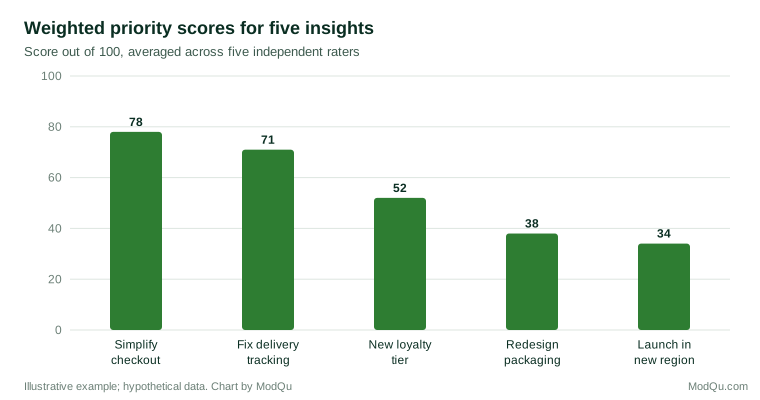
An online retailer's insights team completed a study of customer experience and produced fourteen recommendations. The team scored each on five criteria: expected revenue impact, number of customers affected, strength of evidence, cost and time to implement. Five managers scored independently, and the scores were averaged.
Two recommendations stood out as quick wins: simplifying the checkout and improving delivery tracking. Both had strong evidence from the study and behavioural data, affected most customers and could be done within a quarter. A third, a new loyalty tier, scored well on impact but had weaker evidence, so the team proposed a small test before committing. Expansion into a new region scored low on feasibility and confidence and was deferred. The team also noticed that its estimates of implementation time were optimistic compared with similar past projects and adjusted them upwards. Six months later, the checkout and tracking changes had both produced measurable improvements, and the loyalty test had shown a smaller effect than expected, saving a costly full launch.
Common mistakes
Common mistakes include scoring by consensus in a single meeting, which allows the most senior or confident person to set the scores; treating scores as precise when they rest on rough estimates; ignoring the strength of evidence behind each insight; prioritising only what is easy, so that the most valuable but difficult opportunities are never pursued; and failing to stop work on insights that no longer justify it. Another mistake is using prioritisation as a way to avoid saying no. A list of thirty "high priority" items is not a priority list.
Practical steps
A practical approach for most insight teams has six steps. First, agree a small set of criteria tied to what the organisation values. Second, define what each score means. Third, have several people score independently. Fourth, adjust impact for confidence and check cost and time estimates against past experience. Fifth, place the results on an impact and feasibility matrix, discuss the outliers and balance the portfolio. Sixth, test uncertain high-value insights before committing fully, and review priorities regularly.
Conclusion
Prioritisation turns a list of findings into a plan of action. Simple frameworks, such as the impact and feasibility matrix and weighted scoring models, make trade-offs explicit and help teams apply consistent criteria. Value-of-information analysis helps decide which questions to investigate, and portfolio thinking helps keep the overall set of initiatives balanced. None of these tools removes the need for judgement, and all of them depend on estimates that are prone to optimism, anchoring and noise (Buehler et al., 1994; Kahneman et al., 2021). Teams that combine simple frameworks with independent scoring, reference to past outcomes and willingness to test are most likely to act on the insights that matter most.
References
Arkes, H. R., & Blumer, C. (1985). The psychology of sunk cost. Organizational Behavior and Human Decision Processes, 35(1), 124–140. https://doi.org/10.1016/0749-5978(85)90049-4
Buehler, R., Griffin, D., & Ross, M. (1994). Exploring the "planning fallacy": Why people underestimate their task completion times. Journal of Personality and Social Psychology, 67(3), 366–381. https://doi.org/10.1037/0022-3514.67.3.366
Clemen, R. T., & Reilly, T. (2014). Making hard decisions with DecisionTools (3rd ed.). Cengage Learning.
Cooper, R. G. (1990). Stage-gate systems: A new tool for managing new products. Business Horizons, 33(3), 44–54. https://doi.org/10.1016/0007-6813(90)90040-I
Cooper, R. G., Edgett, S. J., & Kleinschmidt, E. J. (1999). New product portfolio management: Practices and performance. Journal of Product Innovation Management, 16(4), 333–351. https://doi.org/10.1111/1540-5885.1640333
Dawes, R. M. (1979). The robust beauty of improper linear models in decision making. American Psychologist, 34(7), 571–582. https://doi.org/10.1037/0003-066X.34.7.571
Edwards, W., & Barron, F. H. (1994). SMARTS and SMARTER: Improved simple methods for multiattribute utility measurement. Organizational Behavior and Human Decision Processes, 60(3), 306–325. https://doi.org/10.1006/obhd.1994.1087
Flyvbjerg, B. (2006). From Nobel prize to project management: Getting risks right. Project Management Journal, 37(3), 5–15. https://doi.org/10.1177/875697280603700302
Gigerenzer, G., & Gaissmaier, W. (2011). Heuristic decision making. Annual Review of Psychology, 62, 451–482. https://doi.org/10.1146/annurev-psych-120709-145346
Hammond, J. S., Keeney, R. L., & Raiffa, H. (1998). The hidden traps in decision making. Harvard Business Review, 76(5), 47–58.
Howard, R. A. (1966). Information value theory. IEEE Transactions on Systems Science and Cybernetics, 2(1), 22–26. https://doi.org/10.1109/TSSC.1966.300074
Hubbard, D. W. (2014). How to measure anything: Finding the value of "intangibles" in business (3rd ed.). Wiley.
Kahneman, D., & Lovallo, D. (1993). Timid choices and bold forecasts: A cognitive perspective on risk taking. Management Science, 39(1), 17–31. https://doi.org/10.1287/mnsc.39.1.17
Kahneman, D., Lovallo, D., & Sibony, O. (2011). Before you make that big decision. Harvard Business Review, 89(6), 50–60.
Kahneman, D., Sibony, O., & Sunstein, C. R. (2021). Noise: A flaw in human judgment. Little, Brown Spark.
Keeney, R. L. (1992). Value-focused thinking: A path to creative decisionmaking. Harvard University Press.
Kohavi, R., Tang, D., & Xu, Y. (2020). Trustworthy online controlled experiments: A practical guide to A/B testing. Cambridge University Press. https://doi.org/10.1017/9781108653985
Larrick, R. P., & Soll, J. B. (2006). Intuitions about combining opinions: Misappreciation of the averaging principle. Management Science, 52(1), 111–127. https://doi.org/10.1287/mnsc.1050.0459
Lovallo, D., & Kahneman, D. (2003). Delusions of success: How optimism undermines executives' decisions. Harvard Business Review, 81(7), 56–63.
Reinertsen, D. G. (2009). The principles of product development flow: Second generation lean product development. Celeritas.
Saaty, T. L. (1990). How to make a decision: The analytic hierarchy process. European Journal of Operational Research, 48(1), 9–26. https://doi.org/10.1016/0377-2217(90)90057-I
Thomke, S. (2020). Building a culture of experimentation. Harvard Business Review, 98(2), 40–47.
Tversky, A., & Kahneman, D. (1974). Judgment under uncertainty: Heuristics and biases. Science, 185(4157), 1124–1131. https://doi.org/10.1126/science.185.4157.1124