
Insights · The insight function
The Psychology of Insight Acceptance and Resistance in Organizations
Why people in organisations accept some insights and resist others, covering motivated reasoning, biased assimilation, status quo bias, escalation of commitment, information avoidance and reactance, and evidence-based ways to present insights so that they are considered fairly.
An insight has value only if someone acts on it. Yet insight teams often find that well-supported findings are ignored, questioned endlessly or quietly set aside, while weaker findings that confirm what people already believe are accepted without question. This pattern is not usually a sign of bad faith. It reflects well-documented features of human psychology that affect how everyone, including analysts themselves, responds to evidence. Understanding these features helps insight teams present findings in ways that give them a fair hearing, and helps organisations build habits that reduce resistance to unwelcome evidence.
Motivated reasoning
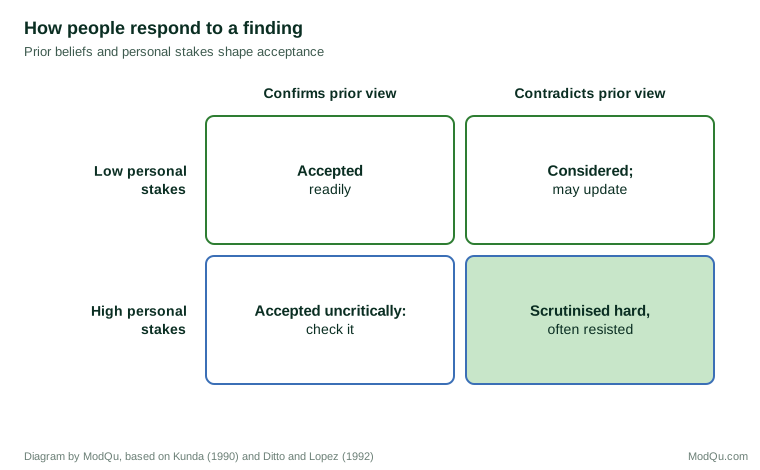
Kunda (1990) reviewed research showing that people's goals affect how they reason. When people want to reach a particular conclusion, they search memory and evidence selectively, apply looser standards to supporting evidence and stricter standards to opposing evidence, and construct justifications that appear objective. Kunda emphasised that motivated reasoning is constrained: people are not free to believe anything they like, because they need to be able to justify their conclusions to themselves and others. But within those constraints, the conclusions people reach are shaped by what they want to be true.
Ditto and Lopez (1992) demonstrated one mechanism. Participants who received unfavourable medical test results were more likely to question the accuracy of the test and to seek further testing than participants who received favourable results. People required more evidence to accept a conclusion they did not want than one they did. Ditto and Lopez called this motivated scepticism.
In organisations, the same pattern appears when a manager asks for more data, a larger sample or a different analysis only when the findings are unwelcome. Insight teams should recognise this as a normal reaction rather than an attack on their competence, while also checking whether the request for more evidence is reasonable.
Biased assimilation
Lord et al. (1979) asked people who supported or opposed capital punishment to read two studies, one apparently supporting and one apparently undermining the claim that the death penalty deters crime. Both groups rated the study that agreed with their position as more convincing and found flaws in the study that disagreed. After reading the same mixed evidence, both groups became more confident in their original positions. Lord et al. called this biased assimilation.
The implication for insight work is uncomfortable. Presenting balanced evidence to a divided group may not bring its members together. Each side may extract support for its view from the same report. Insight teams therefore need to anticipate how different audiences will read a finding and to address the strongest objections directly.
Lord et al. (1984) tested ways of reducing this bias. Simply asking people to be fair and unbiased had little effect. Asking them to consider the opposite, to ask themselves whether they would have rated the study in the same way if it had produced the opposite result, substantially reduced biased assimilation. This "consider the opposite" strategy is one of the most practical tools available for insight teams and decision makers.
Corrections and the backfire question
It was once widely believed that correcting people's mistaken beliefs could backfire, making them more confident in the error. Nyhan and Reifler (2010) reported some evidence of this effect in experiments on political misperceptions. However, Wood and Porter (2019) conducted a series of large experiments covering many issues and found that factual corrections generally moved beliefs in the direction of the evidence, and that backfire effects were rare. People did not abandon their broader views, but they did update specific factual beliefs.
This finding is encouraging for insight teams. Clear, well-supported evidence usually does shift what people believe about specific facts, even if it does not change their overall position immediately. Insight teams should not avoid presenting unwelcome findings for fear of backfire, but they should not expect a single presentation to transform a deeply held view.
Threats to identity and self-image
Some findings are hard to accept because they threaten a person's sense of competence or identity. A finding that a campaign failed is also, implicitly, a finding about the people who designed it. Sherman and Cohen (2006) reviewed research on self-affirmation theory, which holds that people are motivated to maintain a sense of their own integrity and adequacy. When this is threatened, people defend themselves, often by rejecting the threatening information. When people have their sense of self-worth affirmed in another domain, they become more open to threatening information. Cohen et al. (2000) found that participants who had first affirmed an important personal value evaluated evidence that contradicted their views more even-handedly and were more likely to update their beliefs.
In practice, this suggests that insight teams should separate findings about a decision from judgements about the people who made it, acknowledge what went well alongside what did not and present unwelcome results in a setting that does not humiliate anyone.
The pull of the status quo and past commitments
Samuelson and Zeckhauser (1988) found that people disproportionately choose options presented as the status quo. Part of this reflects loss aversion: Kahneman and Tversky (1979) showed that losses loom larger than equivalent gains, so the possible costs of changing course weigh more heavily than the possible benefits. An insight that implies change must overcome this asymmetry.
Past commitments add to the difficulty. Arkes and Blumer (1985) showed that people continue investing in a course of action because of what they have already spent, even when the past costs cannot be recovered and should not affect the decision. Staw (1976) found that people who felt personally responsible for a failing decision invested more in it than people who had not made the original decision. An insight showing that a major project is not working is therefore often resisted most strongly by the people who championed it.
Festinger (1957) described cognitive dissonance, the discomfort people feel when they hold beliefs that conflict with each other or with their actions. One way to reduce dissonance is to change the belief; another is to discount the new information. When people have publicly committed to a course of action, discounting the information is often easier.
Avoiding information
Sometimes people do not resist insight; they avoid it. Golman et al. (2017) reviewed research on information avoidance and found that people often choose not to obtain information even when it is free and potentially useful, especially when they expect it to be unpleasant or when it might require them to act. Sweeny et al. (2010) identified several reasons for avoidance, including the wish to avoid changing beliefs, to avoid obligations to act and to avoid unpleasant emotions.
In organisations, information avoidance appears when managers do not commission research on a sensitive question, do not read a report they suspect will be critical or postpone a meeting at which bad news will be presented. Insight teams can sometimes reduce avoidance by making clear what actions are possible in response to a finding, so that the information feels less like a threat and more like a means of improvement.
Reactance and persuasion
People also resist when they feel their freedom is being restricted. Brehm (1966) described psychological reactance, a motivational state that arises when people feel pressured to adopt a position or behaviour. Reactance leads people to reassert their freedom, often by moving in the opposite direction. An insight presented as an instruction, such as "the data show we must cancel the product", is more likely to provoke reactance than one presented as information for a decision, such as "the data suggest the product is unlikely to reach its targets; here are the options".
Petty and Cacioppo (1986) proposed the elaboration likelihood model, which distinguishes two routes to persuasion. When people are motivated and able to think about a message, they evaluate its arguments carefully, and strong arguments are more persuasive than weak ones. When they are not, they rely on cues such as the credibility of the source or the number of arguments. For important insights, it is worth creating conditions in which decision makers can engage with the evidence, such as time to discuss the findings, rather than relying on a brief summary.
Organisational factors
Individual psychology is shaped by the organisation. Menon and Varadarajan (1992) proposed a model of how marketing knowledge is used within firms and argued that use depends not only on the quality of the knowledge but also on organisational factors such as culture, structure and the relationship between the people who produce knowledge and those who use it. Deshpandé and Zaltman (1982) found that managers made more use of research when they trusted the researchers and when there was more interaction between them. Moorman et al. (1992) found that trust between users and providers of research depended on perceptions of the researcher's integrity, expertise and willingness to reduce uncertainty.
Edmondson (1999) found that teams with higher psychological safety, in which people felt able to raise concerns without fear of embarrassment or punishment, were more willing to discuss errors and learn from them. In an organisation where admitting a mistake is costly, unwelcome insights will be resisted more strongly, regardless of how well they are presented.
Oreg (2003) found that people differ in their general disposition to resist change, and that this disposition predicted reactions to specific changes. Insight teams cannot change these dispositions, but they can identify early which stakeholders are likely to be most resistant and involve them in the work.
An example
A retail chain's insights team analysed a loyalty programme that the marketing director had launched two years earlier. The analysis showed that most of the extra spending by members came from customers who would have shopped at the chain anyway, and that the programme's costs exceeded its benefits.
The first presentation went badly. The director questioned the method, asked for a larger sample and suggested that the analysis had missed long-term effects. For the second meeting, the team changed its approach. Before presenting results, it agreed with the director what evidence would show whether the programme was working. It opened by noting what the programme had done well, including the customer data it had generated. It presented the findings as a basis for deciding how to redesign the programme, not as a verdict on the original decision, and it offered three options. It also asked the group to consider whether they would accept the method if it had shown a positive result. The director accepted the findings and chose to redesign the programme around the customer data it had created.
Common mistakes
Several common mistakes make resistance worse. The first is presenting a surprising or unwelcome finding for the first time in a large meeting, where the people most affected must respond in public. A short private conversation beforehand allows them to absorb the result and raise concerns without losing face. The second is treating every objection as resistance. Some objections identify real weaknesses, and dismissing them damages the insight team's credibility. The third is overstating certainty to make a finding more persuasive. When a confident claim later proves partly wrong, decision makers become more sceptical of future work. The fourth is relying on volume, adding more charts and more data in the hope that the weight of evidence will win the argument. Eppler and Mengis (2004) found that information overload reduces the quality of decisions, and a long report gives a reluctant reader more places to find a reason to disagree. The fifth is presenting only the problem. A finding that something is not working, without any suggestion of what could be done instead, invites avoidance.
A final mistake is assuming that once a finding has been accepted in a meeting, the matter is settled. People who agreed under pressure may return to their earlier views when the meeting ends. Following up, recording agreed actions and reporting progress helps an accepted insight turn into a lasting change.
Practical steps
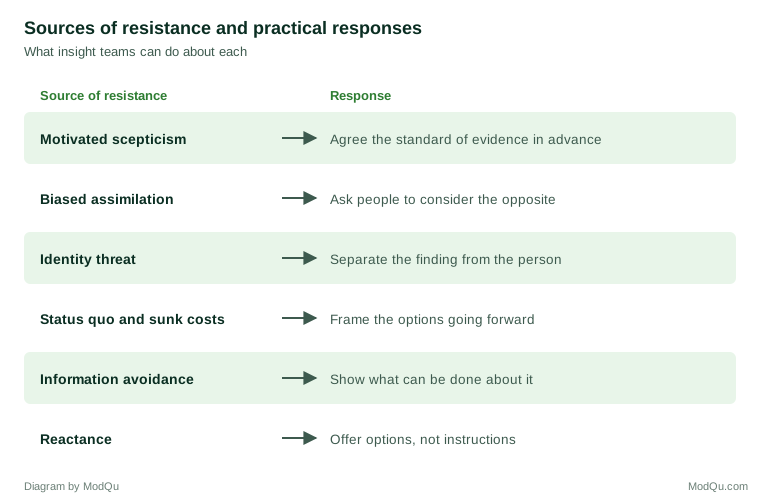
Insight teams can reduce resistance in several ways. Agree on questions, methods and standards of evidence before results are known, so that findings cannot easily be dismissed afterwards. Involve likely sceptics early. Present findings as information for decisions rather than as instructions. Separate findings about decisions from judgements about people. Ask audiences to consider the opposite. Offer clear options for action, so that the insight feels useful rather than threatening. And build trust over time by being transparent about uncertainty and by reporting welcome and unwelcome findings with the same care.
Insight teams should also apply these lessons to themselves. Analysts are subject to the same motivated reasoning as their audiences and may scrutinise unexpected results more harshly than expected ones.
Conclusion
Resistance to insight is a predictable consequence of how people process evidence, protect their self-image and respond to change. Motivated reasoning, biased assimilation, attachment to the status quo, information avoidance and reactance all make some insights harder to accept than others (Kunda, 1990; Lord et al., 1979; Samuelson & Zeckhauser, 1988). The research also shows how to reduce resistance: agree standards in advance, consider the opposite, reduce threats to identity and present options rather than instructions. Insight teams that design their work and communication around these lessons give their findings a better chance of being heard and used.
References
Arkes, H. R., & Blumer, C. (1985). The psychology of sunk cost. Organizational Behavior and Human Decision Processes, 35(1), 124–140. https://doi.org/10.1016/0749-5978(85)90049-4
Brehm, J. W. (1966). A theory of psychological reactance. Academic Press.
Cohen, G. L., Aronson, J., & Steele, C. M. (2000). When beliefs yield to evidence: Reducing biased evaluation by affirming the self. Personality and Social Psychology Bulletin, 26(9), 1151–1164. https://doi.org/10.1177/01461672002611011
Deshpandé, R., & Zaltman, G. (1982). Factors affecting the use of market research information: A path analysis. Journal of Marketing Research, 19(1), 14–31. https://doi.org/10.1177/002224378201900102
Ditto, P. H., & Lopez, D. F. (1992). Motivated skepticism: Use of differential decision criteria for preferred and nonpreferred conclusions. Journal of Personality and Social Psychology, 63(4), 568–584. https://doi.org/10.1037/0022-3514.63.4.568
Edmondson, A. (1999). Psychological safety and learning behavior in work teams. Administrative Science Quarterly, 44(2), 350–383. https://doi.org/10.2307/2666999
Eppler, M. J., & Mengis, J. (2004). The concept of information overload: A review of literature from organization science, accounting, marketing, MIS, and related disciplines. The Information Society, 20(5), 325–344. https://doi.org/10.1080/01972240490507974
Festinger, L. (1957). A theory of cognitive dissonance. Stanford University Press.
Golman, R., Hagmann, D., & Loewenstein, G. (2017). Information avoidance. Journal of Economic Literature, 55(1), 96–135. https://doi.org/10.1257/jel.20151245
Kahneman, D., & Tversky, A. (1979). Prospect theory: An analysis of decision under risk. Econometrica, 47(2), 263–291. https://doi.org/10.2307/1914185
Kunda, Z. (1990). The case for motivated reasoning. Psychological Bulletin, 108(3), 480–498. https://doi.org/10.1037/0033-2909.108.3.480
Lord, C. G., Lepper, M. R., & Preston, E. (1984). Considering the opposite: A corrective strategy for social judgment. Journal of Personality and Social Psychology, 47(6), 1231–1243. https://doi.org/10.1037/0022-3514.47.6.1231
Lord, C. G., Ross, L., & Lepper, M. R. (1979). Biased assimilation and attitude polarization: The effects of prior theories on subsequently considered evidence. Journal of Personality and Social Psychology, 37(11), 2098–2109. https://doi.org/10.1037/0022-3514.37.11.2098
Menon, A., & Varadarajan, P. R. (1992). A model of marketing knowledge use within firms. Journal of Marketing, 56(4), 53–71. https://doi.org/10.1177/002224299205600405
Moorman, C., Zaltman, G., & Deshpandé, R. (1992). Relationships between providers and users of market research: The dynamics of trust within and between organizations. Journal of Marketing Research, 29(3), 314–328. https://doi.org/10.1177/002224379202900303
Nyhan, B., & Reifler, J. (2010). When corrections fail: The persistence of political misperceptions. Political Behavior, 32(2), 303–330. https://doi.org/10.1007/s11109-010-9112-2
Oreg, S. (2003). Resistance to change: Developing an individual differences measure. Journal of Applied Psychology, 88(4), 680–693. https://doi.org/10.1037/0021-9010.88.4.680
Petty, R. E., & Cacioppo, J. T. (1986). The elaboration likelihood model of persuasion. Advances in Experimental Social Psychology, 19, 123–205. https://doi.org/10.1016/S0065-2601(08)60214-2
Samuelson, W., & Zeckhauser, R. (1988). Status quo bias in decision making. Journal of Risk and Uncertainty, 1(1), 7–59. https://doi.org/10.1007/BF00055564
Sherman, D. K., & Cohen, G. L. (2006). The psychology of self-defense: Self-affirmation theory. Advances in Experimental Social Psychology, 38, 183–242. https://doi.org/10.1016/S0065-2601(06)38004-5
Staw, B. M. (1976). Knee-deep in the big muddy: A study of escalating commitment to a chosen course of action. Organizational Behavior and Human Performance, 16(1), 27–44. https://doi.org/10.1016/0030-5073(76)90005-2
Sweeny, K., Melnyk, D., Miller, W., & Shepperd, J. A. (2010). Information avoidance: Who, what, when, and why. Review of General Psychology, 14(4), 340–353. https://doi.org/10.1037/a0021288
Wood, T., & Porter, E. (2019). The elusive backfire effect: Mass attitudes' steadfast factual adherence. Political Behavior, 41(1), 135–163. https://doi.org/10.1007/s11109-018-9443-y