
Inquiry · Inquiry in practice
Ethnographic Inquiry and Understanding From the Inside
Ethnography seeks to understand how people live and work by spending time among them. This article explains the origins of ethnographic inquiry, its core methods of participant observation and fieldnotes, and how organisations use it to understand customers and workplaces from the inside.
Some questions cannot be answered by asking people directly. What people say they do often differs from what they actually do, and much of what shapes behaviour is so familiar to those involved that they never think to mention it. Ethnographic inquiry addresses this by having the researcher spend extended time among the people being studied, observing and taking part in their everyday lives. Its aim is to understand a way of life, a workplace or a practice from the inside.
Origins
Modern ethnography is often traced to Bronisław Malinowski (1922), who lived for long periods in the Trobriand Islands during the First World War. He argued that the ethnographer's goal was "to grasp the native's point of view, his relation to life, to realise his vision of his world", and that this required living among people, learning their language and observing everyday life rather than relying on brief interviews through interpreters. In sociology, William Foote Whyte (1943) applied similar methods in an American city, living for several years in an Italian-American neighbourhood in Boston and documenting the social structure of its street-corner groups.
Seeing from the inside
The linguist Kenneth Pike (1967) distinguished emic descriptions, which use the categories and meanings that members of a culture themselves use, from etic descriptions, which use categories defined by an outside observer. Ethnography gives priority to the emic view, though good ethnographers move between the two. Clifford Geertz (1973) argued that the ethnographer's task is thick description: not merely recording what people do, but interpreting what their actions mean to them. His example was the difference between a twitch and a wink. The physical movement may be identical, but a wink is a message, and only someone who understands the social code can tell them apart.
Methods
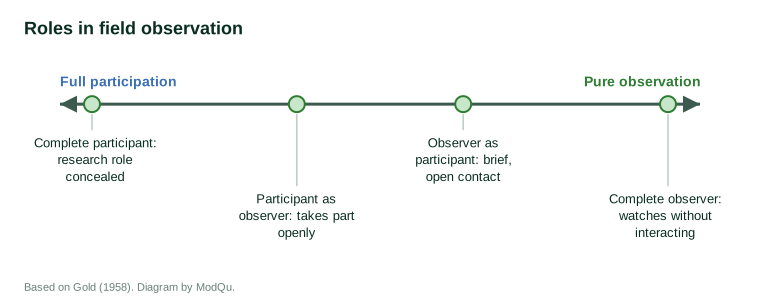
The core method is participant observation. Raymond Gold (1958) described a range of roles the fieldworker can adopt, from complete participant, whose research role is concealed, to complete observer, who watches without interacting. Figure 1 shows the range. Most ethnographers work in the middle, taking part enough to understand and observing enough to reflect.
Participant observation is supported by informal interviews, the collection of documents and objects, and above all by fieldnotes. Emerson et al. (2011) show that writing fieldnotes is itself an act of interpretation. What the researcher notices, records and describes shapes the analysis that follows, so careful, detailed and prompt writing is central to good ethnography. Hammersley and Atkinson (2019) emphasise that ethnography is reflexive: the researcher is part of the social world being studied, and must consider how their presence and assumptions affect what they see.
Access and ethics
Ethnography depends on access, and access depends on trust. Researchers usually need a gatekeeper, someone who can introduce them to a setting and vouch for them, and they must then build relationships with the people they observe. Hammersley and Atkinson (2019) note that how a researcher gains entry shapes what they are later able to see, since people may treat an observer introduced by management very differently from one introduced by colleagues. Ethical questions follow from the closeness of the method. People should know they are being studied and agree to it, notes must protect their identities, and the researcher must consider how the findings might affect those who shared their lives. Covert observation, in which the research role is hidden, is now used rarely and only with strong justification.
Ethnography in organisations and markets
Ethnographic methods are widely used outside academic anthropology. Julian Orr (1996) spent time with photocopier repair technicians and found that much of their expertise was shared through stories told over coffee and lunch, about difficult machines and how they were fixed. This knowledge, essential to the job, appeared nowhere in the official manuals. His study influenced how organisations think about informal learning and knowledge sharing.
In marketing, Arnould and Wallendorf (1994) set out how ethnographic methods can be used to understand consumers. Observing people in their homes, shops and daily routines reveals how products are actually used, what problems people work around without complaint and what meanings products hold for them. Such insights are hard to obtain from surveys, because people seldom report habits they take for granted.
Consider a hypothetical example. A company that makes cleaning products surveys customers, who report satisfaction with a spray bottle. A researcher who spends time in customers' homes notices that many people decant the product into other containers because the bottle does not fit under their sinks. Nobody mentioned this in the survey, because it seemed too ordinary to report.
Strengths and limits
Ethnography provides depth, context and an understanding of meaning that other methods struggle to reach. It is especially valuable at the start of an inquiry, when the right questions are not yet known. Its limits are equally clear. It is slow and costly, it usually studies a small number of settings, and its findings depend heavily on the researcher's interpretation. The essays in Clifford and Marcus (1986) drew attention to how ethnographic texts are written and argued that the authority of the ethnographer's account should not be taken for granted.
For these reasons, ethnography works well alongside other methods. It can identify what matters and how people think about it; surveys and experiments can then measure how widespread those patterns are. Used this way, ethnographic inquiry ensures that the questions an organisation asks reflect the lives of the people it hopes to understand.
References
Arnould, E. J., & Wallendorf, M. (1994). Market-oriented ethnography: Interpretation building and marketing strategy formulation. Journal of Marketing Research, 31(4), 484–504. https://doi.org/10.1177/002224379403100404
Clifford, J., & Marcus, G. E. (Eds.). (1986). Writing culture: The poetics and politics of ethnography. University of California Press.
Emerson, R. M., Fretz, R. I., & Shaw, L. L. (2011). Writing ethnographic fieldnotes (2nd ed.). University of Chicago Press.
Geertz, C. (1973). The interpretation of cultures: Selected essays. Basic Books.
Gold, R. L. (1958). Roles in sociological field observations. Social Forces, 36(3), 217–223. https://doi.org/10.2307/2573808
Hammersley, M., & Atkinson, P. (2019). Ethnography: Principles in practice (4th ed.). Routledge. https://doi.org/10.4324/9781315146027
Malinowski, B. (1922). Argonauts of the Western Pacific. Routledge.
Orr, J. E. (1996). Talking about machines: An ethnography of a modern job. Cornell University Press.
Pike, K. L. (1967). Language in relation to a unified theory of the structure of human behavior (2nd ed.). Mouton.
Whyte, W. F. (1943). Street corner society: The social structure of an Italian slum. University of Chicago Press.