
The Generation of Knowledge · Knowledge management
Organisational Memory and Knowledge Loss
How organisations remember, where their memory is held, how quickly knowledge gained from experience can fade, why knowledge leaves with people, and practical ways to keep what an organisation has learned.
Organisations learn from experience. They discover which methods work, which customers behave in which ways and which mistakes to avoid. Yet they also forget. A team that once solved a problem may find, a few years later, that nobody remembers how. A firm that loses a handful of experienced staff may find that skills it took for granted have gone with them. This article examines what researchers mean by organisational memory, where that memory is held, how and why knowledge is lost, and what organisations can do to keep what they have learned.
What organisational memory is
The idea that an organisation can remember goes back to Cyert and March (1963), who described how firms record their experience in standard operating procedures: rules, forms and routines that encode what has worked before and guide what people do next. Nelson and Winter (1982) developed the idea further, arguing that routines are the main way firms remember. A firm "remembers by doing": its knowledge is held less in documents than in the regular patterns of activity through which people coordinate their work. When those patterns are not exercised, the knowledge they hold weakens.
Levitt and March (1988) described organisational learning as encoding inferences from history into routines that guide behaviour. They noted that this memory is recorded unevenly. Some experience is written down; much is not. Some is kept by people who stay; some leaves when they go. The retrieval of memory is also uneven: knowledge that is used often is easy to find, while knowledge that is rarely used becomes hard to locate, even when it still exists somewhere in the organisation.
Walsh and Ungson (1991) gave the most influential definition. They described organisational memory as stored information from an organisation's history that can be brought to bear on present decisions. Memory, in their account, involves three processes: acquisition of information about decisions and their outcomes, retention of that information, and retrieval when it is needed. Retrieval may be deliberate, as when someone searches past reports, or automatic, as when people follow an established procedure without thinking about where it came from.
Where memory is held
Walsh and Ungson (1991) identified several "retention bins" in which an organisation's memory resides. Figure 1 summarises them.
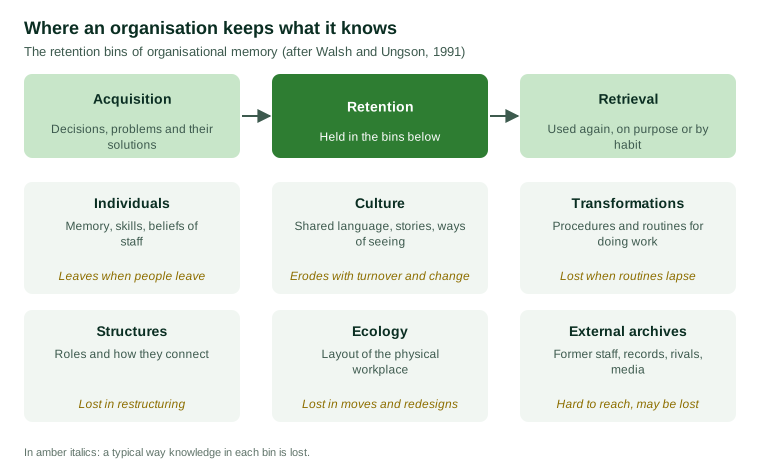
Individuals hold memory in their own recollections, skills and beliefs, often supported by personal files and notes. Culture holds memory in shared language, stories and ways of interpreting events. Transformations, the procedures by which inputs are turned into outputs, hold memory in the way work is done. Structures hold memory in roles and in the expected behaviour attached to them. Ecology, the physical layout of the workplace, holds memory in where people and equipment are placed. Finally, much of an organisation's past is kept outside it, in external archives such as former employees, competitors, government records and the media.
Stein (1995) reviewed the concept and stressed that organisational memory can be both a strength and a weakness. It saves effort, because problems need not be solved again from the beginning, and it gives stability and identity. But it can also make organisations rigid, because established routines and beliefs resist change even when circumstances have moved on.
Memory in people's heads: transactive memory
Much organisational knowledge is not held by any one person but distributed across a group, with each member knowing who knows what. Wegner (1987) called this transactive memory. In a team with a well-developed transactive memory system, members specialise in different areas, trust each other's expertise and know whom to ask. Lewis (2003) developed a way of measuring such systems in working teams and found that teams with stronger transactive memory performed better.
Transactive memory is efficient, but it is also fragile. When a team member leaves, the group loses not only that person's knowledge but also the part of the team's map that pointed to it. Anand et al. (1998) argued that organisations need ways of locating knowledge, such as directories and networks, as much as they need ways of storing it.
How quickly knowledge fades
A striking line of research has measured how quickly knowledge gained from experience is lost. Studies of learning curves show that the cost or time needed to make a product falls as cumulative output increases, because workers and managers learn better ways of working. Argote et al. (1990) examined the shipyards that built Liberty ships in the United States during the Second World War. They found that knowledge acquired through production did not simply accumulate: it depreciated rapidly, so that recent output was a much better predictor of productivity than output in the more distant past. Knowledge also transferred between shipyards, but only to a limited degree.
Darr et al. (1995) found the same pattern in a service setting. Studying pizza franchises, they showed that the knowledge stores gained from experience depreciated quickly, and that knowledge transferred between stores owned by the same franchisee but not between stores owned by different franchisees. Shared ownership created the meetings, phone calls and personal acquaintance through which knowledge could travel.
Benkard (2000) studied the production of the Lockheed L-1011 TriStar aircraft and found evidence of organisational forgetting: when production slowed and experienced workers left, the labour needed to build each aircraft rose again. Argote (2013) reviewed this body of work and concluded that depreciation of knowledge is common, though its rate varies widely between organisations. Knowledge embedded in technology and well-designed routines tends to last longer than knowledge held only by individuals, and organisations with high staff turnover tend to forget faster.
Why knowledge is lost
People leave
The most obvious source of loss is the departure of people. Retirement, resignation, redundancy and internal moves all take knowledge out of the places where it was used. DeLong (2004) studied organisations facing the retirement of large numbers of experienced staff and argued that the loss of knowledge is often invisible until a problem arises that only the departed staff knew how to solve. He distinguished several kinds of knowledge at risk: human knowledge (skills and expertise), social knowledge (relationships and networks), cultural knowledge (understanding of how things are done) and structured knowledge (embedded in systems and processes).
Parise et al. (2006) argued that organisations underestimate this risk because they focus on replacing the explicit knowledge of departing staff, such as documents and procedures, while neglecting their networks. An experienced employee often knows whom to call outside the organisation, which colleague has relevant experience and how to get things done informally. These relationships are rarely recorded and are hard to hand over.
Massingham (2008) studied the effects of staff departures in a public organisation and found that the loss of knowledge affected not only the individual's own work but that of colleagues who had relied on them, reducing productivity, learning and the organisation's ability to respond to new demands.
Memory is not maintained
Knowledge can also be lost when it is not used. Routines that are rarely exercised fade, as Nelson and Winter (1982) predicted. Records that are not organised, indexed and reviewed become impossible to find. Systems are replaced and old files become unreadable. Structures change, and the knowledge built into old roles disappears with them.
De Holan and Phillips (2004) distinguished between forgetting that is accidental and forgetting that is intentional. Accidental forgetting includes the failure to keep new knowledge long enough for it to become established, and the gradual decay of knowledge that is no longer practised. Intentional forgetting, sometimes called unlearning, is the deliberate abandonment of outdated beliefs and practices. They argued that both matter: organisations need to retain valuable knowledge, but they also need to let go of knowledge that has ceased to be useful.
Memory is not used
Even where knowledge is retained, it may not be retrieved. Huber (1991) observed that organisations often do not know what they know. Information is stored in places that the people who need it do not think to look, or in forms they cannot easily use. Moorman and Miner (1997) studied new product development and found that organisational memory could help or hinder: well-dispersed memory improved short-term performance but could reduce creativity, because established knowledge steered teams towards familiar solutions.
Keeping what an organisation has learned
Research and practice suggest several approaches to protecting organisational memory.
Identify knowledge at risk. Organisations can map which roles hold critical knowledge that is not shared, and which of those roles are likely to become vacant. DeLong (2004) recommended starting with the knowledge whose loss would do the most harm.
Capture knowledge before it leaves. Exit and handover interviews, recorded walkthroughs and structured documentation can capture some explicit knowledge. Kransdorff (1998) argued that organisations should routinely record lessons from projects and decisions while they are fresh, rather than relying on recollection later.
Transfer tacit knowledge through people. Much of what experienced staff know cannot be written down. Mentoring, job shadowing, overlapping handovers and working in pairs allow newer staff to learn by observation and practice.
Build memory into routines and tools. Argote (2013) found that knowledge embedded in technology, procedures and structures is more durable than knowledge held only by individuals. Checklists, templates and well-designed systems help knowledge outlast the people who created it.
Make knowledge findable. Olivera (2000) studied memory systems in a large consulting organisation and found that their usefulness depended as much on the mechanisms for finding and accessing knowledge as on what was stored. Directories of expertise, consistent naming and regular review help people find what exists.
Keep networks alive. Communities of practice, regular cross-team meetings and continued contact with former staff and partners help preserve the relationships through which knowledge flows.
Review and prune. Memory needs maintenance. Assigning owners to important knowledge, reviewing it regularly and retiring what is obsolete keeps it current and trustworthy.
Memory in research and survey organisations
For an organisation that conducts surveys and research, memory has particular value. Each study generates knowledge about questions that worked and questions that confused respondents, about how response rates varied, about which weighting choices made a difference and about how results related to later events. Kim (1993) argued that individual learning becomes organisational learning only when it is captured in shared mental models and routines. If the lessons of a study remain in the heads of the people who ran it, the next study may repeat its mistakes.
Practical forms of memory in a research organisation include questionnaire libraries with notes on how each question performed, methodology logs that record design decisions and their reasons, archived data with full documentation, and structured reviews at the end of each project. These forms of memory also support the comparability of results over time, which depends on knowing exactly how earlier measurements were made. Equally important is the tacit judgement of experienced researchers, which is best preserved by involving newer staff in design decisions and explaining the reasoning behind them.
Conclusion
Organisations remember through people, culture, routines, structures, workplaces and records, and they forget when any of these change. Research on learning curves shows that knowledge gained from experience can depreciate quickly, and studies of staff departures show how much knowledge leaves with people, including the relationships that tie an organisation together. Keeping knowledge requires deliberate effort: identifying what is at risk, capturing what can be captured, passing on what cannot, building knowledge into routines and tools, and keeping it findable and current. For a research organisation, whose value lies in what it knows, protecting its memory is part of protecting the quality of its work.
References
Anand, V., Manz, C. C., & Glick, W. H. (1998). An organizational memory approach to information management. Academy of Management Review, 23(4), 796–809. https://doi.org/10.5465/amr.1998.1255639
Argote, L. (2013). Organizational learning: Creating, retaining and transferring knowledge (2nd ed.). Springer. https://doi.org/10.1007/978-1-4614-5251-5
Argote, L., Beckman, S. L., & Epple, D. (1990). The persistence and transfer of learning in industrial settings. Management Science, 36(2), 140–154. https://doi.org/10.1287/mnsc.36.2.140
Benkard, C. L. (2000). Learning and forgetting: The dynamics of aircraft production. American Economic Review, 90(4), 1034–1054. https://doi.org/10.1257/aer.90.4.1034
Cyert, R. M., & March, J. G. (1963). A behavioral theory of the firm. Prentice-Hall.
Darr, E. D., Argote, L., & Epple, D. (1995). The acquisition, transfer, and depreciation of knowledge in service organizations: Productivity in franchises. Management Science, 41(11), 1750–1762. https://doi.org/10.1287/mnsc.41.11.1750
de Holan, P. M., & Phillips, N. (2004). Remembrance of things past? The dynamics of organizational forgetting. Management Science, 50(11), 1603–1613. https://doi.org/10.1287/mnsc.1040.0273
DeLong, D. W. (2004). Lost knowledge: Confronting the threat of an aging workforce. Oxford University Press.
Huber, G. P. (1991). Organizational learning: The contributing processes and the literatures. Organization Science, 2(1), 88–115. https://doi.org/10.1287/orsc.2.1.88
Kim, D. H. (1993). The link between individual and organizational learning. Sloan Management Review, 35(1), 37–50.
Kransdorff, A. (1998). Corporate amnesia: Keeping know-how in the company. Butterworth-Heinemann.
Levitt, B., & March, J. G. (1988). Organizational learning. Annual Review of Sociology, 14, 319–340. https://doi.org/10.1146/annurev.so.14.080188.001535
Lewis, K. (2003). Measuring transactive memory systems in the field: Scale development and validation. Journal of Applied Psychology, 88(4), 587–604. https://doi.org/10.1037/0021-9010.88.4.587
Massingham, P. (2008). Measuring the impact of knowledge loss: More than ripples on a pond? Management Learning, 39(5), 541–560. https://doi.org/10.1177/1350507608096040
Moorman, C., & Miner, A. S. (1997). The impact of organizational memory on new product performance and creativity. Journal of Marketing Research, 34(1), 91–106. https://doi.org/10.1177/002224379703400108
Nelson, R. R., & Winter, S. G. (1982). An evolutionary theory of economic change. Belknap Press of Harvard University Press.
Olivera, F. (2000). Memory systems in organizations: An empirical investigation of mechanisms for knowledge collection, storage and access. Journal of Management Studies, 37(6), 811–832. https://doi.org/10.1111/1467-6486.00205
Parise, S., Cross, R., & Davenport, T. H. (2006). Strategies for preventing a knowledge-loss crisis. MIT Sloan Management Review, 47(4), 31–38.
Stein, E. W. (1995). Organization memory: Review of concepts and recommendations for management. International Journal of Information Management, 15(1), 17–32. https://doi.org/10.1016/0268-4012(94)00003-C
Walsh, J. P., & Ungson, G. R. (1991). Organizational memory. Academy of Management Review, 16(1), 57–91. https://doi.org/10.5465/amr.1991.4278992
Wegner, D. M. (1987). Transactive memory: A contemporary analysis of the group mind. In B. Mullen & G. R. Goethals (Eds.), Theories of group behavior (pp. 185–208). Springer. https://doi.org/10.1007/978-1-4612-4634-3_9