
The Generation of Knowledge · Knowledge management
Absorptive Capacity
What absorptive capacity is, why an organisation's ability to learn from outside depends on what it already knows, how the concept has been refined and measured, what builds it, and what it means for organisations that produce and use research.
Knowledge is available to organisations from many sources: scientific publications, suppliers, customers, competitors, consultants, universities and research providers. Yet organisations differ greatly in how much they gain from it. Two firms can read the same report, attend the same conference or hire the same adviser and come away with very different results. One recognises a valuable idea and puts it to use; the other does not see its significance. The concept of absorptive capacity explains much of this difference. This article examines what absorptive capacity is, how researchers have developed and measured it, what builds it and what it means for organisations whose work depends on using evidence.
The original idea
Cohen and Levinthal (1989) began with a puzzle about research and development. Economists usually treated R&D as a way of creating new knowledge. Cohen and Levinthal argued that R&D has two faces. It generates new knowledge, but it also develops the firm's ability to identify, assimilate and exploit knowledge created elsewhere. A firm that does its own research is better able to understand and use the research of others.
In a later and widely cited article, Cohen and Levinthal (1990) defined absorptive capacity as the ability of a firm to recognise the value of new external information, assimilate it and apply it to commercial ends. They drew on research on individual learning and memory, which shows that people learn new things most easily when they can relate them to what they already know. Learning, in this view, is cumulative: the more one knows about a subject, the easier it is to learn more about it, and the easier it is to learn about related subjects.
From this foundation they drew several implications.
Absorptive capacity depends on prior related knowledge. An organisation can absorb knowledge only if it has enough related knowledge to understand it. This includes basic skills, a shared language and awareness of recent developments in the field.
It is path-dependent. Because learning builds on earlier learning, an organisation's past investments shape what it can learn in future. Cohen and Levinthal (1990) warned of a possible lockout: a firm that fails to invest in a field may find that it can no longer understand developments in that field, even when they become important to it.
It is an organisational, not only an individual, property. An organisation's absorptive capacity depends on the knowledge of its members, but also on how knowledge flows between them and across the boundary between the organisation and its environment. Cohen and Levinthal noted the role of gatekeepers and boundary spanners, individuals who monitor the external environment and translate what they find into terms colleagues can use. Earlier studies of research laboratories by Allen (1977) and Tushman (1977) had shown that a small number of such individuals often carried a large share of the flow of outside information into a laboratory.
Diversity helps. An organisation whose members have varied backgrounds is more likely to recognise the value of unexpected knowledge, because someone is more likely to have related knowledge. But some overlap is also needed so that knowledge can pass between members.
Cohen and Levinthal (1994) later argued that absorptive capacity also helps firms to anticipate the future. Firms with a strong knowledge base in a field are better able to judge which new developments are likely to matter. In their phrase, fortune favours the prepared firm.
Refining the concept
The idea proved popular, and the concept was used in thousands of studies. As it spread, researchers worked to make it more precise.
Four capabilities
Zahra and George (2002) proposed that absorptive capacity consists of four capabilities. Acquisition is the ability to identify and obtain external knowledge. Assimilation is the ability to analyse, interpret and understand it. Transformation is the ability to combine new knowledge with existing knowledge, adding to or changing how the organisation sees things. Exploitation is the ability to apply the result in products, processes and decisions.
They grouped the first two as potential absorptive capacity and the last two as realised absorptive capacity. An organisation might be good at gathering and understanding outside knowledge but poor at putting it to use, or the reverse. Figure 1 shows the model.
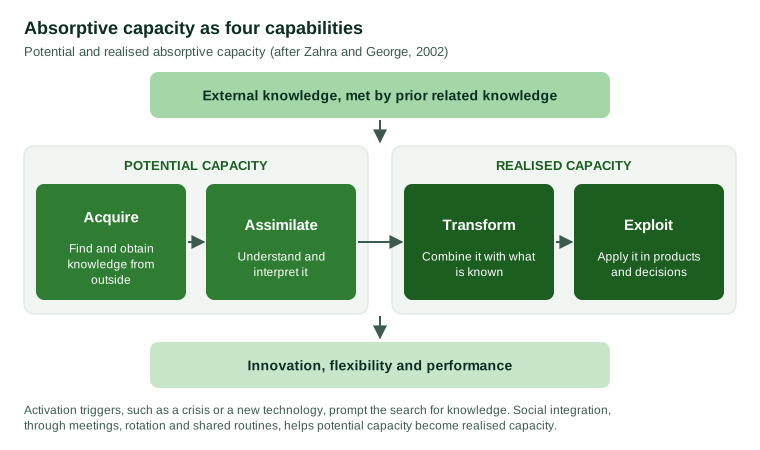
Zahra and George (2002) also identified activation triggers, events such as a crisis, a change in technology or a shift in government policy that prompt an organisation to look for new knowledge. They argued that social integration mechanisms, the formal and informal ways in which people share and interpret information, help convert potential capacity into realised capacity.
Recognising value
Todorova and Durisin (2007) criticised parts of this model. They argued that it had dropped the first element of the original definition, the ability to recognise the value of new knowledge, which they regarded as essential: knowledge that is not seen as valuable will not be acquired. They also argued that transformation is not simply a step after assimilation but an alternative route, used when new knowledge does not fit existing ways of thinking and those ways must change. And they highlighted the role of power within organisations, since those with influence may block knowledge that threatens their position.
A construct in danger of being taken for granted
Lane et al. (2006) reviewed a large body of research on absorptive capacity. They found that many studies used the concept without examining it closely. Most measured it simply by R&D spending, treated it as fixed rather than as something that develops, and paid little attention to the processes through which organisations actually learn. They called this a reification of the construct: it had become a label used without regard to what it described. They proposed a fuller model in which absorptive capacity is built through three sequential processes, exploratory learning to recognise and understand new knowledge, transformative learning to assimilate it and exploitative learning to apply it, each shaped by the organisation's existing knowledge, structures and strategies.
Volberda et al. (2010) reached a similar conclusion. They argued that research had paid too little attention to the individual and managerial foundations of absorptive capacity, and to how organisational form and internal processes shape it.
What the evidence shows
Despite these concerns about measurement, a substantial body of evidence supports the core idea.
Learning from partners
Mowery et al. (1996) studied strategic alliances and found that firms with greater prior knowledge related to their partners' technology absorbed more of that technology. Lane and Lubatkin (1998) showed that absorptive capacity is relative: firms learned most from partners whose basic knowledge was similar to their own, whose ways of organising were compatible and whose commercial problems were related.
Lyles and Salk (1996) studied international joint ventures in Hungary and found that ventures with a stronger capacity to learn, including flexibility, training and clearly stated objectives, acquired more knowledge from their foreign parent companies.
Learning within organisations
Absorptive capacity also matters for transfer within an organisation. Szulanski (1996) found that the recipient's lack of absorptive capacity was among the most important barriers to transferring best practices between units. Tsai (2001) studied business units in two large companies and found that units in central positions in the internal network produced more innovation and performed better, but only when they had high absorptive capacity. Access to knowledge was not enough; units needed the capacity to use it.
Minbaeva et al. (2003) studied the subsidiaries of multinational corporations and argued that absorptive capacity depends on both the ability and the motivation of employees. They found that human resource practices such as training, performance appraisal and merit-based promotion increased absorptive capacity, which in turn helped the subsidiaries receive knowledge from elsewhere in the corporation.
Connecting to science
Cockburn and Henderson (1998) studied pharmaceutical firms and found that firms whose scientists actively collaborated with researchers in universities and public laboratories, shown by co-authorship of papers, were more productive in drug discovery. Doing good science, and being part of the scientific community, gave these firms better access to and understanding of public research.
Griffith et al. (2004) tested the "two faces" idea across industries in several OECD countries. They found that R&D contributed to productivity growth not only directly but also by helping industries that were behind the technological frontier catch up with those that led it. This is consistent with the view that R&D builds the capacity to absorb knowledge from elsewhere.
Van Wijk et al. (2008), in a meta-analysis of studies of knowledge transfer, found that absorptive capacity was one of the factors most strongly associated with successful transfer.
Building capacity deliberately
Absorptive capacity can be built deliberately. Kim (1997) studied how Korean firms moved from imitating foreign technology to developing their own. Kim (1998) described how the Hyundai Motor Company built its capabilities in this way, and argued that absorptive capacity has two elements: the existing knowledge base and the intensity of effort devoted to learning. Hyundai's managers repeatedly created a sense of crisis, setting demanding targets that forced employees to learn intensively, and combined this with hiring experienced engineers, studying foreign designs and sending staff abroad for training.
Jansen et al. (2005) examined which organisational practices build each part of absorptive capacity. They found that coordination practices, such as cross-functional interfaces, participation in decision-making and job rotation, mainly strengthened potential capacity: the ability to acquire and assimilate knowledge. Socialisation practices, such as dense connections between people and shared norms, mainly strengthened realised capacity: the ability to transform and exploit knowledge. Organisations need both.
Measuring absorptive capacity
Because absorptive capacity cannot be observed directly, researchers have measured it in several indirect ways, each with strengths and weaknesses.
The most common measure has been R&D intensity, the share of a firm's revenue spent on research and development. It is easy to obtain and follows directly from the original argument, but it captures only one input and says nothing about how well the spending is turned into learning. Other studies have used the number or share of scientists and engineers employed, the number of patents held or the number of scientific papers published. These measures capture the stock of knowledge but not the processes through which it is used.
A second approach uses surveys of managers or employees. Jansen et al. (2005), for example, asked respondents how often their unit met with outside organisations to acquire knowledge, how quickly it recognised shifts in its market, how readily it recorded and shared new knowledge and how well it turned new knowledge into new products or services. Survey measures can distinguish the different dimensions of absorptive capacity, but they depend on respondents' perceptions and on how carefully the questions are designed and tested.
Lane et al. (2006) argued that the choice of measure should follow from the question being asked. A study of how firms learn from partners needs a measure of the similarity between partners; a study of how units use internal knowledge needs a measure of the processes inside the unit. A single, convenient proxy used for every purpose risks obscuring what the concept is meant to explain.
Openness and its limits
Since the early 2000s, many firms have adopted open innovation, drawing deliberately on ideas from outside and sharing their own ideas with others (Chesbrough, 2003). Absorptive capacity is central to this approach, because outside ideas are useful only to those who can recognise and use them.
Openness has limits, however. Laursen and Salter (2006) studied manufacturing firms in the United Kingdom and found that drawing on a wider range of external sources was associated with more innovation, but only up to a point. Beyond that point, additional sources were associated with less innovation, apparently because firms could not give enough attention to all of them. Absorptive capacity, in other words, is finite, and organisations must choose where to direct it.
A related danger is that the knowledge that makes absorption possible can also narrow it. Leonard-Barton (1992) showed that the core capabilities that make a firm successful can become core rigidities, making it hard to absorb knowledge that does not fit established ways of working. March (1991) described a related tension between exploitation, refining what is already known, and exploration, searching for new possibilities. Organisations that concentrate on exploitation may become efficient at what they already do while losing the capacity to recognise knowledge that would take them in new directions.
Absorptive capacity and research
The concept has clear implications for organisations that commission and use research, and for those that produce it.
For users of research
An organisation that buys survey data or research reports is absorbing external knowledge. The value it gains depends less on the volume of evidence it receives than on its ability to recognise what matters, understand it and act on it. This depends on having people who understand research methods well enough to judge the quality of evidence, who know the organisation's decisions well enough to see which findings are relevant and who have the standing to bring findings into decision-making.
Organisations that treat research as something to be delivered and filed, rather than discussed and integrated, tend to gain little from it. Those that build regular contact between researchers and decision-makers, share findings across departments and follow up on what was learned tend to gain more. The practices that Jansen et al. (2005) identified, cross-functional meetings, participation in decisions and dense connections, apply directly.
For producers of research
A research organisation also needs absorptive capacity of its own. Survey and research methods change constantly: new modes of data collection, new statistical techniques, new evidence on question design and new standards for transparency. A research provider that keeps up with these developments, through staff who read the methodological literature, attend professional meetings and take part in methodological research, can adopt improvements quickly. One that does not risks the lockout that Cohen and Levinthal (1990) described, falling so far behind that it can no longer recognise which developments matter.
A research provider can also help its clients absorb what it delivers. Findings presented in terms that relate to what the client already knows, connected explicitly to the client's decisions and accompanied by clear statements of what the evidence can and cannot support, are easier to absorb. In the language of Lane and Lubatkin (1998), the provider can reduce the distance between its knowledge and the client's.
Building absorptive capacity
The research suggests several practical ways for organisations to strengthen their capacity to learn from outside.
Invest in related knowledge. Keep expertise in the fields from which important knowledge is likely to come, even when that expertise is not immediately needed.
Value boundary spanners. Identify and support the people who connect the organisation with outside sources of knowledge and translate what they find.
Combine diversity with overlap. Hire people with varied backgrounds, but ensure enough shared knowledge for ideas to pass between them.
Connect people internally. Cross-functional teams, job rotation and regular meetings help knowledge acquired by one part of the organisation reach the parts that can use it.
Create reasons to learn. Clear goals, demanding targets and attention to emerging threats give people the motivation to seek and absorb new knowledge.
Choose where to look. Attention is limited. Focus external search on the sources most relevant to the organisation's needs rather than trying to monitor everything.
Guard against rigidity. Review established assumptions regularly, and make room for exploration as well as exploitation.
Conclusion
Absorptive capacity explains why organisations gain so differently from the same external knowledge. Its central insight is that learning builds on what is already known: organisations that have invested in related knowledge, that connect their people internally and externally and that are motivated to learn can recognise, understand and use outside knowledge far better than those that have not. The concept has been refined to distinguish potential from realised capacity and to emphasise the processes and people through which it works. For organisations that commission research, absorptive capacity determines how much value they gain from evidence. For organisations that produce research, it determines how well they keep up with their field and how effectively they help their clients learn.
References
Allen, T. J. (1977). Managing the flow of technology: Technology transfer and the dissemination of technological information within the R&D organization. MIT Press.
Chesbrough, H. W. (2003). Open innovation: The new imperative for creating and profiting from technology. Harvard Business School Press.
Cockburn, I. M., & Henderson, R. M. (1998). Absorptive capacity, coauthoring behavior, and the organization of research in drug discovery. Journal of Industrial Economics, 46(2), 157–182. https://doi.org/10.1111/1467-6451.00067
Cohen, W. M., & Levinthal, D. A. (1989). Innovation and learning: The two faces of R&D. Economic Journal, 99(397), 569–596. https://doi.org/10.2307/2233763
Cohen, W. M., & Levinthal, D. A. (1990). Absorptive capacity: A new perspective on learning and innovation. Administrative Science Quarterly, 35(1), 128–152. https://doi.org/10.2307/2393553
Cohen, W. M., & Levinthal, D. A. (1994). Fortune favors the prepared firm. Management Science, 40(2), 227–251. https://doi.org/10.1287/mnsc.40.2.227
Griffith, R., Redding, S., & Van Reenen, J. (2004). Mapping the two faces of R&D: Productivity growth in a panel of OECD industries. Review of Economics and Statistics, 86(4), 883–895. https://doi.org/10.1162/0034653043125194
Jansen, J. J. P., Van den Bosch, F. A. J., & Volberda, H. W. (2005). Managing potential and realized absorptive capacity: How do organizational antecedents matter? Academy of Management Journal, 48(6), 999–1015. https://doi.org/10.5465/amj.2005.19573106
Kim, L. (1997). Imitation to innovation: The dynamics of Korea's technological learning. Harvard Business School Press.
Kim, L. (1998). Crisis construction and organizational learning: Capability building in catching-up at Hyundai Motor. Organization Science, 9(4), 506–521. https://doi.org/10.1287/orsc.9.4.506
Lane, P. J., Koka, B. R., & Pathak, S. (2006). The reification of absorptive capacity: A critical review and rejuvenation of the construct. Academy of Management Review, 31(4), 833–863. https://doi.org/10.5465/amr.2006.22527456
Lane, P. J., & Lubatkin, M. (1998). Relative absorptive capacity and interorganizational learning. Strategic Management Journal, 19(5), 461–477. https://doi.org/10.1002/(SICI)1097-0266(199805)19:5<461::AID-SMJ953>3.0.CO;2-L
Laursen, K., & Salter, A. (2006). Open for innovation: The role of openness in explaining innovation performance among U.K. manufacturing firms. Strategic Management Journal, 27(2), 131–150. https://doi.org/10.1002/smj.507
Leonard-Barton, D. (1992). Core capabilities and core rigidities: A paradox in managing new product development. Strategic Management Journal, 13(S1), 111–125. https://doi.org/10.1002/smj.4250131009
Lyles, M. A., & Salk, J. E. (1996). Knowledge acquisition from foreign parents in international joint ventures: An empirical examination in the Hungarian context. Journal of International Business Studies, 27(5), 877–903. https://doi.org/10.1057/palgrave.jibs.8490155
March, J. G. (1991). Exploration and exploitation in organizational learning. Organization Science, 2(1), 71–87. https://doi.org/10.1287/orsc.2.1.71
Minbaeva, D., Pedersen, T., Björkman, I., Fey, C. F., & Park, H. J. (2003). MNC knowledge transfer, subsidiary absorptive capacity, and HRM. Journal of International Business Studies, 34(6), 586–599. https://doi.org/10.1057/palgrave.jibs.8400056
Mowery, D. C., Oxley, J. E., & Silverman, B. S. (1996). Strategic alliances and interfirm knowledge transfer. Strategic Management Journal, 17(S2), 77–91. https://doi.org/10.1002/smj.4250171108
Szulanski, G. (1996). Exploring internal stickiness: Impediments to the transfer of best practice within the firm. Strategic Management Journal, 17(S2), 27–43. https://doi.org/10.1002/smj.4250171105
Todorova, G., & Durisin, B. (2007). Absorptive capacity: Valuing a reconceptualization. Academy of Management Review, 32(3), 774–786. https://doi.org/10.5465/amr.2007.25275513
Tsai, W. (2001). Knowledge transfer in intraorganizational networks: Effects of network position and absorptive capacity on business unit innovation and performance. Academy of Management Journal, 44(5), 996–1004. https://doi.org/10.5465/3069443
Tushman, M. L. (1977). Special boundary roles in the innovation process. Administrative Science Quarterly, 22(4), 587–605. https://doi.org/10.2307/2392402
van Wijk, R., Jansen, J. J. P., & Lyles, M. A. (2008). Inter- and intra-organizational knowledge transfer: A meta-analytic review and assessment of its antecedents and consequences. Journal of Management Studies, 45(4), 830–853. https://doi.org/10.1111/j.1467-6486.2008.00771.x
Volberda, H. W., Foss, N. J., & Lyles, M. A. (2010). Absorbing the concept of absorptive capacity: How to realize its potential in the organization field. Organization Science, 21(4), 931–951. https://doi.org/10.1287/orsc.1090.0503
Zahra, S. A., & George, G. (2002). Absorptive capacity: A review, reconceptualization, and extension. Academy of Management Review, 27(2), 185–203. https://doi.org/10.5465/amr.2002.6587995