
The Generation of Knowledge · Knowledge management
Nonaka's SECI Model of Organisational Knowledge Creation
Ikujiro Nonaka's model of how organisations create knowledge through socialisation, externalisation, combination and internalisation, the idea of ba as a shared space for knowledge creation, the main criticisms of the model and how it can be applied in research work.
How do organisations create new knowledge? In the early 1990s the Japanese management scholar Ikujiro Nonaka offered an answer that became one of the most influential ideas in management. Studying Japanese companies that had been unusually successful at innovation, he argued that organisational knowledge is created through a continuous movement between two kinds of knowledge: tacit knowledge, held in people's experience and skills, and explicit knowledge, expressed in words, numbers and documents (Nonaka, 1991, 1994). He described four modes of conversion between them, known by their initials as the SECI model: socialisation, externalisation, combination and internalisation. This article explains the model, the related concept of ba, the criticisms the model has faced and what it offers to organisations that produce knowledge.
Two kinds of knowledge
Nonaka built on the work of the philosopher Michael Polanyi, who argued that "we can know more than we can tell" (Polanyi, 1966). A skilled craftsperson, a physician reading an X-ray or an experienced interviewer knows things that they cannot fully put into words. Nonaka (1994) described tacit knowledge as having both a technical side, the skills and know-how of practice, and a cognitive side, the mental models, beliefs and perspectives that shape how people see the world. Explicit knowledge, in contrast, can be expressed in formal language, stored in documents and databases and transmitted easily.
Western management, Nonaka and Takeuchi (1995) argued, had tended to treat knowledge as explicit information to be processed. Japanese companies, by contrast, had learned to draw on the tacit knowledge of their employees, including their hunches, intuitions and experience, and to turn it into new products and processes.
The four modes of conversion
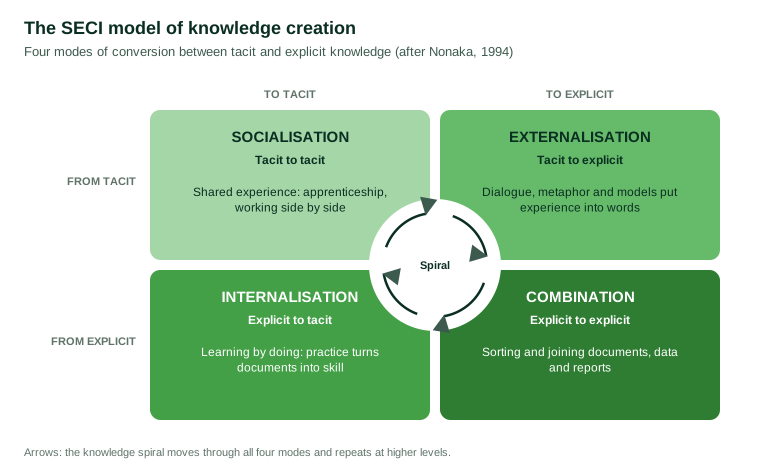
Nonaka (1994) proposed that new knowledge is created as knowledge moves between tacit and explicit forms and between individuals, groups and the organisation as a whole.
Socialisation: tacit to tacit
In socialisation, tacit knowledge is shared directly through shared experience: working together, observing, imitating and practising. Apprentices learn from masters in this way, often without either party putting the knowledge into words. Nonaka (1991) described how a software developer at Matsushita, trying to design a home bread-making machine, trained with the head baker at a leading hotel in Osaka to learn how he kneaded dough, a skill that could not be learned from a recipe.
Externalisation: tacit to explicit
In externalisation, tacit knowledge is articulated into explicit concepts. Nonaka emphasised the role of metaphor, analogy and models in this process, because they allow people to express what they know intuitively before they can define it precisely. The Matsushita developer described the baker's technique as a "twisting stretch", which engineers could then reproduce mechanically. Nonaka and Takeuchi (1995) also described how a team at Canon used the analogy of a beer can to think about how to make a low-cost disposable drum for a small copier.
Combination: explicit to explicit
In combination, different pieces of explicit knowledge are brought together, sorted, added to and reorganised into new and more complex forms. Reports, databases, meetings and computer networks support combination. A manager who combines sales figures, market research and production data into a new plan is combining explicit knowledge.
Internalisation: explicit to tacit
In internalisation, explicit knowledge is absorbed into individuals' tacit knowledge through practice: learning by doing. Manuals, training and simulations help people turn written knowledge into skill and judgement, which then becomes the starting point for new socialisation.
The knowledge spiral
The four modes are not separate activities but stages in a continuing cycle. Nonaka and Takeuchi (1995) described a knowledge spiral: knowledge created by individuals is shared, articulated, combined with other knowledge and absorbed into practice, and each turn of the spiral raises it to a higher level, from the individual to the group, the organisation and beyond. Innovation, on this view, depends on keeping the spiral moving.
The idea grew partly from earlier research on product development. Takeuchi and Nonaka (1986) described how successful Japanese companies developed new products through overlapping phases and self-organising, cross-functional teams, rather than through a sequence of separate departments. Such teams provided the close contact and shared experience that the spiral requires.
Conditions that enable the spiral
Nonaka and Takeuchi (1995) identified five organisational conditions that help the knowledge spiral to turn. Intention is the organisation's aspiration to its goals, which gives people a basis for judging which knowledge is worth creating. Autonomy allows individuals and teams to act on their own ideas and to find and use information. Fluctuation and creative chaos describe a degree of disruption, such as an ambitious challenge set by leaders, that prompts people to question routines and look at problems afresh. Redundancy means deliberately overlapping information, activities and responsibilities, so that people understand what others are doing and can share tacit knowledge more easily. Requisite variety means internal diversity that matches the complexity of the environment, so that the organisation can respond to the challenges it faces.
Nonaka and Takeuchi also argued that neither top-down nor bottom-up management suits knowledge creation well. They proposed middle-up-down management, in which senior leaders set a vision and middle managers act as "knowledge engineers", translating that vision into concepts that front-line teams can work with, and bringing together the tacit knowledge of those teams with the strategic aims of the organisation. In this view, middle managers are not obstacles between leaders and workers but the main agents of knowledge creation.
Several of these conditions are counter-intuitive. Redundancy, for example, looks like inefficiency, and creative chaos looks like poor management. Nonaka's argument was that efficiency in processing existing information and effectiveness in creating new knowledge require different arrangements, and that organisations that optimise only for the first may lose the capacity for the second.
Ba: the place of knowledge creation
Knowledge creation needs a context. Nonaka and Konno (1998) introduced the Japanese concept of ba, roughly "place", to describe a shared space, physical, virtual or mental, in which knowledge is created. Nonaka et al. (2000) linked a type of ba to each mode of conversion: originating ba, where individuals share feelings and experiences face to face, supports socialisation; dialoguing ba, where people reflect and articulate ideas together, supports externalisation; systemising ba, often supported by information technology, supports combination; and exercising ba, where people practise and apply knowledge, supports internalisation. They argued that leaders create knowledge less by directing it than by building and energising these spaces.
Criticisms
The SECI model has been widely used, but also criticised.
Can tacit knowledge be converted? Tsoukas (2003) argued that Nonaka misread Polanyi. For Polanyi, tacit knowledge is not a store of unspoken information waiting to be translated; it is an inseparable part of all knowing, and cannot be fully converted into explicit form. What can happen is that people, through conversation and reflection, come to notice and talk about aspects of their practice differently. Collins (2010) distinguished several kinds of tacit knowledge and argued that only some can, in principle, be made explicit.
What is the evidence? Gourlay (2006) reviewed the evidence offered for the model and argued that much of it came from anecdotes and case descriptions rather than systematic study, and that the four modes were not clearly defined. He suggested that knowledge creation might be better understood in terms of different kinds of behaviour and reasoning.
Does it travel? Glisby and Holden (2003) argued that the model reflects features of large Japanese companies of the 1980s, such as lifetime employment and strong group identity, and may not apply in the same way in other cultures and types of organisation.
In response, Nonaka and von Krogh (2009) clarified that tacit and explicit knowledge lie on a continuum rather than forming separate categories, and that "conversion" refers to the interaction through which knowledge is expanded, not to a literal translation.
Related views
Other researchers reached similar conclusions by different routes. Brown and Duguid (1991), drawing on Orr's (1996) ethnographic study of photocopier repair technicians, showed that workers learned largely by sharing stories about difficult repairs, a form of socialisation that official manuals did not capture. Lave and Wenger (1991) described learning as participation in communities of practice. Boisot (1998) proposed a model in which knowledge moves through cycles of codification, abstraction, diffusion and absorption. Davenport and Prusak (1998) and Alavi and Leidner (2001) placed knowledge conversion within broader frameworks of knowledge management.
Applying SECI in research work
The model offers a useful lens for organisations whose work is producing knowledge.
Socialisation: New researchers learn questionnaire design, moderation and analysis largely by working alongside experienced colleagues. Pairing, shadowing and joint fieldwork pass on judgement that manuals cannot.
Externalisation: Debriefs after projects, methodological notes and discussions of "what we would do differently" turn individual experience into shared, written knowledge. Metaphors and examples help express judgements that are hard to define.
Combination: Libraries of tested questions, databases of past results and syntheses across studies combine explicit knowledge into more powerful resources.
Internalisation: Training, practice with real data and supervised projects turn documented methods into personal skill.
Creating spaces for each mode, such as regular team reviews, mentoring relationships and well-organised archives, keeps the spiral turning. The criticisms are a useful reminder not to expect too much from documentation alone: some of the most valuable knowledge in a research team can only be passed on through shared work.
Conclusion
Nonaka's SECI model describes organisational knowledge creation as a spiral of socialisation, externalisation, combination and internalisation, supported by shared spaces for interaction. Its claims about the conversion of tacit knowledge and its evidence base have been questioned, and its origins in Japanese corporate culture limit how directly it can be applied elsewhere. Yet its central insight has endured: organisations create knowledge not only by processing information, but by connecting people's experience with shared, explicit knowledge in a continuing cycle. For research organisations, which depend on both skilled judgement and documented method, that insight is directly practical.
References
Alavi, M., & Leidner, D. E. (2001). Review: Knowledge management and knowledge management systems: Conceptual foundations and research issues. MIS Quarterly, 25(1), 107–136. https://doi.org/10.2307/3250961
Boisot, M. H. (1998). Knowledge assets: Securing competitive advantage in the information economy. Oxford University Press.
Brown, J. S., & Duguid, P. (1991). Organizational learning and communities-of-practice: Toward a unified view of working, learning, and innovation. Organization Science, 2(1), 40–57. https://doi.org/10.1287/orsc.2.1.40
Collins, H. (2010). Tacit and explicit knowledge. University of Chicago Press.
Davenport, T. H., & Prusak, L. (1998). Working knowledge: How organizations manage what they know. Harvard Business School Press.
Glisby, M., & Holden, N. (2003). Contextual constraints in knowledge management theory: The cultural embeddedness of Nonaka's knowledge-creating company. Knowledge and Process Management, 10(1), 29–36. https://doi.org/10.1002/kpm.158
Gourlay, S. (2006). Conceptualizing knowledge creation: A critique of Nonaka's theory. Journal of Management Studies, 43(7), 1415–1436. https://doi.org/10.1111/j.1467-6486.2006.00637.x
Lave, J., & Wenger, E. (1991). Situated learning: Legitimate peripheral participation. Cambridge University Press. https://doi.org/10.1017/CBO9780511815355
Nonaka, I. (1991). The knowledge-creating company. Harvard Business Review, 69(6), 96–104.
Nonaka, I. (1994). A dynamic theory of organizational knowledge creation. Organization Science, 5(1), 14–37. https://doi.org/10.1287/orsc.5.1.14
Nonaka, I., & Konno, N. (1998). The concept of "ba": Building a foundation for knowledge creation. California Management Review, 40(3), 40–54. https://doi.org/10.2307/41165942
Nonaka, I., & Takeuchi, H. (1995). The knowledge-creating company: How Japanese companies create the dynamics of innovation. Oxford University Press.
Nonaka, I., Toyama, R., & Konno, N. (2000). SECI, ba and leadership: A unified model of dynamic knowledge creation. Long Range Planning, 33(1), 5–34. https://doi.org/10.1016/S0024-6301(99)00115-6
Nonaka, I., & von Krogh, G. (2009). Tacit knowledge and knowledge conversion: Controversy and advancement in organizational knowledge creation theory. Organization Science, 20(3), 635–652. https://doi.org/10.1287/orsc.1080.0412
Orr, J. E. (1996). Talking about machines: An ethnography of a modern job. ILR Press.
Polanyi, M. (1966). The tacit dimension. Doubleday.
Takeuchi, H., & Nonaka, I. (1986). The new new product development game. Harvard Business Review, 64(1), 137–146.
Tsoukas, H. (2003). Do we really understand tacit knowledge? In M. Easterby-Smith & M. A. Lyles (Eds.), The Blackwell handbook of organizational learning and knowledge management (pp. 410–427). Blackwell.