
The Generation of Knowledge · Knowledge management
The Knowledge-Creating Company
What it means for a company to create knowledge rather than merely process information, drawing on Nonaka and Takeuchi, theories of organisational learning, the knowledge-based view of the firm, and research on the routines, cultures and structures that help or hinder organisational learning.
"In an economy where the only certainty is uncertainty, the one sure source of lasting competitive advantage is knowledge." With this sentence, Ikujiro Nonaka opened an article in the Harvard Business Review that gave a name to a new way of thinking about organisations (Nonaka, 1991). The knowledge-creating company, he argued, is not a machine for processing information but a living organism that continually creates new knowledge, spreads it through the organisation and embodies it in new products, services and systems. This idea, developed with Hirotaka Takeuchi in a book of the same title (Nonaka & Takeuchi, 1995), joined a wider movement in management thought that placed learning and knowledge at the centre of how organisations compete and survive. This article examines the main ideas of that movement and what research has found about the conditions under which organisations learn.
From information processing to knowledge creation
Traditional theories of organisation, Nonaka and Takeuchi (1995) argued, treated organisations as systems for processing information: gathering data from the environment, making decisions and implementing them efficiently. This view captured something real, but it missed how organisations actually innovate. Innovation, in their account, comes from creating knowledge that did not exist before, often by drawing on the tacit experience, intuitions and ideals of employees, and turning them into concepts, prototypes and products. Nonaka's model of how this happens, through socialisation, externalisation, combination and internalisation, is described in a separate article; the focus here is on the organisation as a whole.
The idea fitted a broader argument about the economy. Drucker (1993) argued that knowledge had become the central economic resource, displacing land, labour and capital, and that the productivity of knowledge workers would be the main challenge for organisations. If that was true, the ability to create and use knowledge would determine which organisations prospered.
How knowledge-creating companies work
Nonaka (1991) illustrated his argument with examples from Japanese manufacturers. One of the most cited concerns the development of the Honda City car in the late 1970s. Senior managers gave a young development team a deliberately vague challenge: to create a fundamentally different kind of car. The team expressed its concept in a slogan, "Theory of Automobile Evolution", and a short phrase, "Man-maximum, machine-minimum", which led to a short, tall car with more room for passengers than its length suggested. Nonaka argued that slogans, metaphors and analogies of this kind allow teams to articulate intuitions that cannot yet be stated as specifications, and to coordinate their work around a shared concept.
Earlier, Takeuchi and Nonaka (1986) had compared the product development processes of companies such as Honda, Canon and Fuji-Xerox with the traditional sequential approach, in which a product passes from one specialised department to the next like a relay baton. The successful companies instead used a "rugby" approach, in which a multidisciplinary team worked together from start to finish, with overlapping phases, a high degree of autonomy and constant interaction. This approach allowed knowledge from different specialisms to be combined as the product took shape, rather than being handed over in finished pieces.
Nonaka (1994) generalised these observations into a theory of organisational knowledge creation in which knowledge is created by individuals, amplified through interaction in teams and crystallised in the organisation's products, systems and culture. Three features distinguish the knowledge-creating company in this account. It treats the tacit knowledge of its employees as a resource rather than a nuisance. It uses ambiguity and redundancy deliberately, because they force people to share and interpret knowledge. And it gives middle managers a central role, translating the broad visions of senior leaders into concepts that front-line teams can develop.
The knowledge-based view of the firm
Economists and strategy scholars developed a parallel line of thought known as the knowledge-based view of the firm. Kogut and Zander (1992) argued that firms exist because they are better than markets at sharing and transferring knowledge among their members. Individuals within a firm share a language, routines and relationships that allow them to combine their knowledge in ways that independent parties trading in a market could not. They called this ability combinative capability: the capacity to generate new applications from existing knowledge.
Grant (1996) argued that knowledge is the most important strategic resource of the firm, and that because much of it is held by individuals in tacit form, the main task of management is to integrate specialised knowledge, through rules, routines, sequencing of tasks and group problem-solving. Nelson and Winter (1982) had earlier described organisational routines, the regular and predictable patterns of activity that make up much of what organisations do, as the repository of an organisation's knowledge. Routines remember how to do things even when individual members leave or forget.
Teece et al. (1997) introduced the concept of dynamic capabilities: a firm's ability to integrate, build and reconfigure its internal and external competences to respond to rapidly changing environments. In a stable world, a firm can rely on its existing knowledge. In a changing world, its advantage depends on its capacity to learn.
Organisational learning
Single-loop and double-loop learning
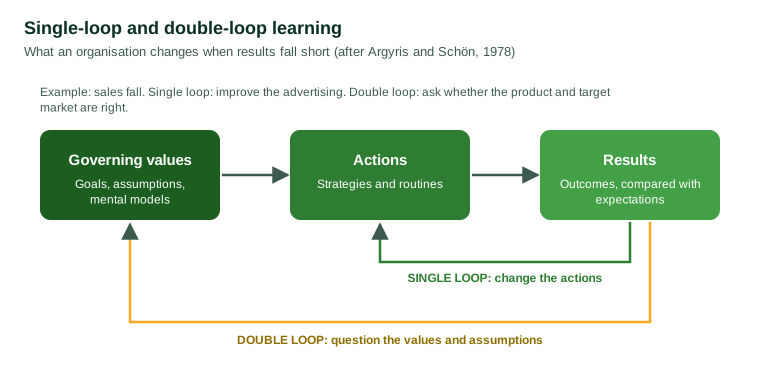
Argyris and Schön (1978) distinguished two kinds of organisational learning. In single-loop learning, an organisation detects and corrects errors within its existing goals, values and assumptions, as a thermostat corrects the temperature to a fixed setting. In double-loop learning, the organisation questions the goals, values and assumptions themselves. A company that responds to falling sales by improving its advertising is learning in a single loop; one that asks whether it is selling the right product to the right customers is learning in a double loop. Argyris and Schön argued that many organisations are good at the first and poor at the second, because questioning underlying assumptions is threatening to those who hold them.
Learning from experience
Levitt and March (1988) reviewed research on how organisations learn from experience. They described organisations as encoding lessons from history into routines, which then guide behaviour. This makes learning cumulative but also creates risks. An organisation may fall into a competency trap, becoming so good at a familiar procedure that it fails to adopt a better one, because its experience with the new procedure is too limited to yield good results at first. Huber (1991) identified four processes through which organisations learn: acquiring knowledge, distributing information among members, interpreting it and storing it in organisational memory.
The learning organisation
Senge (1990) popularised the idea of the learning organisation, one in which people continually expand their capacity to create the results they want. He described five "disciplines": personal mastery, mental models, shared vision, team learning and, binding them together, systems thinking, the ability to see the interconnections and feedback loops that shape outcomes over time. Garvin (1993) offered a more practical definition: a learning organisation is skilled at creating, acquiring and transferring knowledge, and at modifying its behaviour to reflect new knowledge and insights. He identified five activities that such organisations perform well: systematic problem-solving, experimentation, learning from their own past experience, learning from the experiences of others and transferring knowledge quickly and efficiently throughout the organisation.
Exploration and exploitation
March (1991) identified a fundamental tension in organisational learning. Exploitation refines and extends existing knowledge, technologies and products; it produces returns that are relatively certain and quick. Exploration searches for new possibilities through experimentation and risk-taking; its returns are uncertain, distant and often negative. Because exploitation pays off sooner and more reliably, organisations tend to drift towards it, improving what they already do while neglecting what they might do next. In the long run, an organisation that only exploits may become highly efficient at activities that are becoming obsolete.
Tushman and O'Reilly (1996) argued that successful companies must be ambidextrous: able to pursue incremental improvement in existing businesses while also pursuing more radical innovation, often by creating separate units with different structures and cultures under a common leadership.
When strengths become weaknesses
Leonard-Barton (1992) studied new product development projects and found that the same core capabilities that give a firm its advantage, its skills, systems, values and knowledge, can become core rigidities that prevent it from adapting when circumstances change. A company that excels at a particular technology may undervalue new technologies that do not fit its expertise. Leonard-Barton (1995) later described how knowledge-creating organisations deliberately maintain the "wellsprings" of their knowledge through problem-solving, experimentation, importing knowledge from outside and integrating knowledge across functions.
Knowledge brokering and learning from others
Knowledge creation often involves bringing ideas from one context to another. Hargadon and Sutton (1997) studied IDEO, a product design consultancy, and found that much of its innovation came from technology brokering: designers worked for clients in many different industries and recombined solutions they had seen in one industry to solve problems in another. The firm's routines, such as brainstorming sessions and collections of objects and materials, helped designers remember and share what they had learned.
Retaining and transferring knowledge
Knowledge created in one part of an organisation must be transferred to others, and it must be retained. Argote (2013) reviewed decades of research on organisational learning curves and found that organisations differ greatly in how quickly they learn from experience and how well they retain what they have learned. Darr et al. (1995) studied pizza franchises and found that productivity gains from experience transferred between stores owned by the same franchisee, but not between stores with different owners, and that knowledge depreciated quickly: much of what was learned was forgotten within weeks unless it was used. The study showed that organisational knowledge is not a stable stock but something that must be continually renewed.
The human conditions for learning
Learning requires people to admit mistakes, ask questions and propose untested ideas. Edmondson (1999) studied teams in a manufacturing company and found that teams with higher psychological safety, a shared belief that the team is safe for interpersonal risk-taking, engaged more in learning behaviours, such as seeking feedback and discussing errors, and performed better as a result. Where people fear blame, they hide errors and avoid challenging assumptions, and the organisation loses the information it needs to learn.
von Krogh et al. (2000) argued that knowledge creation must be enabled rather than managed directly. Managers can create the conditions for it, such as a knowledge vision, conversations that allow ideas to be shared and challenged, and relationships of care and trust, but they cannot command it.
A knowledge vision
Several writers argue that knowledge creation needs a sense of direction. von Krogh et al. (2000) described a knowledge vision as a statement of the kind of knowledge an organisation should seek to create, which guides decisions about what to learn, whom to hire, which projects to pursue and which partnerships to form. Without such a vision, learning activities can become scattered, producing knowledge that is interesting but not useful. Nonaka and Takeuchi (1995) made a similar point through their concept of organisational intention: the aspiration that tells people which knowledge matters. For a research organisation, a knowledge vision might specify the populations, topics and methods in which it aims to be expert, so that the knowledge accumulated across many client projects adds up to a coherent body of capability rather than a collection of unrelated reports.
Criticisms and limits
The knowledge-creating company and the learning organisation have been criticised as idealised. Many accounts rely on selected case studies of successful firms, and it is difficult to show that learning practices cause success rather than accompanying it. Concepts such as the learning organisation can be vague, and attempts to implement them sometimes produce new jargon without real change. The cultural specificity of the Japanese cases on which Nonaka and Takeuchi drew also raises questions about how far their conclusions apply elsewhere. These criticisms suggest caution in applying any single model, but they do not undermine the central claim that organisations differ in their capacity to learn and that this capacity matters.
The knowledge-creating research organisation
Research organisations are knowledge-creating companies by definition: their products are new knowledge for clients. They also need to learn as organisations, improving their own methods and judgement over time. The research reviewed here suggests several practices.
Build double loops into projects. After each major project, ask not only what went wrong and how to fix it, but whether the assumptions behind the design, such as the sampling approach, the measures used or the way findings were presented, were right.
Balance exploitation and exploration. Standard methods and tracking studies provide reliable, efficient service. Experiments with new methods, data sources and analytical techniques prepare for the future. Both need resources.
Guard against core rigidities. Expertise in established methods is valuable but can blind an organisation to better alternatives. Regularly review whether the methods the organisation is best at are still the best available.
Broker knowledge across projects. Researchers working on different topics and for different clients can transfer solutions from one context to another. Regular sharing sessions and accessible records make this easier.
Keep knowledge in use. As Darr et al. (1995) showed, knowledge that is not used decays. Practising skills, revisiting past work and updating guidance keep organisational knowledge alive.
Make it safe to learn. Encourage staff to report errors, question findings and propose new approaches without fear of blame.
Learn from clients and respondents. Client feedback on whether findings were useful, and respondent feedback on whether questions made sense, are direct evidence about the quality of the organisation's knowledge. Collecting and acting on such feedback closes the loop between what the organisation produces and how well it serves its users.
Give learning a direction. Decide in which topics, populations and methods the organisation wants to build lasting expertise, and use that choice to guide training, hiring and the selection of projects, so that individual projects add up to cumulative capability.
Conclusion
The knowledge-creating company is one that treats knowledge as its most important resource and learning as its central activity. Research on organisational learning has shown how such organisations work: they integrate specialised knowledge through routines and teams, question their assumptions as well as their actions, balance the refinement of what they know with the search for what they do not, transfer and renew knowledge before it decays, and create a climate in which people can learn from mistakes. These ideas apply to any organisation, but they apply with special force to those whose business is producing knowledge for others.
References
Argote, L. (2013). Organizational learning: Creating, retaining and transferring knowledge (2nd ed.). Springer. https://doi.org/10.1007/978-1-4614-5251-5
Argyris, C., & Schön, D. A. (1978). Organizational learning: A theory of action perspective. Addison-Wesley.
Darr, E. D., Argote, L., & Epple, D. (1995). The acquisition, transfer, and depreciation of knowledge in service organizations: Productivity in franchises. Management Science, 41(11), 1750–1762. https://doi.org/10.1287/mnsc.41.11.1750
Drucker, P. F. (1993). Post-capitalist society. HarperBusiness.
Edmondson, A. (1999). Psychological safety and learning behavior in work teams. Administrative Science Quarterly, 44(2), 350–383. https://doi.org/10.2307/2666999
Garvin, D. A. (1993). Building a learning organization. Harvard Business Review, 71(4), 78–91.
Grant, R. M. (1996). Toward a knowledge-based theory of the firm. Strategic Management Journal, 17(S2), 109–122. https://doi.org/10.1002/smj.4250171110
Hargadon, A., & Sutton, R. I. (1997). Technology brokering and innovation in a product development firm. Administrative Science Quarterly, 42(4), 716–749. https://doi.org/10.2307/2393655
Huber, G. P. (1991). Organizational learning: The contributing processes and the literatures. Organization Science, 2(1), 88–115. https://doi.org/10.1287/orsc.2.1.88
Kogut, B., & Zander, U. (1992). Knowledge of the firm, combinative capabilities, and the replication of technology. Organization Science, 3(3), 383–397. https://doi.org/10.1287/orsc.3.3.383
Leonard-Barton, D. (1992). Core capabilities and core rigidities: A paradox in managing new product development. Strategic Management Journal, 13(S1), 111–125. https://doi.org/10.1002/smj.4250131009
Leonard-Barton, D. (1995). Wellsprings of knowledge: Building and sustaining the sources of innovation. Harvard Business School Press.
Levitt, B., & March, J. G. (1988). Organizational learning. Annual Review of Sociology, 14, 319–340. https://doi.org/10.1146/annurev.so.14.080188.001535
March, J. G. (1991). Exploration and exploitation in organizational learning. Organization Science, 2(1), 71–87. https://doi.org/10.1287/orsc.2.1.71
Nelson, R. R., & Winter, S. G. (1982). An evolutionary theory of economic change. Belknap Press of Harvard University Press.
Nonaka, I. (1991). The knowledge-creating company. Harvard Business Review, 69(6), 96–104.
Nonaka, I. (1994). A dynamic theory of organizational knowledge creation. Organization Science, 5(1), 14–37. https://doi.org/10.1287/orsc.5.1.14
Nonaka, I., & Takeuchi, H. (1995). The knowledge-creating company: How Japanese companies create the dynamics of innovation. Oxford University Press.
Senge, P. M. (1990). The fifth discipline: The art and practice of the learning organization. Doubleday.
Takeuchi, H., & Nonaka, I. (1986). The new new product development game. Harvard Business Review, 64(1), 137–146.
Teece, D. J., Pisano, G., & Shuen, A. (1997). Dynamic capabilities and strategic management. Strategic Management Journal, 18(7), 509–533. https://doi.org/10.1002/(SICI)1097-0266(199708)18:7<509::AID-SMJ882>3.0.CO;2-Z
Tushman, M. L., & O'Reilly, C. A., III. (1996). Ambidextrous organizations: Managing evolutionary and revolutionary change. California Management Review, 38(4), 8–30. https://doi.org/10.2307/41165852
von Krogh, G., Ichijo, K., & Nonaka, I. (2000). Enabling knowledge creation: How to unlock the mystery of tacit knowledge and release the power of innovation. Oxford University Press.