
The Generation of Knowledge · Knowledge management
Knowledge Transfer Between Organisations
How knowledge moves between organisations through alliances, networks, people and supply chains, what makes transfer succeed or fail, and what research organisations can learn from the evidence.
No organisation creates all the knowledge it uses. Firms learn from suppliers, customers, partners, universities and even competitors. Public bodies adopt practices developed elsewhere. Research organisations draw on methods invented by others and pass their findings to clients who must put them to use. Knowledge transfer is the process through which one organisation is affected by the experience of another (Argote & Ingram, 2000). This article examines how knowledge moves between organisations, why the process is often harder than expected and what makes it succeed.
Why transfer matters
Argote and Ingram (2000) argued that the ability to transfer knowledge is a basis for competitive advantage. Organisations that can absorb and apply knowledge from outside learn faster than those that rely only on their own experience. At the same time, knowledge that is hard to transfer is also hard for competitors to copy, which is why firms often guard their most valuable know-how.
Kogut and Zander (1992) argued that firms exist partly because they are better than markets at sharing and combining knowledge. Knowledge moves more easily within a firm, where people share a language, routines and a common identity, than between firms, where those things must be built. This explains why transfer between organisations takes deliberate effort.
Transfer is also costly. Teece (1977) studied international technology transfer projects by multinational firms and found that the resources needed to transfer know-how were substantial and varied widely between projects. Transfer costs were lower when the technology was well understood, had been transferred before and was going to a recipient with relevant experience.
Channels of transfer
Knowledge moves between organisations through several channels.
Alliances and joint ventures. Firms form alliances partly to gain access to each other's knowledge. Mowery et al. (1996) found that equity joint ventures were more effective channels for transferring knowledge than contract-based agreements, because shared ownership created closer and longer-lasting contact. Hamel (1991) studied international alliances and found that partners often competed to learn from each other. The partner that learned faster could gain bargaining power and, in some cases, no longer need the alliance.
Networks. Powell et al. (1996) studied the biotechnology industry, where knowledge was complex and spread across many organisations. They found that the locus of innovation lay in networks of collaboration rather than in individual firms, and that firms with more and more varied ties grew faster and became more central in the network.
Supply chains. Dyer and Nobeoka (2000) studied Toyota's relationships with its suppliers in the United States and Japan. Toyota built a knowledge-sharing network through supplier associations, teams of consultants who helped suppliers solve problems, and voluntary learning groups. It established norms that made sharing expected and reduced the risk that a supplier would take knowledge without giving any back. Suppliers in the network improved their productivity faster than they did elsewhere.
People. Much knowledge moves when people move. Almeida and Kogut (1999) studied semiconductor engineers and found that their movement between firms helped explain why knowledge tended to stay within particular regions. Jaffe et al. (1993) showed that patents were more likely to cite earlier patents from the same metropolitan area than would be expected by chance, evidence that knowledge spills over most easily across short distances, where people meet and change jobs.
Universities and public research. Universities transfer knowledge through publications, graduates, consulting, licensing and joint projects. Bozeman (2000) reviewed research on technology transfer from universities and government laboratories and found that its effectiveness depended on the characteristics of the transferring agent, the recipient, the knowledge itself and the channel used, and that success should be judged by more than counts of licences or patents.
Why transfer is difficult
Szulanski (1996) studied the transfer of best practices within firms and found that the main barriers were the recipient's lack of absorptive capacity, causal ambiguity about why a practice worked, and an arduous relationship between source and recipient. These barriers are usually stronger between organisations than within them.
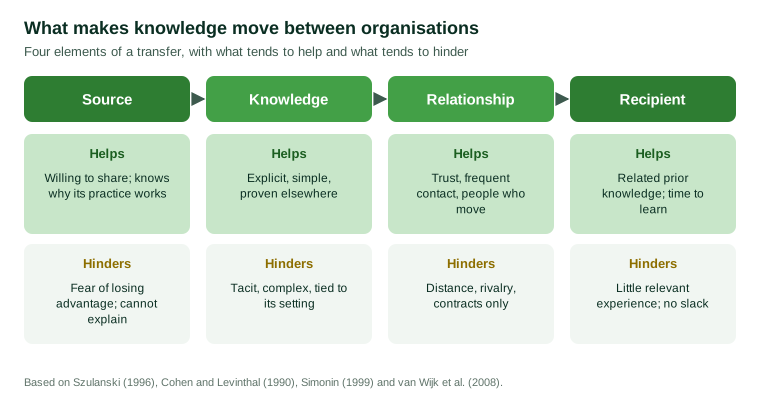
Figure 1 summarises the factors that research has linked to successful transfer.
The knowledge
Simonin (1999) studied strategic alliances and found that ambiguity about the knowledge was the main obstacle to its transfer. Ambiguity was greater when the knowledge was tacit, complex and specific to the setting in which it had been developed. Such knowledge cannot be passed on simply by handing over documents. It needs demonstration, practice and close contact.
The recipient
Cohen and Levinthal (1990) argued that an organisation's ability to recognise the value of new external knowledge, absorb it and apply it depends on its existing related knowledge. They called this ability absorptive capacity. Lane and Lubatkin (1998) showed that what matters is not only a firm's general capacity but its similarity to its partner: firms learned more from partners whose knowledge base, organisational structure and commercial focus were similar enough for knowledge to be understood but different enough to be worth learning.
The relationship
Inkpen and Tsang (2005) argued that knowledge transfer depends on social capital: the structure of ties between organisations, shared goals and understanding, and trust. Strong, trusting relationships make partners more willing to share and better able to understand what is shared. Hansen (1999) found a trade-off within firms: weak ties between units helped people search for useful knowledge, but strong ties were needed to transfer complex knowledge once it had been found.
The evidence as a whole
Van Wijk et al. (2008) carried out a meta-analysis of studies of knowledge transfer within and between organisations. They found that absorptive capacity, the ambiguity of the knowledge and the characteristics of the network linking the organisations were all associated with how much knowledge was transferred, and that transfer, in turn, was associated with better performance and more innovation.
Transfer in survey and research work
Research organisations sit in the middle of knowledge transfer. They draw on methods developed by universities, statistical agencies and other research groups, and they pass their findings to clients who must understand and act on them. Each direction benefits from the lessons above.
When adopting methods from elsewhere, a research team benefits from understanding not only what a method does but why it works and under what conditions. A weighting procedure or question design that succeeded in one country or population may not transfer unchanged to another. Close contact with the people who developed a method, pilot testing and careful documentation reduce the causal ambiguity that Szulanski (1996) identified.
When transferring findings to clients, the research organisation is the source and the client is the recipient. The client's absorptive capacity matters: findings presented in terms the client already understands, connected to decisions the client faces, are more likely to be used. Ongoing relationships, in which researchers and clients meet regularly and discuss what results mean, transfer more than a report delivered at the end of a project.
Research organisations can also judge whether transfer has happened. A report that has been delivered has not necessarily been understood, and a finding that has been understood has not necessarily been used. Following up with clients some months after a project, to learn which findings shaped decisions and which were set aside, gives the research organisation knowledge of its own: about which forms of reporting work, which clients need more support and which kinds of evidence are most valued. That knowledge, in turn, improves the next transfer.
Practical lessons
The research suggests several practical steps for organisations seeking to gain knowledge from others or pass it on.
- Invest in related knowledge. Organisations learn most from outside when they already know enough to understand what they are receiving.
- Choose partners carefully. Partners whose knowledge is similar enough to be understood but different enough to be useful offer the most to learn.
- Build relationships, not only contracts. Trust, frequent contact and shared goals make sharing more likely and more effective.
- Move people. Secondments, joint teams, visits and hiring carry tacit knowledge that documents cannot.
- Reduce ambiguity. Explain why a practice works, demonstrate it and support the recipient as they apply it.
- Allow time. Transfer is a process, not an event. Recipients need time to adapt knowledge to their own setting.
Conclusion
Knowledge transfer between organisations is how good ideas spread across an economy, how firms learn from partners and how research reaches the people who use it. The evidence shows that it is shaped by the nature of the knowledge, the capacity of the recipient and the strength of the relationship between the organisations involved. Knowledge that is tacit and complex moves slowly and needs close contact; recipients with related knowledge learn faster; and trusting, well-connected relationships make transfer easier. For a research organisation, these lessons apply both to the methods it adopts and to the findings it delivers.
References
Almeida, P., & Kogut, B. (1999). Localization of knowledge and the mobility of engineers in regional networks. Management Science, 45(7), 905–917. https://doi.org/10.1287/mnsc.45.7.905
Argote, L., & Ingram, P. (2000). Knowledge transfer: A basis for competitive advantage in firms. Organizational Behavior and Human Decision Processes, 82(1), 150–169. https://doi.org/10.1006/obhd.2000.2893
Bozeman, B. (2000). Technology transfer and public policy: A review of research and theory. Research Policy, 29(4–5), 627–655. https://doi.org/10.1016/S0048-7333(99)00093-1
Cohen, W. M., & Levinthal, D. A. (1990). Absorptive capacity: A new perspective on learning and innovation. Administrative Science Quarterly, 35(1), 128–152. https://doi.org/10.2307/2393553
Dyer, J. H., & Nobeoka, K. (2000). Creating and managing a high-performance knowledge-sharing network: The Toyota case. Strategic Management Journal, 21(3), 345–367. https://doi.org/10.1002/(SICI)1097-0266(200003)21:3<345::AID-SMJ96>3.0.CO;2-N
Hamel, G. (1991). Competition for competence and inter-partner learning within international strategic alliances. Strategic Management Journal, 12(S1), 83–103. https://doi.org/10.1002/smj.4250120908
Hansen, M. T. (1999). The search-transfer problem: The role of weak ties in sharing knowledge across organization subunits. Administrative Science Quarterly, 44(1), 82–111. https://doi.org/10.2307/2667032
Inkpen, A. C., & Tsang, E. W. K. (2005). Social capital, networks, and knowledge transfer. Academy of Management Review, 30(1), 146–165. https://doi.org/10.5465/amr.2005.15281445
Jaffe, A. B., Trajtenberg, M., & Henderson, R. (1993). Geographic localization of knowledge spillovers as evidenced by patent citations. Quarterly Journal of Economics, 108(3), 577–598. https://doi.org/10.2307/2118401
Kogut, B., & Zander, U. (1992). Knowledge of the firm, combinative capabilities, and the replication of technology. Organization Science, 3(3), 383–397. https://doi.org/10.1287/orsc.3.3.383
Lane, P. J., & Lubatkin, M. (1998). Relative absorptive capacity and interorganizational learning. Strategic Management Journal, 19(5), 461–477. https://doi.org/10.1002/(SICI)1097-0266(199805)19:5<461::AID-SMJ953>3.0.CO;2-L
Mowery, D. C., Oxley, J. E., & Silverman, B. S. (1996). Strategic alliances and interfirm knowledge transfer. Strategic Management Journal, 17(S2), 77–91. https://doi.org/10.1002/smj.4250171108
Powell, W. W., Koput, K. W., & Smith-Doerr, L. (1996). Interorganizational collaboration and the locus of innovation: Networks of learning in biotechnology. Administrative Science Quarterly, 41(1), 116–145. https://doi.org/10.2307/2393988
Simonin, B. L. (1999). Ambiguity and the process of knowledge transfer in strategic alliances. Strategic Management Journal, 20(7), 595–623. https://doi.org/10.1002/(SICI)1097-0266(199907)20:7<595::AID-SMJ47>3.0.CO;2-5
Szulanski, G. (1996). Exploring internal stickiness: Impediments to the transfer of best practice within the firm. Strategic Management Journal, 17(S2), 27–43. https://doi.org/10.1002/smj.4250171105
Teece, D. J. (1977). Technology transfer by multinational firms: The resource cost of transferring technological know-how. Economic Journal, 87(346), 242–261. https://doi.org/10.2307/2232084
van Wijk, R., Jansen, J. J. P., & Lyles, M. A. (2008). Inter- and intra-organizational knowledge transfer: A meta-analytic review and assessment of its antecedents and consequences. Journal of Management Studies, 45(4), 830–853. https://doi.org/10.1111/j.1467-6486.2008.00771.x