
The Generation of Knowledge · Knowledge management
Knowledge Management: Concepts and Practice
What knowledge management means, the core processes it covers, the choice between codifying knowledge and connecting people, why knowledge is hard to move inside organisations, and what makes knowledge management work in practice.
Organisations know more than any of their documents record. Their knowledge lies in reports and databases, but also in the skills of their staff, the routines they follow and the relationships between colleagues. Knowledge management is the deliberate effort to create, keep, share and use that knowledge so that the organisation performs better. The field grew rapidly in the 1990s, as companies recognised knowledge as a central economic resource. This article introduces its main concepts and the lessons learned from practice.
Knowledge as a resource
Davenport and Prusak (1998) described knowledge in organisations as a fluid mix of experience, values, contextual information and expert insight that provides a framework for evaluating new experiences and information. It originates in people's minds and is embedded not only in documents but in routines, processes and norms. Grant (1996) argued that knowledge is the most strategically important resource of the firm, and that the main role of a firm is to integrate the specialised knowledge of its members into products and services.
A central distinction is between explicit knowledge, which can be written down and shared through documents, and tacit knowledge, which is held in skills and experience and is hard to express. Polanyi (1966) summarised the second with the remark that we can know more than we can tell. Nonaka (1994) argued that organisations create knowledge through continual conversion between the two.
Core processes
Alavi and Leidner (2001) identified four processes that knowledge management must support: creating new knowledge, storing and retrieving it, transferring it between people and units, and applying it to tasks and decisions. Dalkir (2017) described the cycle in similar terms, emphasising that captured knowledge must be assessed, shared, used and updated, or it quickly loses value.
Two strategies
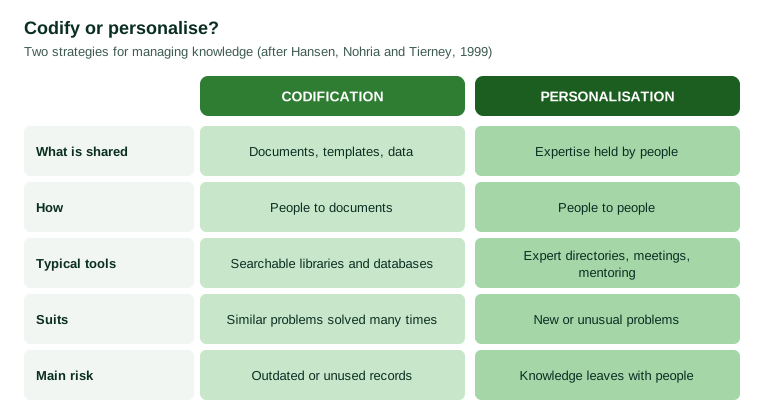
Hansen et al. (1999) observed that consulting firms managed knowledge in two different ways. Some followed a codification strategy: they captured knowledge in documents and databases so that it could be reused many times, which suited firms solving similar problems repeatedly. Others followed a personalisation strategy: they relied on connecting people, so that knowledge was shared through conversation and direct contact, which suited firms solving novel, customised problems. The authors argued that successful firms emphasised one strategy and used the other in support, rather than trying to do both equally.
Why knowledge does not move easily
Knowledge often fails to travel even within one organisation. Szulanski (1996) studied the transfer of best practices between units of large firms and found that the main barriers were the recipient's lack of capacity to absorb the knowledge, uncertainty about why the practice worked, and difficult relationships between the source and the recipient, rather than lack of motivation. Wenger (1998) argued that much knowledge lives in communities of practice, groups of people who share a concern and learn from each other through regular interaction, and that such communities often matter more than formal systems.
Many knowledge management programmes of the 1990s and 2000s disappointed for related reasons. Organisations installed large document repositories that few people used, because contributing took time, finding anything useful was difficult and the content quickly went out of date. The lesson drawn by later writers was that technology is necessary but not sufficient: knowledge moves when people have reasons to share it, time to absorb it and trust in its source (Davenport & Prusak, 1998).
Knowledge management in a research organisation
For an organisation that produces research, knowledge management has a double role. Its products are knowledge, so the quality of what it sells depends on what it knows. And its own working knowledge, how to design a sample for a hard-to-reach group, which questions have worked before, how a client's market behaves, determines how efficiently and reliably it can produce those products. Codified knowledge includes questionnaire libraries, methodological notes, data dictionaries and archived results. Personal knowledge includes the judgement of experienced researchers about design trade-offs and the tacit skills of moderators and analysts. A research organisation needs both, and it needs ways to pass the second kind from experienced staff to newer colleagues before it is lost.
Making it work
Experience suggests several practical principles:
- Start from work, not technology. Knowledge systems succeed when they support real tasks and decisions.
- Choose a main strategy. Decide whether the organisation's value lies mainly in reusing knowledge or in applying expertise to new problems.
- Connect people. Directories of expertise, communities and mentoring often move tacit knowledge better than databases.
- Keep knowledge current. Assign owners to important knowledge and review it regularly.
- Make sharing part of the job. Recognise and reward contributions to shared knowledge.
Conclusion
Knowledge management treats what an organisation knows as a resource to be developed and used, not left to chance. Its core lessons are that knowledge is both explicit and tacit, that it must be created, stored, transferred and applied, and that people and relationships matter as much as systems. For a research organisation, whose product is knowledge, managing its own knowledge well is part of managing its quality.
References
Alavi, M., & Leidner, D. E. (2001). Review: Knowledge management and knowledge management systems: Conceptual foundations and research issues. MIS Quarterly, 25(1), 107–136. https://doi.org/10.2307/3250961
Dalkir, K. (2017). Knowledge management in theory and practice (3rd ed.). MIT Press.
Davenport, T. H., & Prusak, L. (1998). Working knowledge: How organizations manage what they know. Harvard Business School Press.
Grant, R. M. (1996). Toward a knowledge-based theory of the firm. Strategic Management Journal, 17(S2), 109–122. https://doi.org/10.1002/smj.4250171110
Hansen, M. T., Nohria, N., & Tierney, T. (1999). What's your strategy for managing knowledge? Harvard Business Review, 77(2), 106–116.
Nonaka, I. (1994). A dynamic theory of organizational knowledge creation. Organization Science, 5(1), 14–37. https://doi.org/10.1287/orsc.5.1.14
Polanyi, M. (1966). The tacit dimension. Doubleday.
Szulanski, G. (1996). Exploring internal stickiness: Impediments to the transfer of best practice within the firm. Strategic Management Journal, 17(S2), 27–43. https://doi.org/10.1002/smj.4250171105
Wenger, E. (1998). Communities of practice: Learning, meaning, and identity. Cambridge University Press. https://doi.org/10.1017/CBO9780511803932