
The Generation of Knowledge · Knowledge management
Communities of Practice
What communities of practice are, how newcomers learn by participating in them, how organisations have tried to cultivate them, the evidence on their value, the criticisms of the concept, and how research teams can use it to share skill and judgement.
Much of what people know about their work they did not learn from manuals or courses. They learned it from colleagues: by watching, asking, trying, being corrected and swapping stories about difficult cases. The groups in which this learning happens are called communities of practice. The term was introduced by the anthropologist Jean Lave and the educational theorist Etienne Wenger, and it has become one of the most widely used concepts in the study of learning and knowledge in organisations. This article explains the idea, how it developed, how organisations have tried to use it and what its critics have argued.
Learning as participation
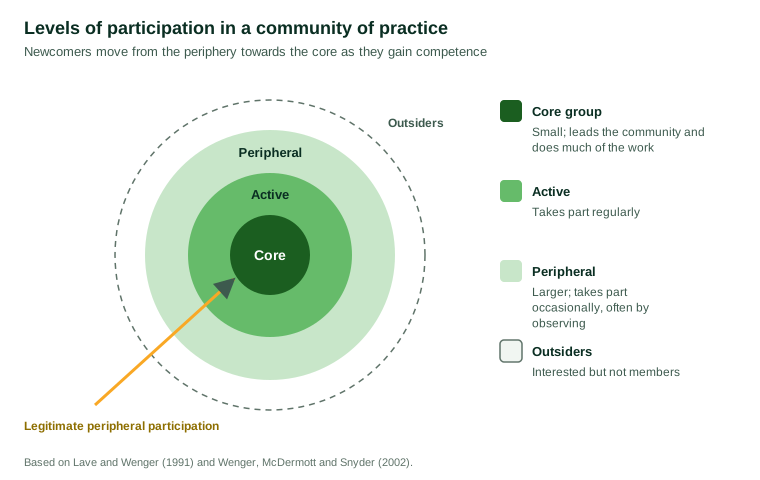
Lave and Wenger (1991) studied apprenticeship in very different settings, including midwives in Mexico, tailors in West Africa, quartermasters in the United States Navy, butchers in supermarkets and members of Alcoholics Anonymous. They found that in each case, learning did not consist mainly of receiving instruction. Newcomers learned by gradually taking part in the real work of a community, starting with simple, low-risk tasks on its edges and moving towards the centre as their competence grew. Lave and Wenger called this process legitimate peripheral participation. It is legitimate because the newcomer is accepted as a member, peripheral because they start at the edge, and participation because learning happens through doing the community's work.
On this view, learning is not just the acquisition of knowledge in individual heads. It is a change in how a person takes part in a community: what they can do, how they understand their work and who they are becoming. Knowledge is held not only by individuals but in the practices, tools, stories and relationships of the community as a whole. This view connects with Polanyi's (1966) observation that we can know more than we can tell. Much of the knowledge a community holds is tacit: it shows itself in how members perform their work, not in what they can write down. It is therefore passed on mainly through shared activity, as newcomers watch experienced members, try tasks themselves and receive correction, rather than through documents.
Participation also shapes identity. Lave and Wenger stressed that becoming a full member of a community means coming to see oneself, and being seen by others, as a midwife, a tailor or a butcher. Learning a practice and taking on an identity are part of the same process. This helps explain why newcomers who are kept away from real work, or who are not accepted as legitimate members, often learn slowly however much formal instruction they receive.
What makes a community of practice
Wenger (1998) developed the concept in a detailed study of claims processors in an American insurance company. He found that the processors had developed, among themselves, a shared way of doing their work that went far beyond the official procedures: shortcuts, interpretations of rules, ways of handling difficult customers and a common understanding of what counted as doing the job well. Wenger identified three features that define a community of practice:
- Mutual engagement: members interact regularly and help one another.
- A joint enterprise: members share a common understanding of what their work is about, negotiated among themselves rather than simply imposed from above.
- A shared repertoire: over time, members develop common resources, such as routines, words, tools, stories and ways of doing things.
Communities of practice differ from formal teams and departments. Wenger and Snyder (2000) noted that a team is defined by a task and disbands when the task is done, while a community of practice is defined by a shared area of expertise and lasts as long as members find it valuable. Membership is self-selected, and the community is held together by passion, commitment and identification with the group's expertise, not by reporting lines.
Stories and non-canonical practice
Brown and Duguid (1991) drew on Orr's (1996) ethnography of photocopier repair technicians to show how communities of practice create and share knowledge. The technicians' official training and manuals described how machines should be repaired, but real machines often failed in ways the manuals did not cover. The technicians solved these problems by talking: over breakfast and lunch they told stories about difficult repairs, which helped them diagnose new problems and spread solutions among colleagues. Brown and Duguid distinguished canonical practice, the official account of how work is done, from non-canonical practice, the way it is actually done, and argued that organisations that ignore the second lose much of their real knowledge.
Brown and Duguid (2001) later argued that knowledge flows easily within communities and networks of people who share a practice, even across organisations, but flows with difficulty between groups with different practices, even within the same organisation. Knowledge is "sticky" across practices and "leaky" within them. This helps explain why transferring best practices between units of a company is often hard (Szulanski, 1996), while specialists in the same field at rival companies may share knowledge readily.
Crossing the boundaries between communities
Organisations contain many communities of practice, and much important knowledge must cross their boundaries. Bechky (2003) studied a manufacturing company in which engineers, technicians and assemblers worked on the same machines but understood them differently. Engineers relied on drawings, technicians on prototypes and assemblers on hands-on experience of building the machines. Misunderstandings were resolved not by better documents alone but when members of different groups worked together around physical objects, such as the machine itself, which allowed them to reach a shared understanding.
Cultivating communities in organisations
As the concept spread, managers became interested in using communities of practice deliberately. Wenger et al. (2002) offered a practical guide, describing a community of practice in terms of three elements: a domain of knowledge that defines its shared interest, a community of people who care about that domain, and the shared practice they develop. They argued that communities cannot be created by order but can be cultivated, and they proposed principles for doing so, including designing for evolution, inviting different levels of participation, developing both public and private spaces, focusing on value and creating a regular rhythm of activity.
Wenger et al. (2002) described typical levels of participation. A small core group takes leadership and does much of the work; an active group participates regularly; a larger peripheral group participates occasionally, mostly by observing; and outsiders have an interest but are not members. People move between levels over time, and the periphery is not a problem to be fixed but a normal and valuable part of the community.
Online and distributed communities
Communities of practice increasingly meet online. Wasko and Faraj (2005) studied an online network of legal professionals and asked why people contributed their knowledge to strangers. They found that contributors were motivated largely by building their professional reputation, and that people who were more central in the network contributed more. Lakhani and von Hippel (2003) studied volunteers who answered questions from users of open-source software and found that helpers often gained benefits themselves, including learning from the problems they solved. Such studies suggest that online communities can share knowledge widely, although they may transmit tacit knowledge less effectively than face-to-face interaction.
Evidence of value
Many organisations, especially in health care, have set up communities of practice to share knowledge and improve practice. Ranmuthugala et al. (2011) systematically reviewed studies of communities of practice in health care. They found that the communities varied widely in form and purpose, that they were often established to share knowledge and improve practice, but that rigorous evidence of their effects on professional practice and patient outcomes was limited. Wenger et al. (2011) proposed a framework for assessing the value that communities create, from immediate value, such as useful conversations, to changes in practice and eventually to improved performance.
Criticisms of the concept
The idea of communities of practice has been criticised on several grounds.
A shifting concept. Cox (2005) compared four foundational works and found that the meaning of the term changed significantly, from a description of how learning happens in practice to a management tool for knowledge sharing. Li et al. (2009) traced the same evolution and noted that the later, more managerial version focused on cultivating communities to improve organisational competitiveness.
Neglect of power. Contu and Willmott (2003) argued that the managerial use of the concept played down the role of power and conflict in learning, such as who controls access to the community's centre and whose knowledge is valued. Roberts (2006) similarly identified limits to the concept, including the effects of power relations, the time needed to build trust, the size and spread of communities and the speed of change in their environment.
Not all knowing happens in communities. Amin and Roberts (2008) argued that "community of practice" had been stretched to cover very different kinds of collective learning. They distinguished craft-based knowing, professional knowing, creative knowing and online knowing, each with different social dynamics, and suggested that analysts should look at the particular forms of knowing in action rather than labelling all of them communities of practice.
Management construction. Swan et al. (2002) studied an attempt by a company to promote innovation through communities of practice and found that managers used the language of communities to mobilise people and win support for their plans. The communities were partly constructed by management rather than emerging naturally, raising questions about how far communities can be designed without losing the features that make them work.
Communities of practice in research organisations
Research organisations depend heavily on the kind of knowledge that communities of practice share: judgement about questionnaire design, sampling, moderation, analysis and reporting that is learned mainly through experience. Several practices follow from the research reviewed here.
Give newcomers legitimate peripheral roles. New researchers learn best by taking real but limited responsibility, such as drafting sections of a questionnaire or analysing part of a data set, under the guidance of experienced colleagues, and moving to fuller responsibility as they gain competence.
Make time for stories. Regular informal sessions where researchers discuss difficult projects, unexpected results and mistakes spread the non-canonical knowledge that manuals miss.
Support communities that cross teams. Specialists in sampling, statistics or qualitative methods working on different client teams can form communities that share expertise across the organisation.
Use shared objects. Question libraries, analysis templates and annotated examples serve as a shared repertoire and help knowledge cross between groups.
Connect beyond the organisation. Professional associations, conferences and methodological networks are communities of practice that keep researchers in touch with developments in their field.
Watch for exclusion. Ensure that access to experienced colleagues and interesting work is open to all, and that knowledge is not hoarded by a closed core.
Conclusion
Communities of practice explain how much practical knowledge is created, shared and passed on: through participation in the shared work of a group, rather than through formal instruction alone. The concept has been influential in management, education and health care, and it has also been stretched, criticised for neglecting power and questioned for its evidence base. Its central insight remains valuable. Organisations that want to keep and develop the skills of their people need to support the communities in which those skills live, giving newcomers a path to full participation and giving members time and occasions to learn from one another.
References
Amin, A., & Roberts, J. (2008). Knowing in action: Beyond communities of practice. Research Policy, 37(2), 353–369. https://doi.org/10.1016/j.respol.2007.11.003
Bechky, B. A. (2003). Sharing meaning across occupational communities: The transformation of understanding on a production floor. Organization Science, 14(3), 312–330. https://doi.org/10.1287/orsc.14.3.312.15162
Brown, J. S., & Duguid, P. (1991). Organizational learning and communities-of-practice: Toward a unified view of working, learning, and innovation. Organization Science, 2(1), 40–57. https://doi.org/10.1287/orsc.2.1.40
Brown, J. S., & Duguid, P. (2001). Knowledge and organization: A social-practice perspective. Organization Science, 12(2), 198–213. https://doi.org/10.1287/orsc.12.2.198.10116
Contu, A., & Willmott, H. (2003). Re-embedding situatedness: The importance of power relations in learning theory. Organization Science, 14(3), 283–296. https://doi.org/10.1287/orsc.14.3.283.15167
Cox, A. (2005). What are communities of practice? A comparative review of four seminal works. Journal of Information Science, 31(6), 527–540. https://doi.org/10.1177/0165551505057016
Lakhani, K. R., & von Hippel, E. (2003). How open source software works: "Free" user-to-user assistance. Research Policy, 32(6), 923–943. https://doi.org/10.1016/S0048-7333(02)00095-1
Lave, J., & Wenger, E. (1991). Situated learning: Legitimate peripheral participation. Cambridge University Press. https://doi.org/10.1017/CBO9780511815355
Li, L. C., Grimshaw, J. M., Nielsen, C., Judd, M., Coyte, P. C., & Graham, I. D. (2009). Evolution of Wenger's concept of community of practice. Implementation Science, 4, Article 11. https://doi.org/10.1186/1748-5908-4-11
Orr, J. E. (1996). Talking about machines: An ethnography of a modern job. ILR Press.
Polanyi, M. (1966). The tacit dimension. Doubleday.
Ranmuthugala, G., Plumb, J. J., Cunningham, F. C., Georgiou, A., Westbrook, J. I., & Braithwaite, J. (2011). How and why are communities of practice established in the healthcare sector? A systematic review of the literature. BMC Health Services Research, 11, Article 273. https://doi.org/10.1186/1472-6963-11-273
Roberts, J. (2006). Limits to communities of practice. Journal of Management Studies, 43(3), 623–639. https://doi.org/10.1111/j.1467-6486.2006.00618.x
Swan, J., Scarbrough, H., & Robertson, M. (2002). The construction of "communities of practice" in the management of innovation. Management Learning, 33(4), 477–496. https://doi.org/10.1177/1350507602334005
Szulanski, G. (1996). Exploring internal stickiness: Impediments to the transfer of best practice within the firm. Strategic Management Journal, 17(S2), 27–43. https://doi.org/10.1002/smj.4250171105
Wasko, M. M., & Faraj, S. (2005). Why should I share? Examining social capital and knowledge contribution in electronic networks of practice. MIS Quarterly, 29(1), 35–57. https://doi.org/10.2307/25148667
Wenger, E. (1998). Communities of practice: Learning, meaning, and identity. Cambridge University Press. https://doi.org/10.1017/CBO9780511803932
Wenger, E., McDermott, R., & Snyder, W. M. (2002). Cultivating communities of practice: A guide to managing knowledge. Harvard Business School Press.
Wenger, E. C., & Snyder, W. M. (2000). Communities of practice: The organizational frontier. Harvard Business Review, 78(1), 139–145.
Wenger, E., Trayner, B., & de Laat, M. (2011). Promoting and assessing value creation in communities and networks: A conceptual framework (Rapport 18). Ruud de Moor Centrum, Open Universiteit.