
Share how you handle snow and seasonal jobs
Tell us who clears your snow, what equipment you use and what you pay. Your answers are combined with other people's and reported only as totals.
Start the snow removal and seasonal upkeep surveyAbout 5 minutes. No account needed. You can stop at any time.
What snow removal and seasonal upkeep cover
Snow removal means clearing snow and ice from driveways, walkways, steps, sidewalks and sometimes roofs. Seasonal upkeep covers the other jobs that come with the change of seasons:
- Fall: raking leaves, cleaning gutters, putting away hoses and patio furniture, winterizing outdoor taps, and putting on winter tires.
- Winter: snow clearing, salting or sanding icy surfaces, and watching for ice dams on the roof.
- Spring: clearing debris, checking for winter damage, opening up the garden and changing tires again.
- Summer: lawn mowing, watering, hedge trimming and garden care.
How much of this a household does depends on the home. People in detached houses usually deal with all of it. People in townhouses and condominiums often pay fees that cover some or all, and renters may share duties with the landlord according to the lease.
Who clears the snow
Households clear snow in several ways:
- By hand, with a shovel or snow pusher.
- With a snow blower (also called a snowthrower).
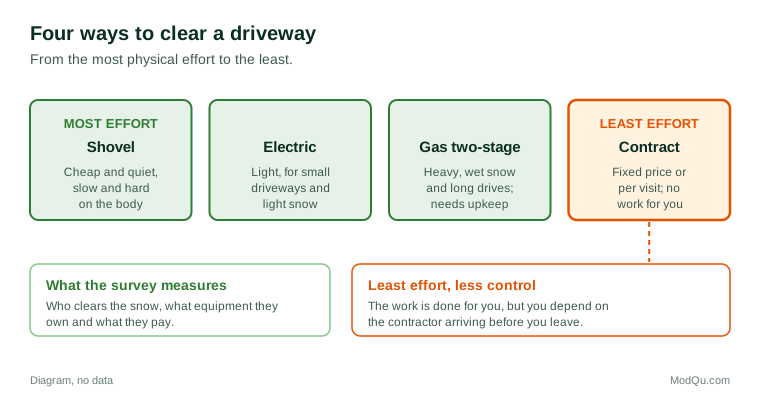
- By hiring a contractor on a seasonal contract or per visit.
- With help from a neighbour, family member or a local teenager.
- Through a municipal program, where available, for older adults or people with disabilities.
Example
A street of older bungalows has one resident with a large two-stage snow blower. After each storm, they clear their own driveway and then the sidewalks and ends of the driveways of three older neighbours. In return the neighbours drop off baking and pay for a tune-up of the snow blower each fall.
The choice depends on the size of the driveway, how much snow typically falls, the person's health and age, time, budget and storage space.
Shovels, snow blowers and other equipment
Equipment ranges widely in price and effort:
- Shovels and pushers: cheap and quiet, but slow and physically demanding.
- Electric single-stage snow blowers: light and suited to small driveways and light snow.
- Battery-powered snow blowers: increasingly common, with no cord or gas.
- Gas two-stage and three-stage snow blowers: for large driveways and heavy, wet snow, but costly and needing maintenance.
- Salt, sand and grit: to melt ice or improve grip on icy surfaces.
- Roof rakes: long-handled tools to pull snow off a roof edge from the ground.
Paying for snow removal
Snow removal contractors usually offer a few kinds of arrangement:
- Seasonal contracts: a fixed price for the whole winter, often with a minimum snowfall that triggers a visit (for example 5 cm).
- Per-visit pricing: a charge each time the contractor comes.
- Per-event or per-centimetre pricing for heavy storms.
- Add-ons: walkways, steps, salting and hauling snow away.
Example (hypothetical figures)
A homeowner compares a seasonal contract at $450 with per-visit pricing at $45 a visit. If the contractor comes 8 times, per-visit costs $360; at 12 visits it costs $540. The break-even is 10 visits. In a light winter the contract costs more; in a heavy one it saves money. They choose the contract for the certainty.
Common complaints include contractors arriving late on workday mornings, ridges of snow left at the end of the driveway by city ploughs after the contractor has gone, damage to lawns and curbs, and contractors who stop answering calls mid-season. Before signing, people are generally advised to read what triggers a visit, how quickly the contractor will come, and what happens if the contractor cannot.
Bylaws and responsibilities
Many municipalities in Canada have bylaws requiring property owners or occupants to clear the public sidewalk in front of their property within a set time after a snowfall. Others clear sidewalks themselves. Rules also often forbid pushing snow from a driveway onto the road. The municipality usually clears roads, and the ridge of snow left by the plough at the end of a driveway, often called a windrow, is generally the homeowner's job, though some cities clear windrows for some residents.
Rules vary from city to city, so people usually check their own municipality's website. Renters should check their lease, which may say whether the tenant or the landlord clears snow.
Safety
Shovelling heavy snow is hard physical work. Health bodies such as the Heart and Stroke Foundation advise people to warm up, take breaks, push rather than lift where possible, and avoid shovelling after a heavy meal. People with heart conditions are often advised to speak to their doctor first. Snow blowers cause hand injuries when people try to clear a jammed chute by hand; manufacturers say to turn the machine off and use a clearing tool. Falls on ice are a common winter injury.
Example
A man in his seventies has always cleared his own driveway. After a dizzy spell while shovelling heavy wet snow, his doctor suggests he stop. He signs up for a municipal snow-clearing program for older adults that covers his sidewalk and driveway apron, and his grandson does the rest of the driveway.
Other seasonal jobs
Many of the same choices apply to other seasonal work. Households decide whether to do it themselves, buy equipment, or pay someone. Lawn care companies, gutter cleaners, tire shops and landscapers all sell seasonal services. Some companies offer year-round packages: lawn care in summer, leaf removal in fall, and snow clearing in winter.
Trends and what people disagree about
Changes include a shift towards battery-powered equipment, more extreme and variable winters in some regions, and rising contractor prices. Debates include whether cities should clear all sidewalks rather than residents, whether gas-powered equipment should be restricted for noise and emissions, how much salt to use given its effect on soil and water, and how to make sure older adults and people with disabilities are not left snowed in.
Key terms
- Snow blowerA machine that clears snow by throwing it to the side; also called a snowthrower.
- Two-stage snow blowerA snow blower with an auger and a fan, suited to deep or heavy snow.
- WindrowThe ridge of snow left by a plough at the end of a driveway.
- Seasonal contractA fixed price for snow clearing over a whole winter.
- Snowfall triggerThe amount of snow that must fall before a contractor comes.
- Ice damA ridge of ice at the edge of a roof that stops melting snow from draining.
- Roof rakeA long-handled tool for pulling snow off a roof edge from the ground.
- De-icerA product, such as salt, that melts ice on surfaces.
Full glossary: snow removal services terms on EditingTests.com.
Snow removal and seasonal upkeep vocabulary test
How well do you know the language of this topic? Try 8 quick questions. Your score is shown straight away and is not saved.
What the snow removal and seasonal upkeep survey asks
This survey is part of ModQu's Household Life survey. The snow removal and seasonal upkeep part takes about five minutes and covers:
- Who clears snow at your home: you, family, a neighbour, a contractor or the city.
- Which equipment you own, such as a shovel or snow blower.
- Whether you pay for snow removal, the type of contract and the cost.
- How satisfied you are with the service, and common problems.
- Which other seasonal jobs you do yourself and which you pay for.
- Whether you have had an injury or health concern from clearing snow.
After that you can choose to continue with other short parts of the Household Life survey, such as cleaning and laundry or household chores and time use, or stop.
Ready to take part?
Your answers help show what people really think and do. Results are only ever reported as totals; no one can see your individual answers.
Start the surveyQuestions about this survey
Who can take part?
Homeowners in snowy regions.
Do I have to give my name?
No. You may be asked for your age group, region and similar details so results can be broken down, but not your name. ModQu never asks for passwords, card numbers or account numbers.
How are the results used?
Answers are combined into totals and percentages and published in ModQu reports. Individual answers are never shown.
Is the vocabulary test part of the survey?
No. It is optional and separate, and your score is not stored.