
Share how you use religious media
Tell us which religious books, broadcasts, podcasts or apps you use and which you trust. Your answers are combined with other people's and reported only as totals.
Start the religious media surveyAbout 5 minutes. No account needed. You can stop at any time.
What religious media covers
Religious media is any book, broadcast, recording or digital service whose main subject is faith, worship or religious teaching. It is produced by places of worship, religious orders, independent teachers, publishers, broadcasters and individual believers. The main forms are:
- Scripture and sacred texts in print, audio and digital editions, often with translations and commentaries.
- Religious books on prayer, teaching, history, biography and daily devotions.
- Radio and television, including dedicated religious channels and religious programmes on general channels.
- Live-streamed and recorded services from places of worship.
- Podcasts and audio talks on teaching, scripture study and personal faith.
- Video channels and short videos on social media.
- Apps for prayer times, reading plans, meditation, scripture recitation and religious calendars.
- Music, such as hymns, devotional songs and chants.
How people use it day to day
People fit religious media into ordinary routines. Common patterns include:
- reading a short passage of scripture each morning on a phone;
- listening to a sermon or talk on the commute;
- playing devotional music while cooking or cleaning;
- following an app that reminds them of prayer times or reading plans;
- watching a weekly service at home when unable to attend;
- joining an online study group that discusses a set passage.
Example
A bus driver listens to a recorded sermon from their home country each morning before their shift and plays recitations of scripture in the car on the way home. They say the recordings keep them connected to the teachers they grew up with, now thousands of kilometres away.
Print and broadcast
Printed scripture remains central for many believers, and some traditions require a printed text for worship or study. Religious publishers produce translations into hundreds of languages, editions for children, study editions with notes and large-print versions. Religious radio is still important in many regions, especially where internet access is limited or costly. Some countries have national religious broadcasters; in others, religious channels are privately run or community-based. Rules on religious broadcasting differ: some countries require balance between faiths, while others limit or ban religious content on public channels.
Apps, podcasts and video
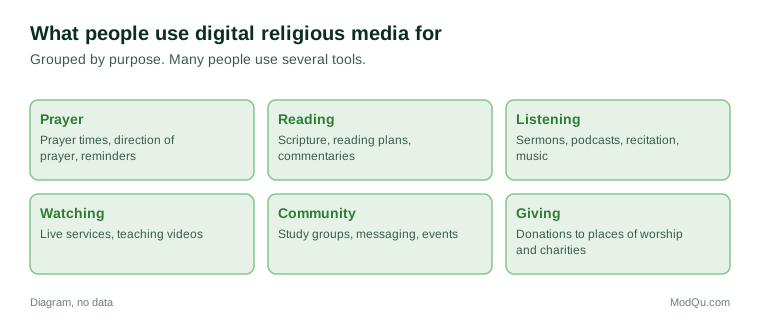
Digital religious media has grown quickly. Apps can show prayer times by location, point to the direction of prayer, offer reading plans, play recitations and track daily habits. Podcasts let people hear long teaching sessions, and short videos reach people who would not open a book or attend a service.
The figure below groups the main digital tools by what people use them for.
Example (hypothetical figures)
A user downloads three faith apps. One is free with advertisements, one is free with an optional donation, and one costs 3 a month. After six months they keep only the donation-based app, give 20 once a year and delete the other two because of advertisements and notifications.
Choosing sources people trust
Because anyone can publish religious content online, people often say it is hard to know which sources to trust. Common ways people judge sources include:
- whether a teacher is recognized by a faith community or trained in a known institution;
- whether a book or app is recommended by their own religious leaders;
- whether content agrees with what they have been taught;
- the tone of the content, such as whether it is respectful to others;
- how open the producer is about who funds it.
Some faiths have formal approval for translations or teaching materials. Others leave the choice to the individual.
Example
A student finds a popular video channel that explains scripture in a lively way. Their family's religious teacher points out that the channel's host has no recognized training and sometimes contradicts the community's teaching. The student keeps watching for interest but checks points with the teacher before sharing them with friends.
Concerns and risks
People raise several concerns about religious media:
- Misinformation: false claims about history, health or other faiths, sometimes spread in religious language.
- Hostile content: material that attacks other religions or groups, or encourages violence.
- Fraud: fake charities and appeals that ask for donations online in the name of a faith.
- Privacy: apps that collect data on religious practice, which is sensitive personal information in many countries' data laws.
- Commercial pressure: advertising, paid upgrades and sales of products in religious apps and broadcasts.
- Shallow learning: worry that short videos replace deeper study.
Religious media for children and families
Families use children's scripture books, animated videos, songs and games to teach faith at home. Parents often look for content that matches their tradition, is suitable for the child's age and does not include advertising. Religious schools and classes may recommend books and apps for home use.
What people disagree about
- Whether online teaching weakens or strengthens local faith communities.
- How platforms should handle religious content that offends other groups.
- Whether religious broadcasting belongs on public channels.
- How far data from religious apps should be protected or shared.
- Whether recorded services can replace attending in person.
Why surveys ask about religious media
Questions that publishers, broadcasters, faith organizations and app makers want answered include which media people use, how often, on which devices, what they pay, which sources they trust and what would make them stop using a source. Answers are grouped, and every question about religion can be skipped.
Religious media in many languages
Religious communities that live across several countries often rely on media in their home languages. Families who have migrated may listen to radio or podcasts from their country of origin, while their children prefer content in the language of the country where they grew up. Some producers now offer the same teaching in several languages, with subtitles or translated audio. Translations of sacred texts into new languages continue to be published, and some communities debate whether worship should use a traditional language or the everyday language of members.
Key terms
- ScriptureThe sacred texts of a religion.
- TranslationA version of a text in another language; some faiths approve official translations.
- CommentaryA book or notes explaining the meaning of a sacred text.
- DevotionalMaterial meant to support personal prayer or worship, such as daily readings.
- RecitationReading aloud or chanting a sacred text, often in a set style.
- Live streamA broadcast of an event over the internet as it happens.
- Sensitive personal dataInformation, such as religious belief, that many data laws give extra protection.
- Religious broadcasterA radio or television service whose main content is religious.
Full glossary: media publishing terms on EditingTests.com.
Religious media vocabulary test
How well do you know the language of this topic? Try 8 quick questions. Your score is shown straight away and is not saved.
What the religious media survey asks
This survey is part of ModQu's Religion and Spirituality survey. The religious media part takes about five minutes and covers:
- Which religious media you use: books, radio, television, podcasts, videos or apps.
- How often you use them, and on which devices.
- Whether you pay for or donate to religious media.
- Which sources you trust most, and why.
- Any concerns you have, such as misinformation, advertising or privacy.
- How your use of religious media has changed in recent years.
After that you can choose to continue with other short parts of the Religion and Spirituality survey, such as religion in daily life or places of worship, or stop.
Ready to take part?
Your answers help show what people really think and do. Results are only ever reported as totals; no one can see your individual answers.
Start the surveyQuestions about this survey
Who can take part?
Adults.
Do I have to give my name?
No. You may be asked for your age group, region and similar details so results can be broken down, but not your name. ModQu never asks for passwords, card numbers or account numbers.
How are the results used?
Answers are combined into totals and percentages and published in ModQu reports. Individual answers are never shown.
Is the vocabulary test part of the survey?
No. It is optional and separate, and your score is not stored.
Do I have to name the apps or channels I use?
No. You can describe the kind of media you use without naming any provider.
Can I take the survey if I do not use religious media?
Yes. Your answers help show how many people do not use it and why.