
Share how faith fits into your day
Tell us how important religion is to you, how you practise and how that has changed. Your answers are combined with other people's and reported only as totals.
Start the religion in daily life surveyAbout 5 minutes. No account needed. You can stop at any time.
What "religion in daily life" means
Religion can be described in three broad ways: what people believe, how they belong to a community, and what they do. This page is mostly about the third. Daily religious practice covers the habits, rules and rituals that a person follows on an ordinary day, not only on major holidays.
Across the world's faiths, everyday practice often includes:
- Prayer or meditation at set times or whenever a person chooses.
- Food rules, such as halal, kosher, vegetarian or fasting practices.
- Dress and appearance, such as head coverings, modest clothing, uncut hair or religious jewellery.
- Reading or reciting scripture at home, on a commute or through an app.
- Rest days, such as a weekly sabbath or day of worship.
- Giving, such as regular donations, alms or helping neighbours.
- Blessings and small rituals before meals, journeys or exams.
Some people follow many of these practices every day. Others follow none, or only one or two that matter most to them.
How important religion is to people
The importance of religion varies a great deal between countries, between generations and between individuals in the same family. In some societies most adults say religion is very important in their lives and take part in daily prayer. In others, many adults say they have no religion, although some still keep customs that began as religious ones, such as family meals on certain days.
Researchers often separate three questions that people sometimes answer differently:
- Identity: which religion, if any, a person says they belong to.
- Importance: how much religion matters in their life.
- Practice: how often they pray, attend services or follow religious rules.
A person can identify with a religion but rarely practise it, or practise privately without belonging to any group. Asking all three questions gives a clearer picture than asking about identity alone.
Example
A nurse who works rotating shifts identifies strongly with her faith but can rarely attend weekly services. She prays at home before each shift, keeps a prayer app on her phone for reminders, and follows her faith's food rules at work by bringing her own lunch. She describes religion as very important to her even though she seldom goes to a place of worship.
Faith at work and school
Daily practice often meets the rules of workplaces and schools. Common points of contact include:
- time and a quiet place to pray during the working day;
- food choices in canteens, at events and on business travel;
- dress codes and uniforms that allow or restrict religious clothing;
- time off for holy days and fasting periods;
- schedules for exams and meetings on days of rest.
Rules differ by country. Some countries protect religious practice at work in law and expect employers to make reasonable accommodation unless it causes undue hardship. Others limit visible religious symbols in some public jobs or schools. Many employers set their own policies, so experiences can differ between two jobs in the same city.
Example
A software tester asks whether a small unused meeting room can be set aside for prayer. The company agrees and also starts labelling food at staff events. A colleague from a different faith later uses the same room for quiet meditation.
Practice at home
The home is where much religious practice takes place. Families may have a prayer corner or small shrine, display religious images, say grace before meals or light candles on certain evenings. Parents often lead these practices with children, and grandparents can play a large role in passing them on.
Technology has changed some home practices. Scripture, prayer times, direction of prayer and religious calendars are now available on phones. Some households stream services or listen to religious talks while cooking or driving. For others, keeping devices away during prayer or on rest days is part of the practice itself.
How practice changes over a lifetime
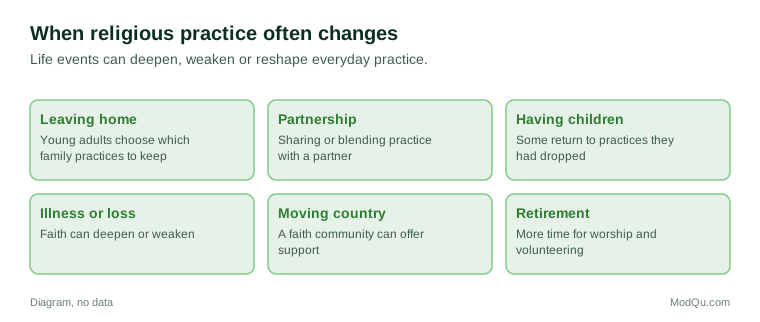
Religious practice is rarely fixed. People often describe changes at certain points in life:
- Leaving home, when young adults decide which family practices to keep.
- Marriage or partnership, especially with someone of a different faith or none.
- Having children, when some people return to practices they had dropped.
- Illness, loss or crisis, which can deepen or weaken faith.
- Moving to a new country, where a faith community may be a source of support or where practice becomes harder.
- Retirement, when people have more time for worship and volunteering.
Example
A man stopped attending services in his twenties and describes himself as not religious. After his father dies, he begins saying a daily prayer for him, as his father did for his own parents. He still rarely attends services, but he says religion now plays a small, steady part in his day.
Belonging without believing, and believing without belonging
Two patterns come up often in research on religion. Some people take part in religious life, such as festivals, weddings and community meals, without holding strong beliefs. They value the culture, the music or the sense of belonging. Others hold firm beliefs and pray regularly but do not belong to any congregation or formal group.
These patterns matter for anyone trying to measure religion. A survey that asks only about attendance can miss private believers, while one that asks only about belief can miss people for whom religion is mainly about family and community.
What people disagree about
Religion in daily life can be a source of discussion and disagreement:
- how much religious practice should be visible in public places;
- whether employers and schools should change rules to allow for prayer, dress or holy days;
- how far parents should pass on practice to children;
- whether religious practice is declining, holding steady or changing form;
- how religious and non-religious people can share public life with respect.
People answer these questions very differently depending on their own beliefs and on the country they live in.
Why surveys ask about daily practice
Questions about religion are personal, and good surveys ask them with care. Respondents can choose not to answer, and answers are reported only as grouped results. Questions that organizations want answered include how important faith is to different age groups, how often people pray or attend services, whether practice has changed in the last decade, and what support people want from employers, schools and faith communities.
Key terms
- PracticeWhat a person does as part of their religion, such as prayer, fasting or attendance.
- ObservantFollowing the rules and practices of one's religion closely.
- RitualA set action or ceremony repeated in a fixed way.
- Dietary lawA religious rule about which foods may be eaten and how they are prepared.
- SabbathA weekly day of rest and worship in some religions.
- Reasonable accommodationA change to rules or routines that lets a person practise their faith without undue hardship to others.
- SecularNot connected with religion.
- DevotionPersonal acts of prayer, worship or commitment.
Full glossary: faith based organizations terms on EditingTests.com.
Religion in daily life vocabulary test
How well do you know the language of this topic? Try 8 quick questions. Your score is shown straight away and is not saved.
What the religion in daily life survey asks
This survey is part of ModQu's Religion and Spirituality survey. The religion in daily life part takes about five minutes and covers:
- Which religion, if any, you identify with.
- How important religion is in your life.
- How often you pray, meditate or attend services.
- Which everyday practices you follow, such as food rules, dress or rest days.
- Whether your practice has changed in the last ten years, and why.
- How well your work or school allows for your religious practice.
After that you can choose to continue with other short parts of the Religion and Spirituality survey, such as places of worship or religious holidays and festivals, or stop.
Ready to take part?
Your answers help show what people really think and do. Results are only ever reported as totals; no one can see your individual answers.
Start the surveyQuestions about this survey
Who can take part?
Adults.
Do I have to give my name?
No. You may be asked for your age group, region and similar details so results can be broken down, but not your name. ModQu never asks for passwords, card numbers or account numbers.
How are the results used?
Answers are combined into totals and percentages and published in ModQu reports. Individual answers are never shown.
Is the vocabulary test part of the survey?
No. It is optional and separate, and your score is not stored.
Do I have to belong to a religion to take this survey?
No. The survey is for everyone, including people with no religion, and asks about any spiritual or religious practice you have.
Can I skip questions about my beliefs?
Yes. Every question about religion can be skipped.