
Share your experience of places of worship
Tell us how often you attend, what makes you go and whether you join services online. Your answers are combined with other people's and reported only as totals.
Start the places of worship surveyAbout 5 minutes. No account needed. You can stop at any time.
What a place of worship is
A place of worship is a building or space where people gather for prayer, religious services and ceremonies. The name and form depend on the faith: a church, chapel or cathedral; a mosque or prayer hall; a synagogue; a Hindu or Buddhist temple; a gurdwara; a meeting house; or a shrine. Some groups meet in rented halls, homes or outdoor spaces rather than in a dedicated building.
Most places of worship do far more than hold services. Common activities include:
- regular services, prayers and sermons;
- weddings, naming ceremonies, coming-of-age rites and funerals;
- religious classes for children and adults;
- food banks, shared meals and help for people in need;
- youth groups, choirs, study circles and seniors' clubs;
- counselling and pastoral visits to the sick and elderly;
- community events open to people of all faiths.
How often people attend
Attendance differs widely between faiths, countries and age groups. Some traditions expect weekly or daily attendance; others centre practice on the home, with visits to a temple or shrine on special occasions. Survey researchers usually ask about frequency on a scale, for example:
- More than once a week
- Once a week
- Once or twice a month
- A few times a year
- Only for weddings, funerals and festivals
- Never
Attendance questions are known to be sensitive to how they are asked. People who see attendance as a duty may report the attendance they intend rather than what they actually did. Asking about a specific recent week, or asking what a person did on their last day of rest, can give more accurate answers.
Example
A shop owner says they attend their mosque "every Friday". When asked about the past month, they recall going twice, because the shop was short of staff on the other two Fridays. Both answers are honest: one describes their usual intention and the other their recent behaviour.
What draws people in
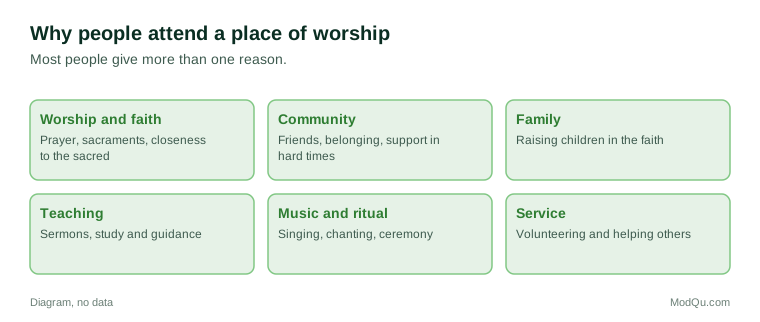
People give many reasons for attending. The most common fall into a few groups, shown in the figure below.
- Worship and faith: prayer, sacraments and a sense of closeness to God or the sacred.
- Community: friends, a sense of belonging and support in hard times.
- Family: bringing children up in the faith, or attending with parents.
- Teaching: sermons, study and guidance on how to live.
- Music and ritual: singing, chanting and the beauty of the service.
- Service to others: volunteering through the congregation.
New arrivals in a country often find a place of worship among the first places that offer practical help, such as advice on housing, jobs and schools, in a familiar language.
What keeps people away
Reasons for not attending, or for attending less, include:
- work shifts and busy family schedules;
- distance, transport costs or a lack of parking;
- poor health, disability or buildings that are hard to access;
- disagreement with leaders or teachings;
- feeling unwelcome, judged or out of place;
- losing faith or never having had strong faith;
- moving to a new area and not finding a community that fits.
Example
A couple in their thirties stopped attending after their first child was born, because the service was at the same time as the baby's nap. They began going again two years later when the congregation started a shorter family service on Saturday afternoons.
Online and hybrid services
Many places of worship began streaming services or holding prayers by video call, and many continued afterwards. Hybrid worship, with people in the building and others joining online, is now common in some faiths. Online options include live-streamed services, recorded sermons, prayer meetings on video calls and messaging groups for announcements.
People see benefits and drawbacks:
- Benefits: people who are ill, elderly, travelling or living far away can take part; services can be watched later; people can visit a new congregation without walking in.
- Drawbacks: less personal contact; some rituals, such as communal meals or sacraments, cannot be shared online in the same way; some worry that online attendance will replace in-person attendance.
Example
An elderly widow who can no longer walk to her temple watches the morning prayers on a tablet her grandson set up. Volunteers bring food offerings to her home on festival days. She says she feels connected, but misses talking with friends after the service.
Running a place of worship
Places of worship rely on donations, membership dues, fees for ceremonies, hall rentals and volunteer time. Leaders often face the same issues as other community organizations: maintaining old buildings, heating and insurance costs, recruiting volunteers and reaching younger members. In many countries religious bodies have a special legal or tax status, but the rules differ widely. Some states fund religious buildings or clergy; others keep a strict separation between religion and state funding.
Trends and debates
Discussions about places of worship often turn to:
- whether attendance is falling, stable or rising, which varies by country and faith;
- the closure, merger or sale of buildings in some areas and new buildings in others;
- the growth of large congregations alongside small house groups;
- how welcoming places of worship are to newcomers, women in leadership and young people;
- the role of places of worship in disasters and emergencies, when many serve as shelters and food centres.
Why surveys ask about places of worship
Questions that faith organizations, charities and public bodies want answered include how often people attend, what they value most, what would bring them back, and how many join online. Answers are grouped, and every question about religion can be skipped.
Key terms
- CongregationThe people who regularly worship together at one place.
- ClergyPeople ordained or appointed to lead worship, such as priests, imams, rabbis or ministers.
- ServiceA formal gathering for prayer and worship.
- Hybrid worshipA service attended both in person and online at the same time.
- Pastoral careSupport from religious leaders or volunteers for people who are ill, grieving or in need.
- Lay memberA member of a congregation who is not clergy.
- TitheA regular gift to a religious body, traditionally a tenth of income.
- Rite of passageA ceremony marking a stage of life, such as birth, adulthood or marriage.
Full glossary: faith based organizations terms on EditingTests.com.
Places of worship vocabulary test
How well do you know the language of this topic? Try 8 quick questions. Your score is shown straight away and is not saved.
What the places of worship survey asks
This survey is part of ModQu's Religion and Spirituality survey. The places of worship part takes about five minutes and covers:
- How often you attend a place of worship, and how that has changed.
- What makes you go: faith, community, family, teaching or something else.
- What stops you attending more often.
- Whether you have joined a service online, and how it compared.
- Which activities beyond services you take part in.
- What would make a place of worship more welcoming to you.
After that you can choose to continue with other short parts of the Religion and Spirituality survey, such as religion in daily life or religious holidays and festivals, or stop.
Ready to take part?
Your answers help show what people really think and do. Results are only ever reported as totals; no one can see your individual answers.
Start the surveyQuestions about this survey
Who can take part?
Adults.
Do I have to give my name?
No. You may be asked for your age group, region and similar details so results can be broken down, but not your name. ModQu never asks for passwords, card numbers or account numbers.
How are the results used?
Answers are combined into totals and percentages and published in ModQu reports. Individual answers are never shown.
Is the vocabulary test part of the survey?
No. It is optional and separate, and your score is not stored.
Can I take the survey if I only attend for weddings and funerals?
Yes. The survey is for people who attend often, rarely or never.
Will my place of worship see my answers?
No. Answers are reported only as grouped results, and no one can see what you said.