
Share your religious journeys
Tell us whether you have made a pilgrimage, where you went and how you arranged it. Your answers are combined with other people's and reported only as totals.
Start the pilgrimage and religious travel surveyAbout 5 minutes. No account needed. You can stop at any time.
What pilgrimage means
A pilgrimage is a journey to a place of religious importance. It can be a duty, a promise, an act of thanks, a search for healing or forgiveness, or a way to deepen faith. Many religions have pilgrimage traditions:
- the Hajj and Umrah to Mecca in Islam;
- journeys to Jerusalem, Rome, Lourdes or along the Camino de Santiago in Christianity;
- visits to the Western Wall and other sites in Jewish tradition;
- journeys to the Ganges, Varanasi and great temple festivals in Hinduism;
- visits to Bodh Gaya, Lumbini and other sites linked to the Buddha;
- visits to the Golden Temple in Amritsar in Sikhism;
- local pilgrimages to shrines, tombs of saints and sacred mountains in many faiths.
Religious travel is a broader term. It includes pilgrimage but also trips to religious conferences, mission or volunteer trips, visits to the graves of religious figures, and tourist visits to religious sites by people of any faith or none.
Why people go
People give many reasons for making a religious journey:
- fulfilling a religious duty or a promise made in prayer;
- seeking healing for themselves or a relative;
- asking forgiveness or marking a fresh start;
- giving thanks after a birth, recovery or success;
- honouring parents or ancestors who made the same journey;
- spending time apart from daily life to reflect;
- interest in history, culture and walking routes.
Example
A retired factory worker walks a long pilgrimage route over five weeks to mark the end of his working life. He is not sure about his beliefs but says the walk gave him time to think about his late wife, and he met pilgrims from more than a dozen countries.
How journeys are arranged
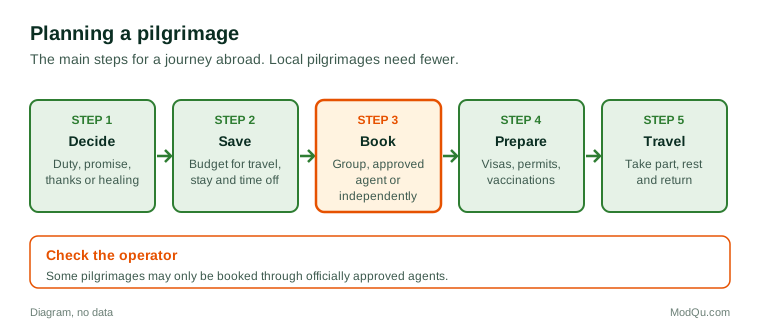
Arrangements depend on the destination and the scale of the pilgrimage.
- Organized group tours through a faith community or specialist travel agent, often including flights, hotels, transport and a religious guide.
- Official quota systems for some major pilgrimages, where the host country allots places by country and pilgrims must apply through approved agents.
- Independent travel, with pilgrims booking their own flights and rooms.
- Walking pilgrimages, staying in hostels along a route and carrying a pilgrim passport stamped at each stop.
- Local day trips by bus or car to a regional shrine.
Costs and saving
The cost of a pilgrimage varies widely, from a free walk to a local shrine to a major journey abroad that can take years of saving. Costs include travel, accommodation, permits or visas, guides, food, offerings and time off work. Some families pool money so that one member, often a parent or grandparent, can go. Some faith communities run savings schemes for this purpose.
Example (hypothetical figures)
A couple plan a group pilgrimage costing 4,800 for both of them. They save 200 a month. After 18 months they have 3,600, and a relative gives them the remaining 1,200 as a gift so they can travel the following season.
Health, safety and fraud
Large pilgrimages bring very large crowds, sometimes in hot weather, and authorities and organizers work on crowd control, water, shade and medical care. Some destinations require specific vaccinations or health certificates. Pilgrims are often advised to check official travel and health guidance for their destination.
Fraud is a known risk. Fake travel agents may sell packages that do not exist, or promise places in quota systems that they cannot provide. Pilgrims are often advised to book only through licensed or officially approved agents and to keep written receipts.
Example
A family pays a deposit to an agent who advertises cheap pilgrimage packages on social media. When the agent stops answering calls, they discover the business was not on the official list of approved operators. They report it to the police and their faith community warns others.
Religious sites and local communities
Pilgrimage brings income to towns and cities near holy sites: hotels, restaurants, guides, transport and shops selling religious items. It can also bring crowding, high prices for local residents, litter and wear on old buildings. Many sites manage visitor numbers with timed entry, dress codes and rules on photography. Visitors who are not pilgrims are often asked to respect worshippers and local customs.
What people disagree about
- How much pilgrimage should be commercialized.
- How to share limited places fairly in quota systems.
- Whether tourists should be allowed at sacred sites during worship.
- The environmental cost of long-distance travel.
- How to keep very large gatherings safe.
Why surveys ask about religious travel
Questions that faith organizations, travel firms and public bodies want answered include who makes religious journeys, where they go, how they book, how much they spend and what problems they meet. Questions about religion can be skipped, and answers are reported in groups.
Religious travel for people of any faith
Many visitors to cathedrals, temples, mosques and other sacred sites are not pilgrims. They come for the architecture, history, art or music, or because a site is on a tourist route. Most sites welcome respectful visitors but ask them to follow rules such as covering shoulders and legs, removing shoes, keeping quiet during prayers and not photographing worshippers. Some sites close to visitors at certain times or on holy days. Guides and visitor centres often explain the meaning of rituals that visitors may see.
For some travellers, a visit begins as tourism and becomes something more personal, such as lighting a candle for a relative or sitting quietly for a time.
Key terms
- PilgrimageA journey to a place of religious importance.
- PilgrimA person who makes a pilgrimage.
- ShrineA place linked to a holy person or event, where people pray or leave offerings.
- QuotaA limit on how many pilgrims from each country may attend in a given year.
- Pilgrim passportA document stamped at stops along a walking route to record the journey.
- RelicAn object, often a bodily remain or belonging, linked to a holy person.
- OfferingA gift given at a holy place, such as money, flowers, food or candles.
- Licensed operatorA travel agent approved by the relevant authority to sell certain trips.
Full glossary: tour operations terms on EditingTests.com.
Pilgrimage and religious travel vocabulary test
How well do you know the language of this topic? Try 8 quick questions. Your score is shown straight away and is not saved.
What the pilgrimage and religious travel survey asks
This survey is part of ModQu's Religion and Spirituality survey. The pilgrimage and religious travel part takes about five minutes and covers:
- Whether you have made a religious journey or pilgrimage.
- Where you went, and why.
- How you arranged it: group, agent, quota system or on your own.
- What it cost and how you paid for it.
- Any problems you had, such as crowds, health or fraud.
- Whether you plan another religious journey.
After that you can choose to continue with other short parts of the Religion and Spirituality survey, such as religion in daily life or places of worship, or stop.
Ready to take part?
Your answers help show what people really think and do. Results are only ever reported as totals; no one can see your individual answers.
Start the surveyQuestions about this survey
Who can take part?
Adults.
Do I have to give my name?
No. You may be asked for your age group, region and similar details so results can be broken down, but not your name. ModQu never asks for passwords, card numbers or account numbers.
How are the results used?
Answers are combined into totals and percentages and published in ModQu reports. Individual answers are never shown.
Is the vocabulary test part of the survey?
No. It is optional and separate, and your score is not stored.
Can I take the survey if I have never made a pilgrimage?
Yes. The survey also asks about visits to religious sites and about journeys people hope to make.
Does a local shrine visit count as religious travel?
Yes. Day trips to regional shrines, temples or graves of holy people are included.
Will the survey ask for my travel documents?
No. It never asks for passport, visa or booking numbers.