
Share your experience of pet services
Tell us which pet services you use, how you found them and what you spend. Your answers are combined with other people's and reported only as totals.
Start the pet services surveyAbout 5 minutes. No account needed. You can stop at any time.
What pet services cover
Pet services are paid help with the care of an animal, apart from vet care and the sale of food and supplies. As more owners treat pets as family members and spend long hours at work or away, these services have grown from a few kennels and groomers into a wide range of businesses and individual providers.
The main services are:
- Grooming: bathing, brushing, haircuts, nail trims and ear cleaning.
- Boarding: overnight care at a kennel, cattery or boarding facility.
- Daycare: daytime care, usually for dogs, with play in groups.
- Dog walking: solo or group walks while the owner is out.
- Pet sitting: care in the owner's home, from drop-in visits to overnight stays.
- Training: puppy classes, obedience, behaviour help and sports such as agility.
- Pet transport, for trips to the vet or between cities.
- Other services, such as waste removal from yards, pet photography and aftercare (cremation or burial).
Grooming
Some pets need little grooming beyond brushing at home; others need regular professional care. Breeds with coats that keep growing, such as poodles and many poodle mixes, often need a haircut every few weeks. Long-haired cats may need help with mats. Nail trims are a common reason for visits because many owners find them hard to do at home.
Grooming is offered in salons, in pet stores, in mobile vans that park outside the home, and by groomers working from their own homes. In many places, grooming is not a licensed trade, so training and standards vary. Owners often judge a groomer by how their pet looks and behaves after a visit, and by whether the groomer handles anxious or older animals gently.
Example (hypothetical figures)
An owner of a poodle mix pays $95 for a full groom every six weeks, about eight or nine times a year. At eight visits that is $760 a year, before tips. They try a mobile groomer that charges $115 but saves them a 40-minute round trip, and decide the extra $20 a visit is worth it.
Boarding, daycare and pet sitting
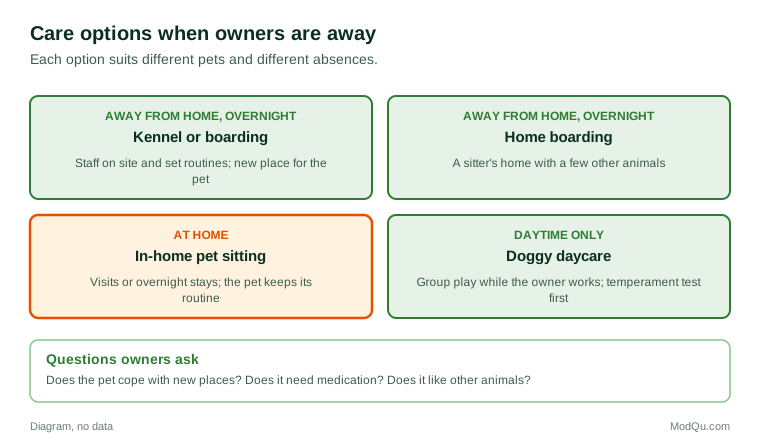
When owners travel or work long days, they choose among several kinds of care:
- Kennels and boarding facilities offer a run or suite, feeding and exercise, and often staff on site overnight.
- Home boarding places the pet in a sitter's home with a small number of other animals.
- In-home sitting keeps the pet in its own home, with a sitter visiting or staying overnight.
- Daycare gives dogs supervised play during the day and is used by people who work outside the home.
Each option has trade-offs. A pet that is stressed by new places may do better at home; a social dog may enjoy daycare; an older pet on medication may need a sitter who can give it reliably. Many facilities ask for proof of vaccination, and daycares often assess a dog's temperament before accepting it.
Example
Before a two-week trip, a couple with an elderly cat and a young dog compares options. Boarding both would mean two different facilities. They hire one sitter to stay overnight in their home, which keeps the cat in a familiar place and costs less than two boarding bills combined.
Dog walking
Dog walkers usually offer 30- or 60-minute walks, either one dog at a time or in small groups. Some take dogs to off-leash parks; some cities limit how many dogs one walker can handle at once or require a commercial dog walker licence. Owners who use walkers often look for reliability, clear updates by text or app, insurance, and an understanding of their dog's behaviour around other dogs.
Some walkers also offer extras such as feeding, giving medication, bringing in mail or a midday visit for a cat. Many owners use a walker only on days they work outside the home, which makes scheduling a frequent source of friction on both sides.
Example
A nurse who works 12-hour shifts books a walker on working days only. The schedule changes every month, so the walker asks for shifts two weeks ahead. When the walker is sick, a backup walker from the same small business comes instead, which the owner says was the main reason they chose a business over an individual.
Training
Training ranges from group puppy classes to private sessions for problems such as pulling on the leash, barking, reactivity or separation anxiety. Methods have been widely debated. Many trainers and veterinary behaviour groups favour reward-based training, while others use a mix of methods. Training is mostly unregulated, so owners rely on certifications from training organizations, reviews and recommendations from vets. Serious behaviour problems may need a veterinary behaviourist, who can assess medical causes.
Example
A family's adopted dog barks and lunges at other dogs on walks. A group class makes things worse because the dog is too stressed to learn. They switch to private sessions with a trainer who uses rewards and distance from other dogs, and the dog slowly becomes calmer on walks.
How owners find and choose providers
Owners find pet services through recommendations from friends, neighbours and vets, online reviews, local social media groups, booking apps, and signs at parks and pet stores. Common things owners check before hiring include:
- references and reviews;
- insurance and, where needed, a business licence;
- a meet-and-greet visit before the first booking;
- what happens in an emergency, and which vet will be used;
- how the provider communicates during a booking;
- cancellation terms, holiday rates and payment methods.
Trust is central, because the provider is alone with the animal and often has a key to the home.
Costs, concerns and trends
Prices depend on the city, the size and needs of the animal, the length of service, and holidays, when demand peaks. Common concerns include injuries at daycare or boarding, lost pets, sitters who do not show up, groomers who cut a pet's skin or a whisker short, and unclear terms when something goes wrong.
Trends include booking apps that connect owners with local walkers and sitters, cameras that let owners watch their dog at daycare, services for senior pets, and more owners using daycare after changes in work patterns. Questions businesses want answered include which services owners use, how often, how they found them, what they pay and what would make them switch.
Key terms
- GroomerA person who bathes, brushes, trims and cuts a pet's coat and nails.
- BoardingOvernight care for a pet away from home.
- Doggy daycareSupervised daytime care and group play for dogs.
- Pet sitterA person who cares for a pet, usually in the owner's home.
- Meet-and-greetA first meeting between a provider, the owner and the pet before booking.
- Separation anxietyDistress some pets show when left alone.
- Reward-based trainingTeaching behaviour by rewarding what the animal does right.
- Temperament assessmentA test of how a dog behaves with people and other dogs before admission.
Full glossary: animal health terms on EditingTests.com.
Pet services vocabulary test
How well do you know the language of this topic? Try 8 quick questions. Your score is shown straight away and is not saved.
What the pet services survey asks
This survey is part of ModQu's Pets and Animals survey. The pet services part takes about five minutes and covers:
- Which pet services you use: grooming, walking, daycare, boarding, sitting or training.
- How often you use each one.
- How you found your providers, and what you checked before hiring them.
- How much you spend on pet services in a typical month.
- Whether you have had a problem with a provider, and how it was handled.
- Which services you would use more if they were cheaper or closer.
After that you can choose to continue with other short parts of the Pets and Animals survey, such as pet ownership or veterinary care, or stop.
Ready to take part?
Your answers help show what people really think and do. Results are only ever reported as totals; no one can see your individual answers.
Start the surveyQuestions about this survey
Who can take part?
Pet owners.
Do I have to give my name?
No. You may be asked for your age group, region and similar details so results can be broken down, but not your name. ModQu never asks for passwords, card numbers or account numbers.
How are the results used?
Answers are combined into totals and percentages and published in ModQu reports. Individual answers are never shown.
Is the vocabulary test part of the survey?
No. It is optional and separate, and your score is not stored.