
Share your experience of owning a pet
Tell us which pets you have, what you spend on them and where you buy their supplies. Your answers are combined with other people's and reported only as totals.
Start the pet ownership surveyAbout 5 minutes. No account needed. You can stop at any time.
What pet ownership covers
Pet ownership means taking responsibility for an animal that lives with a household for company rather than for work or food. It covers the animal itself and everything around it: food, a place to sleep, health care, training, toys, cleaning, licences and the time spent on daily care.
Dogs and cats are the most common pets in Canada and the United States. Many homes also keep:
- Small mammals such as rabbits, guinea pigs, hamsters, gerbils, rats and ferrets.
- Birds, from budgies and canaries to larger parrots that can live for decades.
- Fish, in freshwater or saltwater aquariums, and pond fish such as koi.
- Reptiles and amphibians, including turtles, lizards, snakes and frogs.
- Horses, usually kept at a stable or farm rather than at home.
Some households have one animal; others have several of different kinds. Many owners describe their pets as members of the family, and that view shapes how much they are willing to spend and what they expect from vets, pet stores and landlords.
Why people get pets and who owns them
People give many reasons for owning a pet: company, a reason to exercise, teaching children responsibility, a sense of routine, and enjoyment of the animal itself. Some get a pet after a life change such as moving into a house with a yard, retiring, or children leaving home. Others take one on because a friend or relative could no longer keep it.
Pet ownership looks different at different stages of life:
- Young adults in rentals often choose cats or small animals because many buildings limit dogs.
- Families with children are more likely to have a dog, and often add small pets or fish.
- Older adults may value a quiet companion and think carefully about who would care for the animal if they could not.
- Rural households may keep several dogs, barn cats or horses alongside other animals.
Example
A couple in their twenties renting an apartment would like a dog, but their lease allows only cats and caged animals. They adopt two adult cats from a shelter. Three years later they buy a townhouse and start looking at dogs, but now they ask how a dog would get on with the cats.
The daily work of caring for a pet
Owning a pet is a commitment of time as well as money. A dog usually needs walks and play every day, training, and someone to look after it when the owner is away. Cats need less supervision but still need feeding, litter cleaning, play and a safe indoor space. Fish need water testing and tank cleaning; reptiles need the right heat, light and humidity; birds need daily attention and space to fly.
The daily routine is where many owners feel the gap between what they expected and what they got. Some find a pet easier than they thought; others find walking a dog twice a day in winter, or cleaning a cage every week, harder to keep up.
Example
A family buys a rabbit for their nine-year-old, expecting it to live in a hutch and need little care. They learn that rabbits need daily exercise outside the cage, hay at all times and a vet who treats rabbits. The rabbit moves indoors, and a parent ends up doing most of the care.
What owning a pet costs
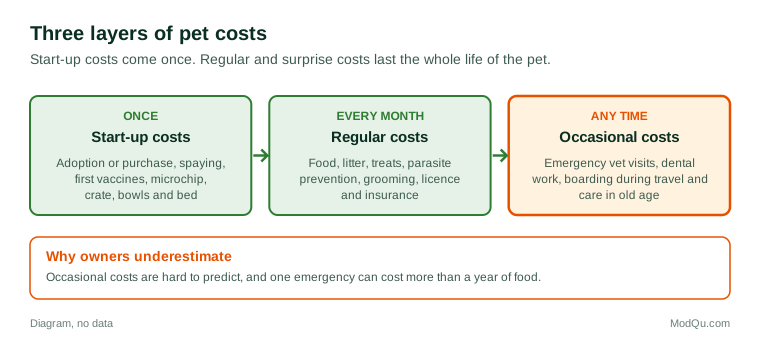
The cost of a pet comes in three layers:
- Start-up costs: adoption or purchase, spaying or neutering, first vaccinations, a microchip, a crate or cage, a bed, bowls, a leash or litter box, and an aquarium or terrarium for fish and reptiles.
- Regular costs: food, litter, treats, toys, grooming, flea and tick prevention, licences, routine vet visits and, for some, pet insurance.
- Occasional costs: emergency vet care, dental work, boarding or pet sitting during travel, replacing damaged furniture, and care in old age.
Owners are often unsure of their yearly total because spending is spread across many small purchases in different places. A survey can ask both what people think they spend and what they actually paid in a recent month.
Example (hypothetical figures)
A dog owner spends $90 a month on food, $25 on treats and toys and $30 on flea, tick and heartworm prevention, for $145 a month or $1,740 a year. A yearly check-up and vaccines add $250, and a licence adds $40, for a planned total of $2,030. In the same year the dog swallows a sock, and the emergency visit costs $1,800, nearly doubling the year's spending.
Where owners buy pet supplies
Pet food and supplies are sold through many channels, and most owners use more than one:
- Large pet specialty stores with a wide range of food, toys and accessories, and sometimes grooming or a vet clinic inside.
- Independent pet shops, often with staff who know particular animals well.
- Grocery stores and big-box retailers, which carry everyday food and litter.
- Online stores, including subscription deliveries that send food on a schedule.
- Veterinary clinics, which sell prescription diets and some medications.
- Farm and feed stores, common for horses, poultry and rural pet owners.
Price, convenience, the specific brand a pet will eat and advice from a vet all affect where people shop. Subscription delivery has grown because heavy bags of food and litter are awkward to carry, but some owners prefer to buy in person so they can ask questions.
Housing, rules and responsibilities
Pet ownership is shaped by rules as well as by personal choice. Many municipalities require dog licences and some require cat licences, set leash and stoop-and-scoop bylaws, and limit the number of animals per home. Some cities restrict certain breeds. Condominium and rental rules may limit the size, number or type of pets, and rules on whether landlords can refuse pets differ between provinces and states.
Travel raises its own questions. Owners need to arrange boarding, a sitter or a friend, or take the pet with them, which brings rules from airlines, hotels and, when crossing a border, government agencies such as the Canadian Food Inspection Agency.
Example
A retired owner with a small dog wants to spend two winter months in the United States. Before the trip they check vaccine and border paperwork, look for rentals that allow pets, and compare the cost of driving with the dog against boarding it at home for eight weeks.
Trends and open questions
Several changes are under way in pet ownership:
- More spending per pet, as owners buy premium food, insurance and services once kept for people, such as dental care and physiotherapy.
- Adoption over purchase, with shelters, rescues and foster networks playing a larger role.
- Pets in more places, including workplaces, patios and stores that welcome dogs.
- Concern about cost, especially for vet care, which can lead owners to delay treatment or give up a pet.
People disagree about several questions: whether pets should be bought from breeders at all, whether cats should be kept indoors, how much it is reasonable to spend on treatment for an old animal, and whether landlords should be allowed to refuse pets. Questions businesses want answered include which pets people plan to get next, how spending is changing, and where owners would switch their shopping.
Key terms
- Spaying and neuteringSurgery that stops an animal from breeding.
- MicrochipA small implant under the skin with a number that links a lost pet to its owner.
- Pet licenceA municipal registration, usually yearly, for a dog or cat.
- RescueA group, often run by volunteers, that takes in animals and finds them new homes.
- Foster homeA home that cares for a rescue animal until it is adopted.
- Exotic petA less common pet such as a reptile, parrot or unusual mammal.
- Companion animalAn animal kept mainly for company.
- Pet-friendlyA rental, hotel or business that allows animals.
Full glossary: pet food manufacturing terms on EditingTests.com.
Pet ownership vocabulary test
How well do you know the language of this topic? Try 8 quick questions. Your score is shown straight away and is not saved.
What the pet ownership survey asks
This survey is part of ModQu's Pets and Animals survey. The pet ownership part takes about five minutes and covers:
- Which pets you have now, how many, and how long you have had them.
- How you got each pet: adoption, breeder, store, friend or other.
- How much you spend on your pet in a typical month, and on what.
- Where you buy pet food and supplies, and why you shop there.
- What you find hardest about owning a pet.
- Whether you plan to get another pet, and what kind.
After that you can choose to continue with other short parts of the Pets and Animals survey, such as veterinary care or choosing a pet, or stop.
Ready to take part?
Your answers help show what people really think and do. Results are only ever reported as totals; no one can see your individual answers.
Start the surveyQuestions about this survey
Who can take part?
Pet owners.
Do I have to give my name?
No. You may be asked for your age group, region and similar details so results can be broken down, but not your name. ModQu never asks for passwords, card numbers or account numbers.
How are the results used?
Answers are combined into totals and percentages and published in ModQu reports. Individual answers are never shown.
Is the vocabulary test part of the survey?
No. It is optional and separate, and your score is not stored.