
Share your experience of your neighbourhood
Tell us how well you know your neighbours, how much you feel you belong and what you take part in. Your answers are combined with other people's and reported only as totals.
Start the neighbourhoods and community life surveyAbout 5 minutes. No account needed. You can stop at any time.
What community life covers
A neighbourhood is the area close to where a person lives: a few streets, a building, a village or a rural road. Community life is the web of contact, trust and shared activity among the people who live there. It includes:
- Knowing neighbours: by sight, by name, or as friends.
- Everyday contact: chatting on the sidewalk, in the elevator, at the bus stop or in local shops.
- Helping each other: lending tools, taking in parcels, watching a house during a holiday, shovelling snow.
- Local places: parks, libraries, community centres, places of worship, cafés and schools.
- Local events: street parties, farmers' markets, festivals, clean-ups and sports leagues.
- Local involvement: volunteering, residents' associations, school councils and municipal consultations.
Researchers often use the term social capital for the networks, trust and shared norms that let people work together. Strong community ties are linked in research with better wellbeing, a greater sense of safety and faster recovery after emergencies such as floods or storms.
Sense of belonging
Sense of belonging is how strongly a person feels connected to their local community. Statistics Canada asks about it in national surveys, using a question that asks people to rate their sense of belonging to their local community from very strong to very weak. The same question is used in other surveys, which lets results be compared across places and over time.
What people mean by "local community" varies. For one person it is their apartment building; for another, the whole town. Survey questions therefore often ask about specific behaviours, such as how many neighbours a person knows by name, alongside the overall feeling.
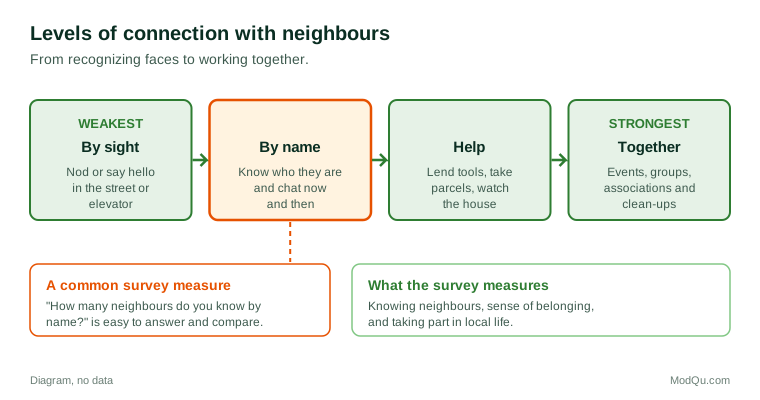
What affects how well people know their neighbours
Many things shape how connected people feel:
- How long they have lived there: belonging usually grows with time.
- Type of housing: detached houses, row houses, high-rise apartments and rural properties create different kinds of contact.
- Children and pets: parents meet at school gates and parks; dog owners meet on walks.
- Work patterns: long commutes leave less time at home; working from home can mean more.
- Shared spaces: front porches, shared courtyards, community gardens and walkable local shops.
- Language and culture: shared language makes contact easier; newcomers can face barriers.
- Turnover: in areas where many people rent short-term, neighbours change often.
Example
A couple move into a new high-rise in a downtown area. After a year they know nobody in the building. When the building sets up a rooftop garden with shared plots, they sign up. Within a season they know a dozen neighbours by name, and one of them waters their tomatoes while they are away.
Local involvement and volunteering
People take part in community life in more and less formal ways. Formal involvement includes volunteering for organizations, serving on boards, joining residents' or tenants' associations and attending public meetings. Informal involvement includes helping a neighbour, organizing a block party or running a group chat for the street.
Example
A retired teacher notices that the corner of a local park has become a dumping spot. They post a notice inviting neighbours to a Saturday clean-up. Fifteen people come. The group asks the city for a new garbage bin and plans a spring clean-up for next year, then starts a small seed-swap at the same spot.
Questions that governments, foundations and community organizations want answered include who takes part, what stops people, and which kinds of events bring in people who do not usually come.
Online neighbourhood groups
Many neighbourhoods now have online groups, from social media pages to messaging groups for a single street. They are used to share lost-pet notices, recommend trades, give away furniture, warn about break-ins and organize events. They can bring neighbours together, but they can also spread rumours, encourage suspicion of strangers or become places of conflict. Moderators often set rules about what can be posted.
Example
A street of thirty houses starts a messaging group after a power outage. It is first used to check on older residents and share generator power. Over time it becomes the place where people ask to borrow a ladder, announce garage sales and welcome new arrivals. When a heated argument about parking breaks out, two neighbours volunteer to moderate and set a few simple rules.
Safety and trust between neighbours
How safe people feel in their neighbourhood is closely linked to how well they know the people around them. Where neighbours recognize each other, people are more likely to notice when something is wrong, to check on someone they have not seen for a while, and to feel comfortable walking at night. Programs such as neighbourhood watch, community policing and building ambassadors aim to build that contact.
Trust between neighbours also matters in emergencies. During heat waves, floods, ice storms and power outages, neighbours are often the first to help, especially for older adults and people living alone. Many emergency management agencies in Canada encourage people to know at least a few neighbours and to agree who will check on whom.
How neighbourhoods change
Neighbourhoods change all the time. New housing brings new residents; rising prices can push long-time residents out, a process often called gentrification when wealthier newcomers replace lower-income residents. Local shops close and others open. Schools, libraries and transit routes change. Rural communities may lose young people to cities, while some see new arrivals from cities.
People often feel strongly about these changes. Some welcome new housing, shops and people; others worry about losing the character of a place, about traffic, or about being priced out. Public consultations on development often bring these views into the open.
What people disagree about
Debates about community life include whether people are less connected to neighbours than in the past, whether online groups help or harm community, how much new housing neighbourhoods should accept, who should pay for community spaces, and whether governments should fund programs to build connection. Surveys on this topic are often used by cities and foundations to decide where to invest in parks, programs and community centres.
Key terms
- Sense of belongingHow strongly a person feels connected to their local community.
- Social capitalThe networks, trust and shared norms that help people work together.
- Residents' associationA group of residents that represents and organizes a neighbourhood.
- GentrificationChange in a neighbourhood as wealthier newcomers move in and costs rise.
- Community centreA public building offering programs and space for local residents.
- Civic engagementTaking part in community and public life, such as voting or volunteering.
- Third placeA social setting outside home and work, such as a café, library or park.
- Block partyA street gathering for neighbours, often with a road closed for the day.
Full glossary: social services administration terms on EditingTests.com.
Neighbourhoods and community life vocabulary test
How well do you know the language of this topic? Try 8 quick questions. Your score is shown straight away and is not saved.
What the neighbourhoods and community life survey asks
This survey is part of ModQu's Communities and Society survey. The neighbourhoods and community life part takes about five minutes and covers:
- How many neighbours you know by name.
- How strong your sense of belonging to your local community is.
- Whether you take part in local events, groups or volunteering, and how often.
- Whether you have helped or been helped by a neighbour in the past year.
- Which local places you use, such as parks, libraries or community centres.
- How your neighbourhood has changed, and how you feel about it.
After that you can choose to continue with other short parts of the Communities and Society survey, such as loneliness and social connection or accessibility and disability, or stop.
Ready to take part?
Your answers help show what people really think and do. Results are only ever reported as totals; no one can see your individual answers.
Start the surveyQuestions about this survey
Who can take part?
Residents.
Do I have to give my name?
No. You may be asked for your age group, region and similar details so results can be broken down, but not your name. ModQu never asks for passwords, card numbers or account numbers.
How are the results used?
Answers are combined into totals and percentages and published in ModQu reports. Individual answers are never shown.
Is the vocabulary test part of the survey?
No. It is optional and separate, and your score is not stored.