
Share your experience of social connection
Tell us how often you feel lonely, how often you see people and who you can count on. Your answers are combined with other people's and reported only as totals.
Start the loneliness and social connection surveyAbout 5 minutes. No account needed. You can stop at any time.
Loneliness and social isolation
Two ideas are often confused:
- Loneliness is a feeling: the distress that comes when a person's social relationships feel fewer or less close than they want. Someone can feel lonely in a crowd or in a marriage.
- Social isolation is a situation: having few relationships or little contact with others. Someone can live alone and see few people without feeling lonely.
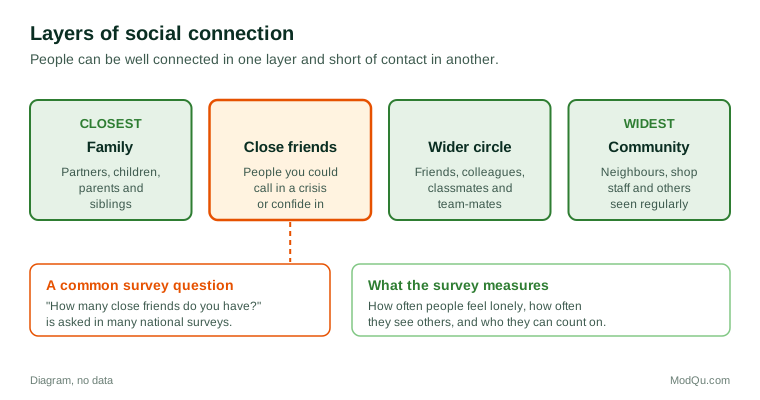
Researchers sometimes also describe social connection as the overall picture: the number of relationships, how often people are in contact, how close those relationships are, and whether people have someone to turn to.
Loneliness can be short-lived, for example after a move or the end of a relationship, or it can become chronic, lasting a long time. Chronic loneliness is the main concern for health researchers.
How loneliness is measured
Because loneliness is a feeling, it is measured by asking people. Surveys use two main approaches:
- A direct question, such as how often a person feels lonely: always, often, sometimes, rarely or never.
- Indirect scales, which ask about related experiences, such as how often a person feels they lack companionship, feel left out or feel isolated from others, without using the word "lonely". The UCLA Loneliness Scale, in short and long versions, is widely used.
Indirect questions matter because some people do not like to describe themselves as lonely. Statistics Canada asks about loneliness in national surveys, and many other countries do the same, so results can be compared.
Who is affected
Loneliness can affect anyone, but certain life events and situations raise the risk:
- Life transitions: moving, starting university, retiring, becoming a parent, separation or bereavement.
- Living alone, especially without regular outside contact.
- Health and mobility: illness, disability, hearing loss and chronic pain can make getting out harder.
- Caregiving: people looking after a family member may lose time for friends.
- Newcomers to a country or a city, who may have left their networks behind.
- Age: both young adults and older adults often report loneliness, for different reasons.
- Low income, which can limit going out and taking part.
Example
A man retires after 35 years in the same workplace. For the first months he enjoys the free time, but he realizes most of his social contact came from work. His partner has their own friends and activities. He joins a woodworking group at the community centre, and the weekly sessions become the part of the week he looks forward to most.
Loneliness and health
Research has linked chronic loneliness and social isolation with poorer physical and mental health, including higher risks of heart disease, depression and dementia, and earlier death. In 2023, the United States Surgeon General issued an advisory on loneliness and isolation as a public health concern, and the World Health Organization set up a commission on social connection. Some countries, such as the United Kingdom, have appointed a minister responsible for loneliness.
These links do not mean that every lonely person will become ill. They mean that, on average across large groups, people who are chronically lonely or isolated have worse health outcomes. This page describes research in general and is not medical advice. Anyone in Canada who is in crisis or thinking about suicide can call or text 9-8-8 at any time.
What helps
There is no single answer, and what helps one person may not suit another. Approaches include:
- Regular, structured activities: clubs, classes, sports, faith communities and volunteering, where people see the same faces each week.
- Reaching out: calling an old friend or saying yes to invitations.
- Shared interests: groups built around a hobby often make conversation easier.
- Social prescribing: health workers referring people to community activities, a practice growing in Canada and elsewhere.
- Intergenerational programs: such as students living with older adults or school visits to care homes.
- Technology: video calls and online communities can help, especially for people who cannot easily get out, though they work best alongside in-person contact.
- Professional support when loneliness comes with low mood or anxiety.
Example
A university student from another province spends their first term mostly alone in residence, talking to family by video call. In January they join a climbing club. The same six people turn up every Tuesday, and after training they go for food together. By the end of the year the student has a close group of friends and plans to share an apartment with two of them.
Example
An older woman living alone in a small town no longer drives. Her family doctor's office refers her to a community program that pairs her with a volunteer who visits once a week and drives her to a seniors' lunch every Thursday. She says the lunch is where she has made her first new friend in years.
Loneliness at different ages
Loneliness looks different at different stages of life. Young adults may feel lonely while leaving home, starting school or work, or comparing their social lives with what they see online. People in mid-life may be busy with work and children yet feel they have little time for friends. Older adults may lose a partner or friends, stop driving, or find it harder to get out because of health.
For this reason, surveys usually ask about loneliness alongside age and life events, and programs are often aimed at particular groups: peer support for students, parent groups for new parents, and visiting and transport programs for older adults.
Changes in how people connect
Patterns of connection have changed in many ways: more people live alone, families are more spread out, many people work from home, and a great deal of contact happens through phones and social media. The pandemic cut in-person contact for long periods. Researchers debate how these changes affect loneliness, and whether online contact replaces, supplements or crowds out in-person contact.
What people disagree about
Debates include whether loneliness is growing or simply being talked about more, whether social media makes young people lonelier or more connected, what governments should do about it, and whether loneliness should be treated as a health issue or a social one. Questions that governments, foundations and community organizations want answered include who is lonely, how often, and which programs make a difference.
Key terms
- LonelinessThe distress felt when relationships feel fewer or less close than a person wants.
- Social isolationHaving few relationships or little contact with others.
- Social connectionThe number, closeness and quality of a person's relationships.
- Chronic lonelinessLoneliness that lasts a long time rather than passing quickly.
- Social prescribingA health worker referring someone to community activities or support.
- Social supportHelp and care a person can get from others, practical or emotional.
- ConfidantA person someone trusts to talk to about personal matters.
- Intergenerational programAn activity that brings together people of different generations.
Full glossary: community psychiatry terms on EditingTests.com.
Loneliness and social connection vocabulary test
How well do you know the language of this topic? Try 8 quick questions. Your score is shown straight away and is not saved.
What the loneliness and social connection survey asks
This survey is part of ModQu's Communities and Society survey. The loneliness and social connection part takes about five minutes and covers:
- How often you feel lonely, left out or isolated.
- How often you see or talk to friends and family, in person and online.
- How many close friends you have and whether you have someone to confide in.
- Whom you would call in an emergency.
- Which activities or groups you take part in.
- What would help you feel more connected.
After that you can choose to continue with other short parts of the Communities and Society survey, such as neighbourhoods and community life or accessibility and disability, or stop.
Ready to take part?
Your answers help show what people really think and do. Results are only ever reported as totals; no one can see your individual answers.
Start the surveyQuestions about this survey
Who can take part?
Adults.
Do I have to give my name?
No. You may be asked for your age group, region and similar details so results can be broken down, but not your name. ModQu never asks for passwords, card numbers or account numbers.
How are the results used?
Answers are combined into totals and percentages and published in ModQu reports. Individual answers are never shown.
Is the vocabulary test part of the survey?
No. It is optional and separate, and your score is not stored.