
Share your experience of living alone
Tell us how long you have lived alone, what is hardest about it and which services make it easier. Your answers are combined with other people's and reported only as totals.
Start the living alone surveyAbout 5 minutes. No account needed. You can stop at any time.
Who lives alone
Living alone means being the only person in a household. In the 2021 Census, Statistics Canada reported that one-person households had become the most common type of household in the country, a shift that has also happened in many other wealthy countries. People who live alone are a varied group:
- Young adults who have moved out of their parents' home or a shared rental.
- Mid-life adults who are single, separated or divorced, or whose partner lives elsewhere.
- Older adults, many of them widowed, who make up a large share of people living alone.
- People living apart from family for work, such as those who commute weekly or work in remote sites.
Some choose to live alone and value the independence; others live alone because of a separation, a death, or the cost and difficulty of finding a suitable shared home. Many move in and out of living alone more than once in their lives.
Why people choose it
People who choose to live alone often mention:
- control over their space, schedule and routines;
- privacy and quiet;
- no need to share chores, food or bills;
- a place to recover from busy work or social lives;
- freedom to decorate, keep pets or work from home without compromise.
Others say living alone was not their plan but they have grown to like it, while some find it hard and would prefer to live with a partner, family or friends.
What it costs
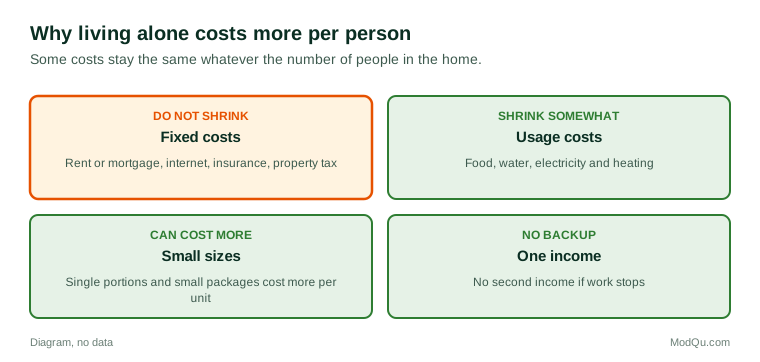
Living alone usually costs more per person than sharing, because many costs do not shrink with fewer people. Rent or a mortgage, property tax, internet, home insurance, a streaming service or a car cost about the same whether one person or three use them. Some costs are lower, such as food and water use, but single-serving groceries and smaller packages often cost more per unit.
Example (hypothetical figures)
A person pays $1,600 a month for a one-bedroom apartment, $80 for internet, $60 for electricity and $25 for tenant insurance, a total of $1,765. If they shared a two-bedroom unit at $2,300 with a roommate, splitting all four costs, each would pay $1,150 for rent plus $82.50 for the other bills, or $1,232.50. Living alone costs them $532.50 more a month.
Some tax and benefit rules also treat single people differently from couples, and single people do not have a second income to fall back on if they lose a job or become ill. This page describes these costs in general; it does not give financial advice.
Social contact and loneliness
Living alone is not the same as being lonely. Many people who live alone have busy social lives, and people who live with others can also feel lonely. Still, living alone can increase the risk of isolation, especially after a loss, a move, retirement or a health problem that makes going out harder. Public health bodies in Canada and other countries have described loneliness and social isolation as a health concern.
People keep up contact in many ways: regular calls and video chats, clubs and classes, volunteering, faith communities, sports, work, neighbours, pets, and online groups. Some cities run programs that connect people living alone with volunteers or with each other.
Example
A 72-year-old widower lives alone in the house he shared with his wife. After she died he rarely left home in winter. His daughter signs him up for a weekly lunch at a community centre, and a neighbour invites him to a walking group. Six months later he goes out four days a week and says the walking group matters most because people notice when he does not come.
Safety and everyday practicalities
Living alone raises practical questions that people in shared households may not think about:
- Emergencies: who would know if the person fell, became ill or did not come home.
- Home security: locks, lighting, cameras and knowing neighbours.
- Illness: getting groceries, medication and help when sick.
- Keys and pets: who has a spare key, and who would care for a pet in an emergency.
- Heavy or difficult tasks: moving furniture, snow clearing, home repairs.
Common measures include daily check-ins by text with a friend or relative, medical alert devices for older adults, sharing location with a trusted person, smart doorbells and keeping an emergency contact list in a visible place.
Example
A 29-year-old who lives alone gets food poisoning and cannot get out of bed for two days. A friend brings groceries and medication from the pharmacy. Afterwards, they make a list of three people with a spare key and set up a daily "good morning" text with a sibling.
Services that make solo living easier
Many services are used heavily by people who live alone:
- grocery delivery and meal kits in single portions;
- prepared meals and meal delivery programs, including programs for older adults;
- cleaning, handyperson and snow removal services;
- pet sitting and dog walking;
- home security and medical alert systems;
- community programs, clubs and classes;
- smaller homes, studio units and co-living buildings with shared common areas.
Businesses that design for one-person households look at portion sizes, smaller appliances, furniture for small spaces, solo travel and single-occupancy pricing, which some people find unfair when hotels and cruises charge a "single supplement".
Example
A person who works long hours and lives alone tries a meal kit for two weeks but throws away food because portions are sized for two. They switch to a local service that sells frozen single portions and use grocery delivery once every two weeks for the rest.
Trends and points of debate
Several trends are shaping solo living: an ageing population with many older adults living alone, more people marrying later or not at all, more separations later in life, and the rising cost of housing, which pushes some people back into shared homes. Housing builders are adding studios and co-living options. People disagree about whether living alone is a sign of independence or of isolation, how far governments should support people who live alone, and whether products and pricing should do more to serve single households. Questions businesses want answered include how long people have lived alone, what is hardest about it, and which services they use.
Key terms
- One-person householdA household with only one person living in it.
- Social isolationHaving few social contacts or relationships.
- LonelinessThe feeling of not having the connection a person wants.
- Medical alert deviceA wearable button that calls for help in an emergency.
- Co-livingA housing model with private rooms and shared common spaces.
- Single supplementAn extra charge for one person using a room priced for two.
- Check-inA regular contact to confirm someone is safe.
- Studio apartmentA small apartment with one main room for living and sleeping.
Full glossary: social care services terms on EditingTests.com.
Living alone vocabulary test
How well do you know the language of this topic? Try 8 quick questions. Your score is shown straight away and is not saved.
What the living alone survey asks
This survey is part of ModQu's Life Stages and Family survey. The living alone part takes about five minutes and covers:
- How long you have lived alone, and how you came to live alone.
- What you like most and what you find hardest about it.
- What your main household costs are each month.
- How often you see or talk with friends and family.
- What you have in place in case of an emergency.
- Which services make living alone easier for you.
After that you can choose to continue with other short parts of the Life Stages and Family survey, such as ageing and senior living or weddings and celebrations, or stop.
Ready to take part?
Your answers help show what people really think and do. Results are only ever reported as totals; no one can see your individual answers.
Start the surveyQuestions about this survey
Who can take part?
Adults who live alone.
Do I have to give my name?
No. You may be asked for your age group, region and similar details so results can be broken down, but not your name. ModQu never asks for passwords, card numbers or account numbers.
How are the results used?
Answers are combined into totals and percentages and published in ModQu reports. Individual answers are never shown.
Is the vocabulary test part of the survey?
No. It is optional and separate, and your score is not stored.