
Share your experience of other faiths
Tell us about your contact with people of other faiths and how well faiths get along where you live. Your answers are combined with other people's and reported only as totals.
Start the interfaith relations surveyAbout 5 minutes. No account needed. You can stop at any time.
What interfaith relations means
Interfaith relations are the contacts, attitudes and shared activities between people of different religions. The term also covers relations between religious and non-religious people. Relations can be close and friendly, distant and indifferent, or tense and hostile, and they often vary from one street, school or workplace to another.
Interfaith relations happen at several levels:
- Personal: friends, neighbours, colleagues and family members of different faiths.
- Community: places of worship working together on local projects.
- Organized dialogue: meetings and councils where faith leaders and members discuss beliefs and shared concerns.
- National and international: statements by religious leaders, laws on religious freedom and international bodies working on tolerance.
Everyday contact
For most people, interfaith relations are not formal. They come from ordinary life:
- sharing an office, classroom or hospital ward;
- living in the same building or street;
- mixed-faith friendships, marriages and families;
- exchanging food and greetings at festivals;
- attending a colleague's wedding or a neighbour's funeral.
Researchers studying group relations have long argued that regular, equal and cooperative contact between groups tends to reduce prejudice, especially when it is supported by schools, employers or local leaders. Brief or hostile contact does not have the same effect.
Example
Two neighbours, one Muslim and one Hindu, have shared a fence for years. Each year they exchange sweets at their own festivals. When one neighbour is in hospital, the other cooks for the family for a week. Neither has attended the other's place of worship, but both describe the friendship as one of the most important in their lives.
Interfaith dialogue
Interfaith dialogue is organized conversation between members of different faiths. Its aims can include learning about each other's beliefs, correcting misunderstandings, building trust and working on shared problems. Common forms include:
- panel discussions and study evenings;
- visits to each other's places of worship;
- shared scripture reading, where each group explains its own texts;
- youth and student exchanges;
- interfaith councils in cities and countries.
Dialogue does not aim to make everyone agree. Most participants keep their own beliefs and aim for respect and understanding.
Shared action
Many interfaith projects focus on doing things together rather than discussing beliefs. Examples include joint food banks, refugee support, disaster relief, environmental clean-ups, peace vigils after attacks and campaigns against hate crime. Shared work can bring together people who would not attend a formal dialogue event.
Example
After a flood, a church, a gurdwara and a mosque in the same town set up a joint relief centre. Volunteers from each serve meals in turn. A year later the three groups hold a shared remembrance event and keep a joint list of volunteers for future emergencies.
What helps and what harms relations
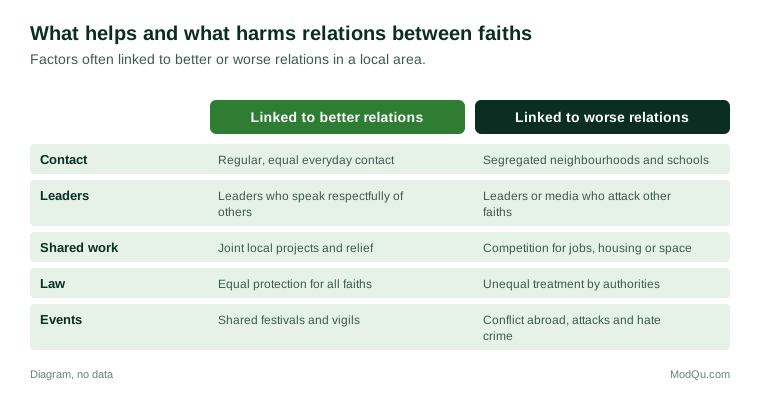
The figure below sets out factors that people and researchers often link to better or worse relations between faiths.
Factors linked to better relations include regular everyday contact, mixed schools and workplaces, leaders who speak respectfully of other faiths, shared local projects and fair laws that protect all faiths equally. Factors linked to worse relations include segregated neighbourhoods and schools, hostile media and online content, conflict abroad that is linked to religion, competition for jobs or housing, and attacks or hate crimes that create fear.
Prejudice, discrimination and hate crime
Interfaith relations also include harm. Religious prejudice can show up as stereotypes, jokes, exclusion at work, refusal of service, vandalism of places of worship and violence. Many countries record hate crimes motivated by religion, although the definitions and recording methods differ. Some people hide signs of their faith, such as clothing or jewellery, to avoid harassment.
Example
A student who wears a religious head covering is told by a classmate that she "does not belong" in the country where she was born. A teacher hears it and arranges a class discussion on religious freedom, and invites speakers from several faiths. The student says she felt supported, though the comment stayed with her.
Mixed-faith families
Marriages and partnerships between people of different faiths are common in many places. Couples decide how to celebrate holidays, which rituals to use at weddings and funerals, and how to raise children. Some choose one faith, some share both and some leave the choice to the children. Families may face pressure from relatives or faith communities, or find them welcoming. Rules on religious marriage and on the faith of children differ between faiths and countries.
What people disagree about
- Whether interfaith events lead to real change or stay among people who already agree.
- How far dialogue should discuss differences rather than only common ground.
- How to handle religious criticism without encouraging hatred.
- How states should balance freedom of religion with freedom of expression.
- Whether non-religious people should take part in interfaith bodies.
Why surveys ask about interfaith relations
Questions that faith bodies, charities, schools and public agencies want answered include how many people have friends of other faiths, whether people have attended another faith's event, how well people think faiths get along locally, and whether people have experienced religious discrimination. Answers are grouped and questions about religion can be skipped.
Interfaith relations at school and work
Schools and workplaces are where many people first meet others of different faiths. Schools may teach about several religions, mark festivals from different traditions and set rules on religious dress and food. Employers may set up prayer rooms open to all faiths, adjust schedules for holy days and train managers on religious discrimination law. When these steps are handled well, staff and pupils often report better relations. When they are handled badly, or when one group feels favoured over another, they can cause resentment. Many people say that small, practical steps, such as labelling food at events or avoiding meetings on major holy days, matter more than formal statements.
Key terms
- InterfaithInvolving people of more than one religion.
- DialogueOrganized conversation aimed at understanding, not necessarily agreement.
- PluralismAccepting that many religions and beliefs can exist side by side in a society.
- ToleranceAccepting the right of others to hold beliefs different from one's own.
- PrejudiceA negative opinion about a group formed without good reason or knowledge.
- DiscriminationTreating someone unfairly because of their religion or another characteristic.
- Hate crimeA crime motivated by hostility toward a group, such as a religion.
- Contact hypothesisThe idea that regular, equal, cooperative contact between groups reduces prejudice.
Full glossary: faith based organizations terms on EditingTests.com.
Interfaith relations vocabulary test
How well do you know the language of this topic? Try 8 quick questions. Your score is shown straight away and is not saved.
What the interfaith relations survey asks
This survey is part of ModQu's Religion and Spirituality survey. The interfaith relations part takes about five minutes and covers:
- Whether you have friends, colleagues or family of other faiths or none.
- How well you think faiths get along where you live.
- Whether you have attended another faith's service, festival or event.
- Whether you have taken part in interfaith dialogue or shared projects.
- Whether you have experienced or seen religious discrimination.
- What you think would improve relations between faiths locally.
After that you can choose to continue with other short parts of the Religion and Spirituality survey, such as religion in daily life or places of worship, or stop.
Ready to take part?
Your answers help show what people really think and do. Results are only ever reported as totals; no one can see your individual answers.
Start the surveyQuestions about this survey
Who can take part?
Adults.
Do I have to give my name?
No. You may be asked for your age group, region and similar details so results can be broken down, but not your name. ModQu never asks for passwords, card numbers or account numbers.
How are the results used?
Answers are combined into totals and percentages and published in ModQu reports. Individual answers are never shown.
Is the vocabulary test part of the survey?
No. It is optional and separate, and your score is not stored.
Can I take the survey if I have no religion?
Yes. Relations between religious and non-religious people are part of the topic.
Will I be asked to name my neighbours or colleagues?
No. The survey never asks for the names of other people.