
Share your experience of household bills
Tell us which bills have gone up, how you pay them and what you have cut back on. Your answers are combined with other people's and reported only as totals.
Start the household bills surveyAbout 5 minutes. No account needed. You can stop at any time.
What household bills cover
Household bills are the regular payments needed to run a home. They usually include:
- Housing: rent, or mortgage payments, property tax and condominium fees.
- Utilities: electricity, natural gas, heating oil or propane, water and sewer, and garbage collection in some places.
- Telecommunications: mobile phones, home internet, home phone and television.
- Insurance: home or tenant insurance, car insurance and life insurance.
- Subscriptions and memberships: streaming services, software, gym memberships and delivery passes.
- Transport costs such as car payments and transit passes.
- Childcare and other regular commitments.
Some bills are fixed, such as rent or a phone plan. Others vary with use or season, such as heating in winter or electricity when air conditioning runs in summer.
How utility bills are set
Utility prices in Canada are set in different ways depending on the province and the service. Electricity and natural gas rates for many households are reviewed and approved by provincial energy regulators, and some provinces have publicly owned utilities. Water and sewer rates are usually set by municipalities. Many bills combine a fixed monthly charge with a charge for each unit used, plus delivery charges, regulatory charges and taxes.
Some electricity customers pay different rates depending on the time of day, so running a dishwasher or dryer in the evening can cost less than in the afternoon. Budget or equal billing plans spread expected annual costs evenly across twelve months, with an adjustment once a year.
Example (hypothetical figures)
A household's gas bills last year totalled $1,560, from $40 in July to $260 in January. On an equal billing plan they pay $130 every month instead. At the end of the year, a colder winter means they used more gas than expected, and they owe a $95 adjustment.
How people pay bills
People pay household bills in several ways:
- Pre-authorized debit from a bank account on a set day.
- Credit card, either automatically or by hand each month.
- Online banking bill payment, where the person sends payment from their bank.
- Paying in person at a bank, post office or the company's office.
- Cheque, now much less common.
Paper bills are being replaced by email and online accounts, and some companies charge a fee for paper bills. Paying by credit card can earn rewards but some companies add a fee for card payments. Missing a payment can lead to late fees, interest, service cuts or, for some bills, a note on a person's credit file.
What has been rising
Which household bills rise fastest changes from year to year. Over recent years, people in Canada have pointed to rent, mortgage payments, property tax, insurance and food as costs that have gone up. Utility costs rise and fall with energy prices and regulatory decisions. Statistics Canada tracks price changes through the Consumer Price Index (CPI), which includes shelter, energy, telecommunications and insurance as separate components.
Official figures describe averages. Many households experience something quite different, depending on where they live, whether they rent or own, how they heat their home and when their mortgage renews. That is why surveys ask people directly which of their own bills have risen most.
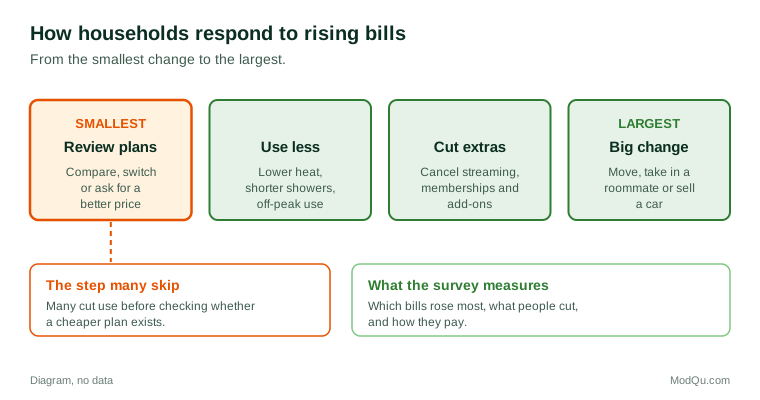
How people cut back
When bills rise, households respond in different ways:
- Using less: turning down the thermostat, shorter showers, line-drying clothes and unplugging devices.
- Switching plans or providers: a cheaper phone or internet plan, or bundling services.
- Negotiating: calling a provider to ask for a better price or a loyalty discount.
- Cutting extras: cancelling subscriptions and memberships.
- Improving the home: insulation, weather-stripping, a programmable thermostat or a heat pump, sometimes with government rebates.
- Bigger changes: moving, taking in a roommate or selling a second car.
Example
A retired couple notice their phone, internet and TV bill has crept up each year. Their adult child spends an evening helping them compare plans. They drop the TV package they rarely watch, keep internet and switch to a smaller phone plan. Their monthly bill drops by about a third, and they wonder why they had not checked sooner.
Example
A young renter in a small apartment pays electricity separately. In their first winter, the bill from electric baseboard heaters is far higher than expected. They buy a door draft stopper and window film and keep the bedroom heat lower at night. Their landlord agrees to replace a cracked window seal.
Keeping track of bills
With bills arriving by email, app, text and post, and many paid automatically, people can lose track of what they pay. Common ways of keeping track include a spreadsheet or budgeting app, a calendar of due dates, a single account used only for bills, and a once-a-year review of every recurring charge. Automatic payments make it less likely a bill is missed, but also make it easier for price increases and forgotten subscriptions to go unnoticed.
Example
A household sets aside one evening each January to list every recurring charge on their bank and credit card statements. They find a cloud storage plan they no longer use, a gym membership one of them cancelled verbally but never in writing, and an insurance policy that renewed at a higher price without anyone noticing.
When people fall behind
Some households cannot keep up with all their bills. People in this situation often juggle, paying the most urgent bills first and letting others slip. Many utilities offer payment arrangements, and some provinces have rules limiting disconnection of heat or electricity in winter. Low-income energy assistance programs, provincial supports and community agencies can help. Non-profit credit counselling agencies can also help people make a plan. This page describes options in general; it is not financial advice.
What people disagree about
Debates about household bills include whether utilities should be publicly or privately owned, how energy and carbon pricing should be passed on to households, whether time-of-use rates are fair to people who cannot shift their use, whether companies should be allowed to charge fees for paper bills or card payments, and how much households should be expected to cut back before receiving help. Questions that businesses and governments want answered include which bills cause most strain, what people have cut, and which payment methods they prefer.
Key terms
- Pre-authorized debitA payment a company takes from your bank account on a schedule you agreed to.
- Equal billingA plan that spreads expected yearly utility costs evenly over twelve months.
- Time-of-use ratesElectricity prices that change with the time of day.
- Delivery chargeThe cost of bringing electricity, gas or water to a home, separate from the energy used.
- Consumer Price IndexA measure of the change in prices paid by consumers, published by Statistics Canada.
- Late payment feeA charge added when a bill is paid after its due date.
- BundleA package of services, such as phone and internet, sold together for one price.
- Payment arrangementAn agreement with a provider to pay an overdue amount over time.
Full glossary: utility billing terms on EditingTests.com.
Household bills vocabulary test
How well do you know the language of this topic? Try 8 quick questions. Your score is shown straight away and is not saved.
What the household bills survey asks
This survey is part of ModQu's Household Life survey. The household bills part takes about five minutes and covers:
- Which household bills you pay and roughly what each costs a month.
- Which bill has risen most for you this year.
- How you pay your bills: automatic debit, card, online banking or in person.
- What you have cut back on, switched or negotiated to save money.
- Whether you have fallen behind on any bill, and what helped.
- What you would most like providers to change.
After that you can choose to continue with other short parts of the Household Life survey, such as cleaning and laundry or household chores and time use, or stop.
Ready to take part?
Your answers help show what people really think and do. Results are only ever reported as totals; no one can see your individual answers.
Start the surveyQuestions about this survey
Who can take part?
Bill payers.
Do I have to give my name?
No. You may be asked for your age group, region and similar details so results can be broken down, but not your name. ModQu never asks for passwords, card numbers or account numbers.
How are the results used?
Answers are combined into totals and percentages and published in ModQu reports. Individual answers are never shown.
Is the vocabulary test part of the survey?
No. It is optional and separate, and your score is not stored.