
Share your experience of hiring trades
Tell us which trades you have hired, how you found them and how it went. Your answers are combined with other people's and reported only as totals.
Start the home services and trades surveyAbout 5 minutes. No account needed. You can stop at any time.
What home services and trades cover
Home services are the paid jobs people bring in someone else to do on their home. They range from a one-hour repair to a renovation that lasts months. Common trades and services include:
- Plumbers: leaks, clogged drains, water heaters, toilets and new fixtures.
- Electricians: outlets, panels, lighting, wiring and electric vehicle chargers.
- Heating, ventilation and air conditioning (HVAC) technicians: furnaces, heat pumps, air conditioners and ducts.
- Handypeople: small repairs, mounting shelves and TVs, assembling furniture and minor carpentry.
- Carpenters, drywallers and painters.
- Roofers, window and door installers, and contractors for larger projects.
- Appliance repair technicians, locksmiths and pest control.
Homeowners hire trades directly. Renters usually ask their landlord, who is responsible for most repairs under provincial tenancy laws, though some renters hire help for small jobs or for their own furniture and fixtures.
Licensed trades and permits
In Canada, some trades are regulated by the provinces and territories. Electrical and gas work in particular usually must be done by licensed or certified workers and contractors, and may need a permit and an inspection. Plumbing rules vary by province and municipality. Handypeople are generally not licensed and are expected to stay away from work that legally needs a licensed trade.
A permit is permission from the municipality, or a provincial safety authority for some electrical work, to carry out certain work. It usually leads to an inspection to check the work meets the building or electrical code. Work done without a required permit can cause problems with insurance claims and when selling a home. Rules differ by place, so people are generally advised to check with their municipality or the relevant provincial authority. This page describes how hiring works in general and is not legal advice.
Example
A homeowner wants a new light fixture in the dining room and a new outlet in the garage. A handyperson offers to do both cheaply. A neighbour points out that adding a new outlet is electrical work that may need a licensed electrician and a permit in their province. The homeowner hires an electrician for the outlet and lets the handyperson hang the fixture after the electrician confirms it is a simple swap that the homeowner is allowed to do.
How people find trades
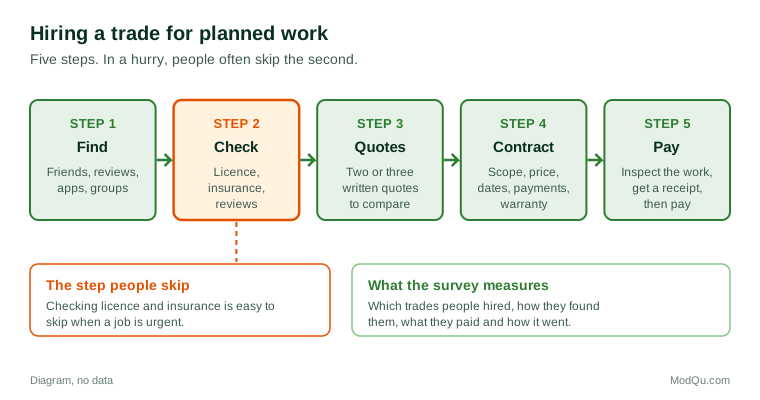
Finding a good tradesperson is one of the hardest parts. People use several routes:
- Word of mouth: friends, family, neighbours and coworkers.
- Online reviews and directories, including search results and map listings.
- Neighbourhood groups and community forums.
- Booking platforms and apps that list and sometimes vet tradespeople.
- Retailers that sell and install products such as flooring, windows or appliances.
- Signs and flyers in the neighbourhood.
Example
After a pipe bursts under the kitchen sink on a Sunday night, a renter of a basement suite cannot reach their landlord. They search online for an emergency plumber, call three, and the one who answers first charges an after-hours call-out fee. The landlord later reimburses them and gives them the number of the plumber the landlord normally uses.
Urgency changes how people choose. In an emergency, speed matters more than price. For planned work, people have time to compare.
Quotes, estimates and contracts
For planned work, people usually ask more than one company for a price. The difference between a quote and an estimate matters:
- A quote is usually a fixed price for a stated job.
- An estimate is an approximate price that can change once work starts.
A written contract or work order that sets out the scope of work, materials, price, payment schedule, start and finish dates and warranty helps avoid disputes. Many provinces have consumer protection laws that cover home improvement contracts above a set amount, including the right to cancel some contracts signed at home within a short period.
Prices and payment
Trades charge in different ways: an hourly rate plus materials, a flat price per job, a minimum charge or call-out fee, or a project price with deposits and stage payments. Prices vary with the region, the season, the trade's demand and how urgent the job is.
Example (hypothetical figures)
A plumber charges a $95 call-out fee that includes the first half-hour, then $110 an hour. The job takes 2 hours in total, so the labour is $95 plus 1.5 hours at $110, which is $165, for $260. Parts cost $48. Before 13% HST, the bill is $308; with tax it comes to $348.04.
Some homeowners are offered a lower price for paying cash. Paying without a receipt can leave them with no proof of the work for warranty, insurance or a future sale, and no record if something goes wrong.
Common problems
Problems people report with trades include:
- not returning calls or not turning up;
- work starting late and running long;
- costs going above the estimate;
- poor workmanship that needs fixing;
- large deposits taken before work starts, followed by delays or no work;
- unclear warranties;
- disputes over clean-up and damage.
Most jobs go without problems, but when something does go wrong, it can be stressful and costly. Provincial consumer protection offices accept complaints, and some regulated trades have their own complaint process.
Reviews and reputation
Reviews play a large part in how people choose trades. After a job, people may leave an online review, recommend the tradesperson to friends, or do nothing. Many people say they read reviews but do not write them, and some worry that reviews can be fake or can be removed. Some trades ask satisfied customers for reviews at the end of a job.
Trends
Changes in this area include more demand for heat pumps and electric vehicle chargers, apps that let people book and pay trades online, labour shortages in some trades that lengthen wait times, and more people doing their own small repairs with help from online videos. Debates include how much work homeowners should do themselves, whether booking platforms improve or lower quality, and how to make sure trades are paid fairly while keeping repairs affordable.
Key terms
- QuoteA fixed price for a stated job.
- EstimateAn approximate price that can change once the work starts.
- PermitOfficial permission to carry out certain work, usually followed by an inspection.
- Call-out feeA charge for coming to the home, sometimes covering the first part of the work.
- Licensed tradeA trade, such as electrical work, that legally requires a licence or certificate.
- Scope of workA description of exactly what a job includes.
- DepositMoney paid before work starts, often to cover materials.
- HoldbackPart of the payment kept back until work is complete, as set out in law or a contract.
Full glossary: plumbing inspection terms on EditingTests.com.
Home services and trades vocabulary test
How well do you know the language of this topic? Try 8 quick questions. Your score is shown straight away and is not saved.
What the home services and trades survey asks
This survey is part of ModQu's Household Life survey. The home services and trades part takes about five minutes and covers:
- Which trades and home services you have hired in the past year.
- How you found them: word of mouth, reviews, apps or other ways.
- Whether you got more than one quote, and how you chose.
- What you paid, and whether the final cost matched the quote or estimate.
- How satisfied you were, and whether you left a review.
- Which small repairs you now do yourself.
After that you can choose to continue with other short parts of the Household Life survey, such as cleaning and laundry or household chores and time use, or stop.
Ready to take part?
Your answers help show what people really think and do. Results are only ever reported as totals; no one can see your individual answers.
Start the surveyQuestions about this survey
Who can take part?
Homeowners and renters.
Do I have to give my name?
No. You may be asked for your age group, region and similar details so results can be broken down, but not your name. ModQu never asks for passwords, card numbers or account numbers.
How are the results used?
Answers are combined into totals and percentages and published in ModQu reports. Individual answers are never shown.
Is the vocabulary test part of the survey?
No. It is optional and separate, and your score is not stored.