
Share how your home is protected
Tell us whether you have a carbon monoxide alarm, when your gas appliances were last checked and what you know about the warning signs. Your answers are combined with other people's and reported only as totals.
Start the gas and carbon monoxide safety surveyAbout 5 minutes. No account needed. You can stop at any time.
Why gas and carbon monoxide safety matter
Many homes use fuel that burns: natural gas, bottled gas such as propane or butane, oil, wood, coal, charcoal or kerosene. These fuels are used for heating, hot water and cooking. When they burn properly, with enough air and well-maintained equipment, they are generally safe. When something goes wrong, two dangers arise:
- Carbon monoxide (CO) poisoning, from fuel that burns without enough oxygen.
- Gas leaks, which can lead to fires and explosions.
Both can be prevented to a large degree with safe installation, regular checks, good ventilation and working alarms. Rules on gas safety, such as who may install appliances and whether alarms are required, vary between countries.
What carbon monoxide is and where it comes from
Carbon monoxide is a gas produced when fuel burns incompletely. It has no colour, smell or taste, so people cannot sense it. When breathed in, it reduces the blood's ability to carry oxygen to the body.
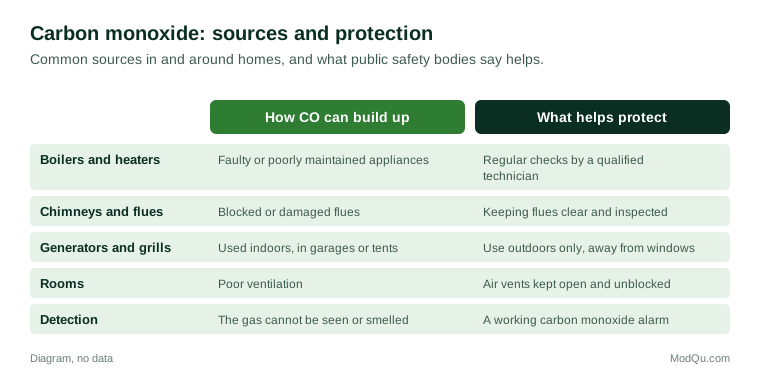
Common sources in and around homes include:
- faulty, poorly installed or poorly maintained boilers, furnaces and water heaters;
- gas, oil, kerosene and wood heaters and fireplaces;
- blocked chimneys and flues;
- gas cookers and ovens used for heating a room;
- charcoal grills and barbecues used indoors or in tents;
- portable generators run indoors, in garages or near windows;
- car engines running in an attached garage.
The figure below shows the main sources and the barriers that help protect a household.
Warning signs of carbon monoxide poisoning
The early symptoms of carbon monoxide poisoning are easy to mistake for flu, food poisoning or tiredness. Public health bodies commonly list:
- headache;
- dizziness;
- nausea and vomiting;
- tiredness and confusion;
- shortness of breath;
- collapse and loss of consciousness at high levels.
Signs that point to carbon monoxide rather than illness include symptoms that affect several people, or pets, in the same home at the same time; symptoms that ease when away from home and return on coming back; and symptoms that are worse when a heater or appliance is in use.
Signs around appliances that may suggest a problem include yellow or orange flames on a gas appliance where the flame is normally blue, soot or staining around an appliance, a pilot light that keeps going out and more condensation than usual on windows. Many appliances produce no visible signs, which is why alarms matter.
This page describes the signs; it does not replace advice from emergency services or health professionals. People who suspect carbon monoxide poisoning are generally advised by public bodies to get fresh air, leave the building and seek urgent medical help.
Carbon monoxide alarms
A carbon monoxide alarm detects the gas and sounds a loud warning before levels become dangerous for most people. It is different from a smoke alarm, which detects smoke, though combined smoke and CO alarms exist.
Guidance from safety bodies in many countries includes fitting CO alarms in rooms with fuel-burning appliances and near sleeping areas, testing them regularly and replacing them at the end of their life, which is often between five and ten years depending on the model. In some countries or regions, CO alarms are required by law in certain homes, such as rented homes, new builds or homes with particular appliances.
Example
A student moves into a shared rented flat with an old gas water heater in the kitchen. There is a smoke alarm but no carbon monoxide alarm. The student asks the landlord, who says the heater was checked two years ago. The student buys a CO alarm for the kitchen. Three months later it sounds one evening; the flatmates leave and call the gas emergency line, and an engineer finds the flue is partly blocked.
Checking and servicing gas appliances
Regular checks by a qualified technician can find problems before they cause harm. A check or service usually includes looking at the appliance, the flue and the ventilation, testing that the appliance burns correctly, and checking for gas leaks.
In many countries only registered or licensed technicians may install or repair gas appliances. In some places landlords must have gas appliances checked every year and give tenants a record. Homeowners are usually responsible for their own checks, and many go years without one.
Example (hypothetical figures)
A homeowner compares two years of costs. Year 1: an annual boiler service at $120 and a CO alarm at $35, a total of $155. Year 2: they skip the service to save money, and the boiler breaks down in mid-winter. The emergency call-out and repair cost $480, more than three times the Year 1 total, and the technician finds a worn seal that a service would probably have caught.
Gas leaks
Natural gas and bottled gas have a strong smell added to them, often described as rotten eggs, so that leaks can be noticed. Signs of a gas leak include that smell, a hissing sound near a gas pipe or appliance, and dead plants near outdoor gas lines.
Public safety advice on suspected gas leaks generally includes not using switches, phones or anything that could cause a spark inside the building, not using open flames, opening doors and windows if it is safe, leaving the building and calling the gas emergency number or emergency services from outside. The specific advice and phone numbers differ by country and supplier.
Example
A person returns from holiday and smells gas as they open the front door. They leave the lights off, step back outside and call the gas emergency number from the street. An engineer finds a loose connection behind the cooker. The person says they knew what the smell meant because a neighbour had had a leak the year before.
Generators, camping and power cuts
Many carbon monoxide incidents happen during power cuts, storms and cold weather, when people use generators, barbecues or heaters in ways they normally would not. Running a generator in a garage, basement or near open windows, or bringing a charcoal grill indoors or into a tent for warmth, can be very dangerous. Public safety campaigns often focus on these situations, especially before and during storm seasons.
Who is most at risk
Everyone is at risk from carbon monoxide, but some groups are more affected: babies and young children, pregnant people and unborn babies, older people, people with heart or lung conditions, and people who live in homes with old appliances, poor ventilation or no alarms. Renters in poorly maintained homes and households using portable heaters or cooking indoors with solid fuel face higher risks.
What people disagree about
- Should CO alarms be required in all homes? Many safety groups support this; some see it as a matter for owners.
- Responsibility in rented homes: views differ on how strictly landlords' duties should be enforced.
- Moving away from gas: some see a shift to electric heating and cooking as a safety benefit as well as an environmental one; others cite cost and reliability.
Questions that public bodies, insurers and businesses want answered here include how many homes have CO alarms, how often appliances are checked and how many people know the warning signs.
Key terms
- Carbon monoxideA poisonous gas with no colour, smell or taste, produced when fuel burns incompletely.
- CO alarmA device that detects carbon monoxide and sounds a warning.
- FlueA pipe or duct that carries fumes from an appliance to the outside.
- VentilationThe flow of fresh air into a room or building.
- BoilerAn appliance that heats water for central heating and hot taps.
- ServiceA routine check and maintenance of an appliance by a qualified technician.
- Pilot lightA small flame kept burning to light a gas appliance.
- Gas odorantA strong-smelling substance added to gas so leaks can be noticed.
Full glossary: fire safety terms on EditingTests.com.
Gas and carbon monoxide safety vocabulary test
How well do you know the language of this topic? Try 8 quick questions. Your score is shown straight away and is not saved.
What the gas and carbon monoxide safety survey asks
This survey is part of ModQu's Safety and Emergencies survey. The gas and carbon monoxide safety part takes about five minutes and covers:
- Whether you have a carbon monoxide alarm, and where it is fitted.
- Which fuel-burning appliances you have at home.
- When your gas or fuel-burning appliances were last checked, and by whom.
- Whether you know the signs of carbon monoxide poisoning and of a gas leak.
- Whether you have ever had an alarm go off or a suspected leak, and what you did.
- Whether you use generators, barbecues or heaters during power cuts or camping.
After that you can choose to continue with other short parts of the Safety and Emergencies survey, such as emergency preparedness or fire safety at home, or stop.
Ready to take part?
Your answers help show what people really think and do. Results are only ever reported as totals; no one can see your individual answers.
Start the surveyQuestions about this survey
Who can take part?
Adults.
Do I have to give my name?
No. You may be asked for your age group, region and similar details so results can be broken down, but not your name. ModQu never asks for passwords, card numbers or account numbers.
How are the results used?
Answers are combined into totals and percentages and published in ModQu reports. Individual answers are never shown.
Is the vocabulary test part of the survey?
No. It is optional and separate, and your score is not stored.