
Share your experience of fragrance
Tell us what fragrances you own, where you buy them and how you choose. Your answers are combined with other people's and reported only as totals.
Start the fragrance surveyAbout 5 minutes. No account needed. You can stop at any time.
What fragrance covers
Fragrance here means products worn on the body for their scent: perfume, cologne, body mists, scented oils and solid perfumes. Many other products contain fragrance too, from shampoo and laundry detergent to candles, but this page focuses on fragrances people wear.
In Canada, fragrances worn on the body are regulated as cosmetics by Health Canada. Ingredient labels can list "parfum" or "fragrance" as a single ingredient rather than naming each scent component, although some allergens may be listed separately. The European Union requires certain fragrance allergens to be named on labels above set levels.
Strength and concentration
Fragrances are sold in different concentrations of scented oils dissolved in alcohol. The names are used loosely, and the exact percentages vary by brand, but the usual order from strongest to lightest is:
- Parfum or extrait, the most concentrated and usually the most expensive per millilitre.
- Eau de parfum (EDP), strong and long-lasting.
- Eau de toilette (EDT), lighter, often for daytime.
- Eau de cologne, lighter again, refreshing and short-lived.
- Body mist or splash, the lightest.
"Cologne" is also used in North America to mean any fragrance marketed to men, whatever its strength. How long a scent lasts depends on concentration, the ingredients, skin type and the weather.
Notes and fragrance families
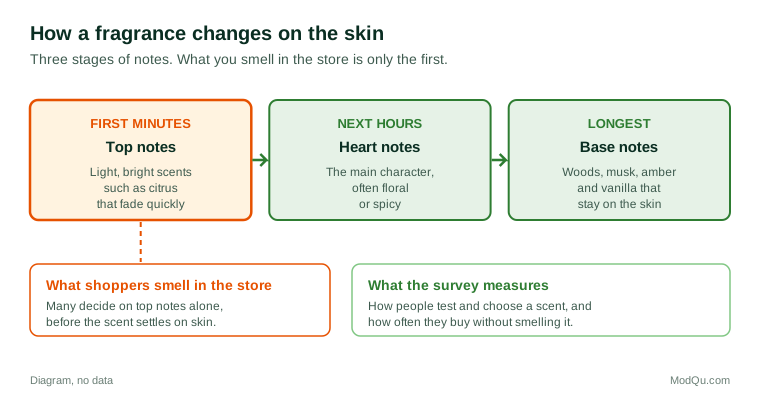
Fragrances are often described by their notes. Top notes are what you smell first and fade within minutes, heart (or middle) notes come through as the scent settles, and base notes last longest. A fragrance can smell quite different on the skin after an hour than when first sprayed, which is why people are advised not to decide on the first sniff.
Fragrances are also grouped into families. One common scheme uses four broad families, each with sub-groups:
- Fresh: citrus, green, water-like and aromatic scents.
- Floral: single flowers such as rose or jasmine, and bouquets.
- Amber (formerly called oriental): warm, spicy, resinous and vanilla scents.
- Woody: sandalwood, cedar, vetiver, moss and leather.
People who know which family they like can narrow down their choices when shopping.
How people choose a fragrance
Choosing a fragrance mixes memory, personality and practical concerns. Reasons people give include:
- Liking the smell, often because it reminds them of a person, place or time.
- Compliments from others.
- Occasion: a light scent for work, a stronger one for evenings.
- Season: fresh scents in summer, warmer ones in winter.
- Brand and bottle, and the image in advertising.
- Price and size.
- Recommendations from friends, sales staff and online reviewers.
Example
A man has worn the same fragrance since university because his partner said they liked it on their first date. He has tried others but always goes back. When the formula changes and it smells different to him, he spends months looking for a replacement and asks friends what they wear.
Sampling and buying without smelling
Fragrance is hard to buy online because it cannot be smelled through a screen. People manage this in several ways:
- testing in stores on paper strips and on skin;
- free samples with other purchases;
- sample sets and discovery kits sold by brands and retailers;
- decants, which are small amounts poured from a full bottle and resold;
- buying a scent they already know;
- reading descriptions of notes and reviews.
Example (hypothetical figures)
A shopper buys a discovery set of eight 2 ml vials for $40, which they can put toward a full bottle. They like one and buy a 100 ml bottle for $165, using the $40 credit, so they pay $125. Without the set, they say they would have bought a different fragrance that smelled good in the store but that they later found too strong.
Buying a fragrance without smelling it first is common for gifts and for repeat purchases. Questions that businesses want answered include how often people buy blind, how much they trust online descriptions, and whether samples lead to full-size purchases.
Gifts, price and counterfeits
Fragrance is one of the most common gifts, especially around holidays, birthdays and Mother's Day and Father's Day. Gift sets that pair a bottle with a lotion or a travel spray are sold mainly in these seasons.
Prices vary widely. Designer and niche fragrances cost far more than mass-market body sprays, and much of the price reflects brand, packaging and advertising rather than ingredients. Very low prices online or in markets can be a sign of counterfeit products, which may contain unknown or unsafe ingredients. Buying from authorized retailers is the usual way people avoid them.
Scent-free spaces and sensitivity
Some people find that fragrances trigger headaches, breathing problems or other symptoms. Many workplaces, hospitals, clinics and schools in Canada have scent-free or scent-reduced policies that ask people not to wear perfume, cologne or scented products.
Example
A nurse wears a favourite perfume on days off but none at work, because the hospital is scent-free. A new colleague does not know about the policy and is asked by a patient to stop wearing cologne. The ward adds a reminder to its welcome package for new staff.
People disagree about scent-free policies. Some see them as a reasonable accommodation, others as an overreach into personal choice. Surveys on fragrance often ask how people feel about such policies and whether scents bother them.
How to wear and store a fragrance
Most fragrance makers suggest spraying onto pulse points such as the wrists and neck, where the skin is warm, and not rubbing the wrists together, which can make the top notes fade faster. Some people spray clothing or hair instead, though some ingredients can stain fabric. A little goes a long way: people around a wearer often notice a scent more than the wearer does, because the nose gets used to a smell after a while.
Fragrance also changes with storage. Heat, light and air break down scent ingredients over time, so bottles last longer kept closed, upright and away from sunny windowsills and steamy bathrooms. An opened bottle stored well can last for years, but one kept in a hot car or on a bright shelf may start to smell sour or flat.
Trends
Recent trends include unisex and gender-neutral fragrances, layering more than one scent, refillable bottles, smaller travel sizes, and fragrances promoted through short videos. Interest in niche houses and independent perfumers has grown, as has interest in "dupes", which are lower-priced products made to smell like well-known fragrances.
Key terms
- Eau de parfumA strong, long-lasting fragrance concentration, lighter than parfum.
- Eau de toiletteA lighter fragrance concentration, often worn in the daytime.
- Top notesThe scents smelled first, which fade within minutes.
- Base notesThe scents that last longest on the skin.
- Fragrance familyA group of fragrances with a similar character, such as floral or woody.
- Discovery setA box of small samples of several fragrances.
- SillageHow far a fragrance's scent spreads from the person wearing it.
- Scent-free policyA rule asking people not to wear perfume or scented products in a place.
Full glossary: personal care products terms on EditingTests.com.
Fragrance vocabulary test
How well do you know the language of this topic? Try 8 quick questions. Your score is shown straight away and is not saved.
What the fragrance survey asks
This survey is part of ModQu's Beauty and Personal Care survey. The fragrance part takes about five minutes and covers:
- How many fragrances you own and how often you wear them.
- Where you bought your last fragrance, and whether it was a gift.
- Whether you have ever bought a fragrance without smelling it first.
- How you try new scents: stores, samples, discovery sets or reviews.
- What you would pay for a full bottle.
- How you feel about scent-free policies at work and in public places.
After that you can choose to continue with other short parts of the Beauty and Personal Care survey, such as skin care or hair care and salons, or stop.
Ready to take part?
Your answers help show what people really think and do. Results are only ever reported as totals; no one can see your individual answers.
Start the surveyQuestions about this survey
Who can take part?
Adults who buy perfume or cologne.
Do I have to give my name?
No. You may be asked for your age group, region and similar details so results can be broken down, but not your name. ModQu never asks for passwords, card numbers or account numbers.
How are the results used?
Answers are combined into totals and percentages and published in ModQu reports. Individual answers are never shown.
Is the vocabulary test part of the survey?
No. It is optional and separate, and your score is not stored.