
Share how faith shapes your family
Tell us whether faith guides family decisions in your home and how you pass on your beliefs. Your answers are combined with other people's and reported only as totals.
Start the faith and family life surveyAbout 5 minutes. No account needed. You can stop at any time.
Where faith and family meet
Faith can shape family life at every stage. Common points include:
- choosing a partner and how a couple meets;
- weddings and the rules of religious marriage;
- the number and timing of children;
- ceremonies for births and naming;
- how children are raised and taught;
- food, rest days and holidays at home;
- roles of parents, grandparents and other relatives;
- care for elderly or sick relatives;
- funerals, mourning and remembrance.
How strongly faith shapes each of these varies between faiths, between families and between generations of the same family.
Choosing a partner and marrying
Some people consider it important to marry someone of the same faith; others do not mind. Families and communities may help couples meet, through introductions, community events or matchmaking. Religious marriage has its own rules in many faiths, such as who may marry whom, required preparation classes, ceremonies and witnesses. In many countries a religious wedding must be followed by, or combined with, a civil registration for the marriage to be legally recognized; in others religious marriage has legal force on its own.
Example
A couple from the same faith but different countries plan their wedding. One family expects a large ceremony with several days of events; the other expects a small service. They agree on a religious ceremony at a place of worship, a civil registration the week before and one shared celebration, and each family hosts a smaller event later.
Mixed-faith and non-religious families
Many couples come from different faiths, or one partner is religious and the other is not. They make choices about:
- which ceremonies to use for the wedding;
- whether children are raised in one faith, both or neither;
- which holidays the household celebrates;
- food rules at home;
- how to handle different expectations from each side of the family.
Some families say a mix of traditions enriches their home. Others describe tension, especially when grandparents have strong views. Non-religious families often keep cultural customs, such as holiday meals, without religious practice.
Raising children
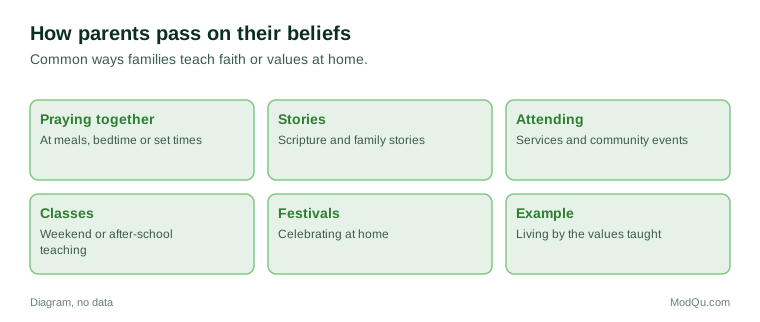
Passing on faith to children is important to many religious parents. Ways of doing this include praying together, telling scripture stories, attending services, religious classes, celebrating festivals and modelling values. Grandparents often play a large role, especially when they live with or near the family.
The figure below shows the main ways parents say they pass on their beliefs.
Example
A grandmother who lives with her son's family teaches her grandchildren evening prayers and festival recipes. Their parents are less observant but are glad the children learn. When the oldest child, now a teenager, says he is not sure what he believes, the family agrees that he can stop attending classes but should still join festival meals.
Food, rest and holidays at home
Daily family life often follows religious rules about food, such as which meats may be eaten or how food is prepared, and about rest, such as not working or using devices on a weekly holy day. Holidays bring extra cooking, visits and spending. Families with members of different levels of observance agree how strictly to keep these rules at home and at shared meals.
Example (hypothetical figures)
A family that keeps religious food rules spends about 15 more a week on certified food than they would on uncertified products. Over a year of 52 weeks that is 780. They say the extra cost is part of keeping their faith and that they save in other areas.
Care for older relatives
Many religions teach respect and care for parents and elders. In some families this means older relatives live with adult children; in others it means regular visits, money sent home or help arranging professional care. Faith communities often visit older members, bring meals and support caregivers. Families may face hard choices when religious duty, work and distance pull in different directions.
Illness, death and mourning
Faith often guides how families respond to serious illness and death: prayers for the sick, last rites, decisions about medical care, burial or cremation, the timing of funerals and periods of mourning. Hospitals and funeral services in diverse cities increasingly accommodate different religious practices, such as quick burial, washing of the body by family members or space for prayer.
What people disagree about
- How far parents should shape a child's religious identity.
- How families should respond when a member leaves the faith or marries outside it.
- Whether religious rules on family roles are fair to all members.
- How the law should treat religious marriage and divorce.
- How to balance religious duty to elders with work and other responsibilities.
Why surveys ask about faith and family
Questions that faith organizations, charities, family services and public bodies want answered include how often faith guides family decisions, how many couples share a faith, how parents pass on beliefs and what support families want from faith communities. Questions can be skipped and answers are grouped.
Faith communities and family support
Places of worship and faith-based charities often provide support for families: marriage preparation courses, parenting groups, help for families in financial difficulty, counselling, youth clubs and visits to the sick and bereaved. In some countries faith-based organizations also run adoption and fostering agencies, family courts or mediation services for religious divorce. Families say this support can be valuable, especially for people far from relatives. Others say they would prefer services that do not depend on religious membership, or worry that advice may not suit every family's situation.
Key terms
- Interfaith marriageA marriage between people of different religions.
- Civil registrationRecording a marriage with the state so it is legally recognized.
- MatchmakingHelping people find a suitable marriage partner, often through family or community.
- Naming ceremonyA religious or cultural ceremony to welcome and name a new baby.
- Last ritesReligious rituals for a person who is dying.
- Mourning periodA set time after a death with customs of grief and remembrance.
- Intergenerational householdA home where three or more generations live together.
- ObservanceThe keeping of religious rules and practices.
Full glossary: faith based organizations terms on EditingTests.com.
Faith and family life vocabulary test
How well do you know the language of this topic? Try 8 quick questions. Your score is shown straight away and is not saved.
What the faith and family life survey asks
This survey is part of ModQu's Religion and Spirituality survey. The faith and family life part takes about five minutes and covers:
- Whether faith guides family decisions in your home.
- Whether you share your partner's faith, if you have a partner.
- How you pass on your beliefs or values to children.
- Which religious rules you keep at home, such as food or rest days.
- The role of grandparents and other relatives in religious life.
- What support you would like from faith communities for your family.
After that you can choose to continue with other short parts of the Religion and Spirituality survey, such as religion in daily life or places of worship, or stop.
Ready to take part?
Your answers help show what people really think and do. Results are only ever reported as totals; no one can see your individual answers.
Start the surveyQuestions about this survey
Who can take part?
Adults.
Do I have to give my name?
No. You may be asked for your age group, region and similar details so results can be broken down, but not your name. ModQu never asks for passwords, card numbers or account numbers.
How are the results used?
Answers are combined into totals and percentages and published in ModQu reports. Individual answers are never shown.
Is the vocabulary test part of the survey?
No. It is optional and separate, and your score is not stored.
Can single people or couples without children take the survey?
Yes. Questions adjust to your household, and you can skip any that do not apply.
Will the survey ask about my partner's beliefs?
It may ask whether you share a faith, but never for anyone's name, and you can skip the question.