
Share how you give
Tell us whether you donated in the last year, which causes you supported and how you gave. Your answers are combined with other people's and reported only as totals.
Start the donating to charity surveyAbout 5 minutes. No account needed. You can stop at any time.
What donating to charity covers
Donating to charity means giving money, goods or other assets to an organization that works for a public benefit. In Canada, a registered charity is an organization registered with the Canada Revenue Agency (CRA) that can issue official donation receipts for income tax purposes. Many other organizations, such as non-profit clubs, community groups and crowdfunding campaigns for individuals, are not registered charities and cannot issue tax receipts.
People give in many forms:
- Cash and card donations, once or regularly.
- Monthly giving, an automatic donation each month.
- In-kind gifts, such as food, clothing and household items.
- Gifts of securities, such as shares donated directly to a charity.
- Planned gifts, such as a gift in a will or life insurance policy.
- Event-based giving, such as sponsoring someone in a run or buying gala tickets.
- Workplace giving, through payroll deductions or campaigns at work.
Which causes people support
People give to a wide range of causes. Common groups include:
- Religious organizations, which receive a large share of donations in Canada.
- Health, including hospitals, disease research and patient support.
- Social services, such as food banks, shelters and services for children and families.
- International development and relief, especially after disasters.
- Education, including schools, universities and scholarships.
- Animals and the environment.
- Arts and culture.
- Local community causes, such as sports clubs, libraries and neighbourhood projects.
People often say they give to causes with a personal link: a disease that affected a family member, a school they attended, an animal shelter where they adopted a pet, or a community where they grew up.
Example
After their father is treated at a regional cancer centre, an adult child starts a monthly donation to the hospital foundation. They also run a community 5 km run each year to raise money for the same centre. Before his illness, they gave only occasionally and mainly to whatever cause friends asked about.
How people give
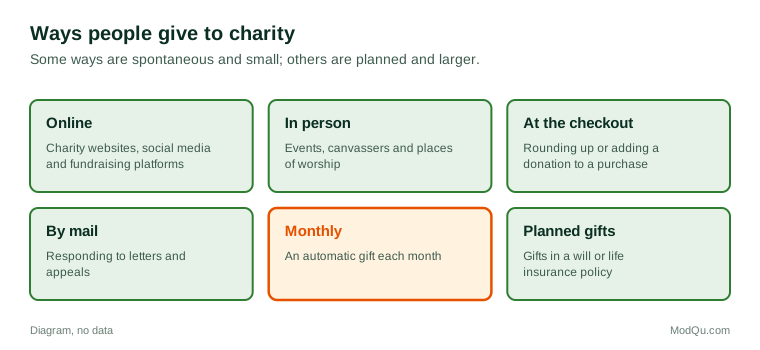
Giving channels have changed a great deal:
- Online, through a charity's website, social media or a fundraising platform.
- In person, at events, door-to-door, through street canvassers or at places of worship.
- At the checkout, by rounding up a purchase or adding a donation at a store or online shop.
- By mail, in response to letters and appeals, still common among older donors.
- By phone or text, including text-to-give campaigns during emergencies.
- Through donor-advised funds and foundations, used by some people who give larger amounts.
Some people prefer to give in ways that feel easy and spontaneous, such as at a till. Others plan their giving carefully once a year, often near the end of the tax year.
Example
A shopper is asked at the checkout whether they would like to donate $2 to a children's hospital. They say yes, as they often do when asked. At the end of the year, they cannot remember how many times they gave this way or to which causes, and none of these small gifts came with a tax receipt.
Monthly giving and loyalty
Many charities encourage monthly giving because it gives them steady income they can plan around. Monthly donors tend to stay for years, often until something changes, such as a drop in income, a move or a bad experience with the charity. People who give monthly often say it lets them give more over a year than they would in one lump sum.
Example (hypothetical figures)
A donor gives $25 a month to a food bank, which comes to $300 a year. In a province where the combined federal and provincial credit for the first $200 is a hypothetical 20% and the rate on the rest is 45%, the credit would be $40 on the first $200 and $45 on the remaining $100, or $85 in total. The donor's after-tax cost would be $215.
Tax receipts and tax credits
In Canada, donations to registered charities can be claimed for a federal and a provincial or territorial tax credit. The federal credit is a lower rate on the first $200 of donations in a year and a higher rate on the amount above $200. Provinces add their own credits. Gifts of publicly listed securities can receive extra tax benefits. Donors usually need an official receipt with the charity's registration number.
Many people say tax credits are not their main reason for giving, but credits can affect how much and when people give, especially larger donors. The United States has a different system based on deductions for people who itemize.
What makes people give, or give more
Research on giving has identified several factors linked to whether and how much people give:
- Being asked: many people give simply because someone asked them directly.
- A personal connection to the cause or to the person asking.
- Trust that the charity will use the money well.
- Seeing the effect: clear stories and specific examples of what a gift achieves.
- Matching gifts, where an employer or donor matches each dollar given.
- Social norms: what friends, family, coworkers and community members do.
- Income and financial security, including how secure people feel about their own future.
- Religion and community life, which research has linked to higher levels of giving.
Reasons people give for not giving, or giving less, include financial pressure, distrust of charities, feeling asked too often, and not knowing which charity to choose.
Example
An office runs a two-week campaign for a local shelter. The company offers to match every employee donation up to a total limit. Several staff who had never given through work donate for the first time, saying the match made their gift feel twice as useful.
Trends in giving
Charities in Canada and elsewhere have reported several trends:
- fewer people giving, while some give larger amounts, so more of the money comes from a smaller group of donors;
- more giving online and through social media;
- growth in crowdfunding for individuals, such as medical costs, which is not the same as giving to a registered charity;
- more interest in giving to local causes and to emergencies;
- younger donors who mix giving money, volunteering, buying from social enterprises and supporting causes online.
What people disagree about
People disagree about whether checkout donations are an appropriate way to ask, whether tax credits for giving are fair when larger donors benefit most, how much charities should spend on fundraising, and whether crowdfunding for individuals should be regulated more closely. Questions that charities and foundations want answered include whether people donated in the last year, which causes they supported and how they gave.
Key terms
- Registered charityAn organization registered with the CRA that can issue official donation receipts.
- Official donation receiptA receipt from a registered charity that can be used to claim a tax credit.
- Monthly givingAn automatic donation made every month.
- In-kind giftA donation of goods or services rather than money.
- Planned giftA gift arranged in advance, such as a bequest in a will.
- Matching giftA donation matched by an employer or another donor.
- CrowdfundingRaising money from many people online, often for a specific project or person.
- Donor-advised fundAn account held at a public foundation from which a donor recommends grants to charities.
Full glossary: fundraising operations terms on EditingTests.com.
Donating to charity vocabulary test
How well do you know the language of this topic? Try 8 quick questions. Your score is shown straight away and is not saved.
What the donating to charity survey asks
This survey is part of ModQu's Charities and Giving survey. The donating to charity part takes about five minutes and covers:
- Whether you donated to a charity in the last year, and roughly how much.
- Which causes you supported, and why those causes.
- How you gave: online, in person, at a store, by mail or through work.
- Whether you give monthly, and what would make you start or stop.
- Whether tax receipts affect how much or when you give.
- What would make you give more.
After that you can choose to continue with other short parts of the Charities and Giving survey, such as volunteering or trust in charities, or stop.
Ready to take part?
Your answers help show what people really think and do. Results are only ever reported as totals; no one can see your individual answers.
Start the surveyQuestions about this survey
Who can take part?
Adults.
Do I have to give my name?
No. You may be asked for your age group, region and similar details so results can be broken down, but not your name. ModQu never asks for passwords, card numbers or account numbers.
How are the results used?
Answers are combined into totals and percentages and published in ModQu reports. Individual answers are never shown.
Is the vocabulary test part of the survey?
No. It is optional and separate, and your score is not stored.