
Share your views on cruising
Tell us whether you have cruised, how you booked and what would make you go, or stop you. Your answers are combined with other people's and reported only as totals.
Start the cruises surveyAbout 5 minutes. No account needed. You can stop at any time.
What this topic covers
This topic covers holidays on passenger ships, including:
- Ocean cruises on large ships carrying thousands of passengers, often in the Caribbean, Mediterranean, Alaska and northern Europe.
- Smaller ship and expedition cruises, including trips to the Arctic and Antarctica.
- River cruises on European, Asian and North American rivers.
- Coastal cruises in Canada, such as voyages along the St. Lawrence River, the Atlantic provinces and the Inside Passage off British Columbia.
- Theme cruises built around music, food, hobbies or interests.
- Ferries and coastal voyages used by travellers, which overlap with cruising in some regions.
It covers people who have cruised and people who are considering it or have decided against it.
Who takes cruises
Cruise passengers are a wide group:
- retirees who value seeing many places without packing and unpacking;
- families attracted by children's programs and set prices;
- couples celebrating anniversaries and honeymoons;
- groups of friends or extended families travelling together;
- first-time travellers who want an easy introduction to a region;
- repeat cruisers, who often stay loyal to one cruise line.
Some people cruise every year; others take one cruise and decide it is not for them. Those who have never cruised often have strong opinions either way.
Example
A couple in their seventies who no longer enjoy long drives or airport connections take a two-week cruise along the coast of Europe. They visit six countries while sleeping in the same cabin each night. They say the cruise let them travel at a pace they could manage.
Kinds of cruises and ships
Cruises vary by ship size, length, region and style:
- Large resort-style ships offer pools, theatres, many restaurants, shops and activities for all ages.
- Mid-size and small ships carry fewer passengers and can reach smaller ports.
- Luxury cruises include more in the fare, with larger cabins and more staff per passenger.
- Expedition cruises focus on nature, wildlife and remote places, often with guides and small boats for landings.
- River cruises stop in towns and cities daily, with a calmer pace and fewer passengers.
Cruise length ranges from short weekend trips to voyages of several weeks or around the world. Many first-time cruisers start with a short trip of three to five nights to see whether they like it.
How people book
People book cruises in several ways:
- through travel agents, who are used more for cruises than for most other kinds of travel;
- directly with the cruise line;
- through online travel sites;
- as part of a group booking, for a reunion or wedding.
Cruises are often booked months or even a year ahead, especially for popular routes and cabin types. Some travellers wait for last-minute deals, which can be cheaper but offer less choice. Choosing a cabin is a key decision: inside cabins with no window cost least, while cabins with balconies and suites cost more.
Example
A family of four books a week-long Caribbean cruise through a travel agent eleven months ahead, to get two connecting cabins during school holidays. The agent also suggests flying in a day early to avoid missing the ship if the flight is delayed, which they had not considered.
What the fare includes and what costs extra
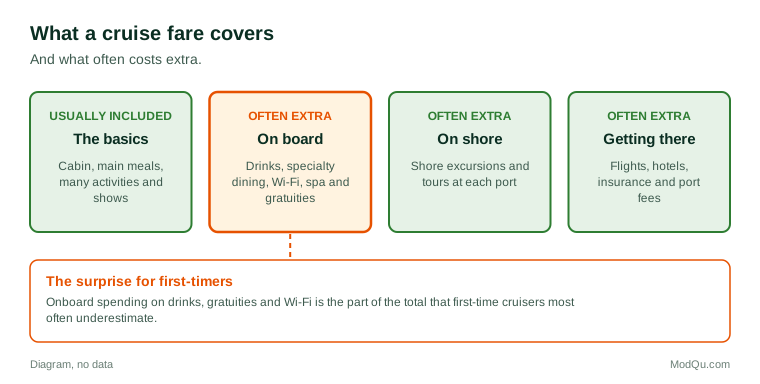
Cruise fares usually include the cabin, main meals, many activities and entertainment. Costs that are often extra include:
- drinks, including alcohol, specialty coffee and sometimes soft drinks, often sold in packages;
- specialty restaurants;
- shore excursions, which are tours at each port;
- Wi-Fi;
- gratuities or service charges, often added per person per day;
- spa treatments and fitness classes;
- port fees and taxes, sometimes shown separately;
- flights and hotels to get to and from the port;
- travel insurance.
These extras can add a large amount to the total. First-time cruisers are often surprised by onboard spending.
Example (hypothetical figures)
Two people book a seven-night cruise for $1,800 each, $3,600 in total. Gratuities are $18 per person per night, adding $252. They buy two shore excursions each at $90, adding $360, and spend $400 on drinks and $80 on Wi-Fi. With flights of $1,000 for both, the total trip costs $5,692.
Questions businesses want answered here include how much passengers spend on board and on shore, which extras they value, and how they compare the total cost with a land-based holiday.
Concerns and reasons people hesitate
People who have not cruised, or have decided not to again, mention:
- seasickness;
- crowds on large ships and in popular ports;
- illness spreading on board, such as stomach viruses;
- feeling confined or tied to a fixed schedule;
- too little time in each port;
- environmental concerns, including emissions and waste;
- effects on port communities, where many passengers arrive at once;
- the cost of extras;
- accessibility, although many ships offer accessible cabins.
Public health agencies monitor sanitation on cruise ships, and the Public Health Agency of Canada runs a program for cruise ships visiting Canadian ports. Many ports, including some in Europe, have introduced limits or fees on cruise visits.
Example
A woman who gets motion sickness on ferries has always refused to cruise. When her sister plans a family river cruise, she agrees to go because rivers are calm and the ship stops in a town every day. She enjoys it, but says she would still not take an ocean cruise.
Cruising and Canadian ports
Canadian ports such as Vancouver, Victoria, Halifax, Quebec City, Saint John and Charlottetown receive cruise ships during the season. Vancouver is a main departure port for Alaska cruises. Cruise visits bring business to local shops, tours and restaurants, but also raise concerns among some residents about congestion and emissions in harbour areas.
What people disagree about
Opinion is divided on whether cruises are good value, whether large ships are too big, how much cruising harms the environment, whether port cities benefit from cruise visitors, and whether a cruise is a real way to see a place. Survey questions help show how these views differ between people who have cruised and people who have not.
Key terms
- Shore excursionA tour or activity at a port of call.
- Port of callA stop on a cruise route where passengers can go ashore.
- EmbarkationBoarding the ship at the start of a cruise.
- Inside cabinA cabin with no window, usually the lowest price.
- Balcony cabinA cabin with a private outdoor deck.
- GratuitiesService charges for crew, often added per day.
- Sea dayA day when the ship is at sea with no port stop.
- Drinks packageA prepaid plan for drinks on board.
Full glossary: cruise operations terms on EditingTests.com.
Cruises vocabulary test
How well do you know the language of this topic? Try 8 quick questions. Your score is shown straight away and is not saved.
What the cruises survey asks
This survey is part of ModQu's Travel and Hospitality survey. The cruises part takes about five minutes and covers:
- Whether you have taken a cruise, how many, and what kinds.
- How you booked your most recent cruise, and how far ahead.
- What you spent on board and on shore, beyond the fare.
- What you liked most and least about cruising.
- What would stop you from cruising, or make you go again.
- Whether you plan to take a cruise in the next two years.
After that you can choose to continue with other short parts of the Travel and Hospitality survey, such as holiday and leisure travel or air travel, or stop.
Ready to take part?
Your answers help show what people really think and do. Results are only ever reported as totals; no one can see your individual answers.
Start the surveyQuestions about this survey
Who can take part?
Adults who have cruised or plan to.
Do I have to give my name?
No. You may be asked for your age group, region and similar details so results can be broken down, but not your name. ModQu never asks for passwords, card numbers or account numbers.
How are the results used?
Answers are combined into totals and percentages and published in ModQu reports. Individual answers are never shown.
Is the vocabulary test part of the survey?
No. It is optional and separate, and your score is not stored.
Can I take part if I have never cruised?
Yes. People who have never cruised are asked about their views and what would make them consider it.