
Share your experience of complaining
Tell us whether you complained about a product or service this year, whether it was resolved and what you know about your rights. Your answers are combined with other people's and reported only as totals.
Start the consumer rights and complaints surveyAbout 5 minutes. No account needed. You can stop at any time.
What consumer rights cover
Consumer rights are legal protections for people who buy goods and services for personal use. In Canada, most consumer protection law is set by the provinces and territories, through consumer protection acts and sale of goods laws, while the federal government covers areas such as product safety, labelling, competition and misleading advertising, banking and telecommunications. In the United States, protections come from both federal and state law.
Common areas covered include:
- Quality: goods should be of acceptable quality and fit for their purpose.
- Accurate descriptions and advertising, with no false or misleading claims.
- Contracts, especially for gyms, home renovations, door-to-door sales and online purchases.
- Cancellation rights for certain contracts.
- Pricing, including hidden fees and price display.
- Debt collection and credit, including rules on how collectors may contact people.
- Product safety, with recalls for dangerous products.
Refunds and returns: policy versus law
Many people believe they have a legal right to return anything they change their mind about. In most of Canada, there is no general legal right to return an item simply because the buyer no longer wants it. Returns for a change of mind depend on the store's own policy, which can vary a great deal and may allow refunds, exchanges, store credit or no returns at all.
Defective goods are different. If a product does not work, is not as described or is not of acceptable quality, sale of goods and consumer protection laws may give the buyer remedies, regardless of a "no returns" sign, though the details differ by province.
Example
A shopper buys a sweater and decides a week later that they do not like the colour. The store's policy allows exchanges only, so they exchange it for another size and colour. The same month they buy a kettle that stops working after two uses. Although the store has a 14-day return policy, the shopper returns it on day 20 and the store replaces it because it was defective.
Warranties and guarantees
A warranty is a promise about a product's quality, usually to repair or replace it if it fails within a period. There are several kinds:
- Manufacturer's warranties, provided with the product.
- Retailer guarantees, such as price match or satisfaction guarantees.
- Extended warranties or protection plans, sold for an extra price.
- Implied warranties or conditions under provincial law that goods are of acceptable quality and fit for purpose, which exist whether or not a written warranty is given.
People often wonder whether extended warranties are worth buying. Consumer groups have noted that some overlap with the manufacturer's warranty, the implied warranty under law or credit card benefits, though it depends on the product and the plan.
Cancellation and cooling-off periods
Some types of contract come with a legal right to cancel within a short period, often called a cooling-off period. In several provinces this applies to door-to-door sales and certain direct agreements, some gym and personal development contracts, and some time-share agreements. Online and distance contracts may also carry cancellation rights if the business did not give required information or did not deliver on time. The rules, time limits and exceptions differ by province.
How people complain
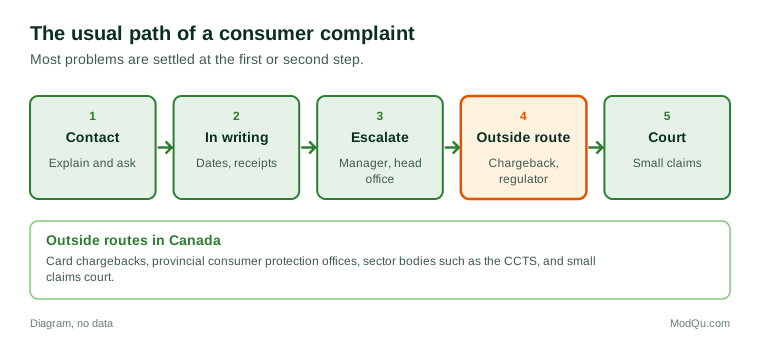
When something goes wrong, people usually follow a sequence:
- Contact the business, in person, by phone, chat or email, and explain the problem and what they want.
- Put it in writing, with the date, order number, photos and receipts.
- Escalate to a manager or head office.
- Use outside routes if the business will not resolve it.
Outside routes include:
- A chargeback through the credit card issuer, for goods not delivered or not as described, subject to the issuer's rules and time limits.
- Provincial consumer protection offices, which take complaints and enforce consumer laws.
- Sector complaint bodies, such as the Commission for Complaints for Telecom-television Services for phone and internet, banking ombudsman services, and the Canadian Transportation Agency for air travel.
- Small claims court, for money claims up to a limit set by each province.
- Public reviews and social media, which some people use to get a business's attention.
Example (hypothetical figures)
A customer pays $640 by credit card for a sofa that never arrives. After six weeks of emails, the store stops replying. The customer files a chargeback with the card issuer, providing the order confirmation and emails. The issuer gives a temporary credit of $640 while it investigates and later makes it permanent when the store does not respond.
Why many people do not complain
Many people with a problem never complain. Reasons people give include:
- the amount is too small to be worth the time;
- they do not know their rights or where to go;
- they expect the business to refuse;
- they find the process tiring or confusing;
- they simply switch to another business next time.
Those who do complain are more likely to have spent more money, to have had a serious problem, or to feel confident about their rights. Businesses that track complaints often see them as a small share of the problems their customers actually have.
Example
A family is charged a $25 "service fee" on a concert ticket order that was not clearly shown until checkout. They feel it is unfair but do not complain because the amount is small. Later, they read that the provincial consumer protection office has received many complaints about the same practice and is reviewing it.
Trends and debates
Trends include more online shopping, which brings issues with delivery, fake websites and returns across borders; subscriptions that are hard to cancel; "drip pricing", where fees are added during checkout; and the right to repair, which concerns access to parts and manuals for fixing products. In Canada, recent changes to federal law have targeted drip pricing as misleading advertising, and several provinces have updated their consumer laws. Debates include how far stores should go beyond the law, whether right-to-repair rules should be widened and how to protect consumers buying from foreign sellers. Questions businesses and public bodies want answered include how often people complain, whether problems are resolved and what people know about their rights.
Key terms
- WarrantyA promise to repair or replace a product if it fails within a period.
- Implied warrantyA legal condition that goods are of acceptable quality, whether or not stated.
- Cooling-off periodA short period in which certain contracts can be cancelled.
- ChargebackReversing a card payment through the card issuer after a dispute.
- Return policyA store's own rules on returns, refunds and exchanges.
- Drip pricingShowing a low price at first and adding fees during checkout.
- Small claims courtA court for money claims up to a set limit, with simpler procedures.
- OmbudsmanAn independent office that investigates complaints.
Full glossary: alternative dispute resolution terms on EditingTests.com.
Consumer rights and complaints vocabulary test
How well do you know the language of this topic? Try 8 quick questions. Your score is shown straight away and is not saved.
What the consumer rights and complaints survey asks
This survey is part of ModQu's Law and Rights survey. The consumer rights and complaints part takes about five minutes and covers:
- Whether you complained about a product or service this year, and what it was.
- How you complained: in person, phone, email, chat, social media or an outside body.
- Whether the problem was resolved, and how long it took.
- What you know about your right to a refund, repair or replacement.
- Whether you have used a chargeback or small claims court.
- What stopped you from complaining, if you had a problem and did not.
After that you can choose to continue with other short parts of the Law and Rights survey, such as using a lawyer or online privacy rights, or stop.
Ready to take part?
Your answers help show what people really think and do. Results are only ever reported as totals; no one can see your individual answers.
Start the surveyQuestions about this survey
Who can take part?
Adults.
Do I have to give my name?
No. You may be asked for your age group, region and similar details so results can be broken down, but not your name. ModQu never asks for passwords, card numbers or account numbers.
How are the results used?
Answers are combined into totals and percentages and published in ModQu reports. Individual answers are never shown.
Is the vocabulary test part of the survey?
No. It is optional and separate, and your score is not stored.