
Surveys · Types and applications
B2B Surveys: Reaching Decision-Makers Inside Organisations
Business-to-business surveys collect the views of people who buy, use or influence purchases on behalf of organisations. This article explains how they differ from consumer surveys, how to reach the right respondents and how to design questionnaires that busy professionals will complete.
Business-to-business (B2B) surveys ask people about decisions they make on behalf of organisations: which suppliers they use, how satisfied they are, what they plan to buy and why. They are used for customer satisfaction research, market sizing, brand tracking and product development among business customers. Although they use the same tools as consumer surveys, they differ in several important ways.
How B2B surveys differ
Small populations. A company selling industrial equipment may have a few hundred customers, and the whole market may contain only a few thousand buying organisations. Samples are small, and losing a few large customers can change results noticeably.
Several decision makers. Business purchases usually involve several people: those who use a product, those who specify it, those who approve the budget and those who negotiate the contract. Each sees the purchase differently, so asking only one person may give a partial picture.
Hard-to-reach respondents. Managers and executives receive many survey requests and have little time. Response rates among executives are typically lower than among the general public (Cycyota & Harrison, 2006), and response rates in organisational research overall have declined over time (Anseel et al., 2010).
Organisational knowledge. Respondents answer as representatives of their organisations. Their answers depend on their role and on what they know about the organisation's decisions.
Choosing the right respondents
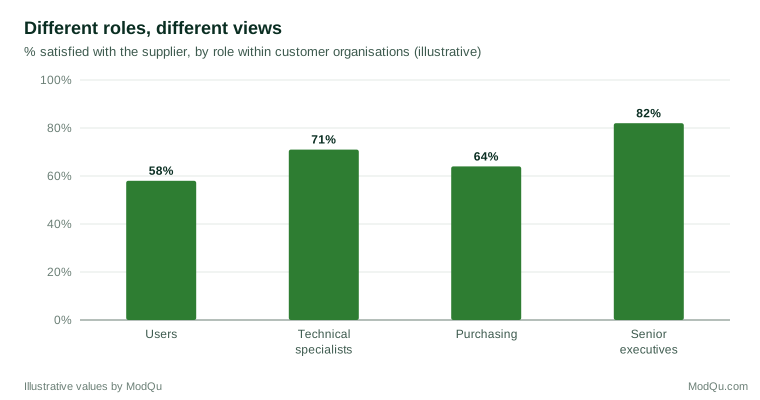
Because the respondent speaks for an organisation, choosing the right person is central. Research on key informants, people chosen because of their knowledge of the topic, shows that informants in different roles can give quite different accounts of the same organisation (Phillips, 1981). Kumar et al. (1993) recommended choosing informants who are well placed to know the answers, using more than one informant per organisation where possible and checking whether their answers agree. Figure 1 shows how views can differ between roles.
Designing the questionnaire
- Keep it short. Ten minutes or less is a common target for busy professionals.
- Use the respondent's language, including the terms used in their industry, but avoid jargon from the supplier's side.
- Ask about their role in decisions, so that answers can be analysed by role.
- Make it easy to answer on a phone, since many professionals respond between meetings.
- Offer a relevant incentive, such as a summary of findings or a donation to charity, which often appeals more to professionals than a small payment.
Methods for business surveys conducted by statistical offices, such as clear definitions and attention to how organisations hold information, also apply to commercial B2B research (Snijkers et al., 2013).
Sampling and weighting
In many B2B markets, a few large customers account for most revenue. A survey that gives each organisation equal weight shows the views of the typical customer, while one weighted by revenue shows the views that matter most to the business. Both are useful, and reports should say which is being shown. Where the whole customer base is small, it is often better to invite every customer than to sample. For market studies beyond a company's own customers, sampling frames such as business directories are incomplete, and the results should be checked against known figures on the number and size of firms in each industry.
Confidentiality
Business respondents may worry that their answers will be shared with suppliers or competitors. Surveys run by an independent research agency, with a clear promise that individual answers will not be passed on without permission, tend to produce more candid answers than surveys sent directly by the supplier.
Contact strategies
Lists of business contacts become outdated quickly as people change jobs. Pre-notifying respondents, personalising invitations, sending reminders and having the invitation come from a known person, such as the account manager, can improve response (Dillman et al., 2014). Telephone interviews remain common for senior respondents and for complex topics.
An example
An industrial software company surveys its 400 customer organisations. Instead of one contact per customer, it invites the main user, the technical lead and the budget holder. Overall, 290 organisations respond, with at least two roles from 180 of them. Users report much lower satisfaction with the product's ease of use than budget holders do, which leads the company to invest in training and interface changes it would otherwise have missed (illustrative example).
Conclusion
B2B surveys require careful choice of respondents, short and relevant questionnaires and persistent contact strategies. Asking several people in different roles within each organisation gives a fuller and more accurate picture of business customers than relying on a single contact.
References
Anseel, F., Lievens, F., Schollaert, E., & Choragwicka, B. (2010). Response rates in organizational science, 1995–2008: A meta-analytic review and guidelines for survey researchers. Journal of Business and Psychology, 25(3), 335–349. https://doi.org/10.1007/s10869-010-9157-6
Cycyota, C. S., & Harrison, D. A. (2006). What (not) to expect when surveying executives: A meta-analysis of top manager response rates and techniques over time. Organizational Research Methods, 9(2), 133–160. https://doi.org/10.1177/1094428105280770
Dillman, D. A., Smyth, J. D., & Christian, L. M. (2014). Internet, phone, mail, and mixed-mode surveys: The tailored design method (4th ed.). Wiley.
Kumar, N., Stern, L. W., & Anderson, J. C. (1993). Conducting interorganizational research using key informants. Academy of Management Journal, 36(6), 1633–1651. https://doi.org/10.2307/256824
Phillips, L. W. (1981). Assessing measurement error in key informant reports: A methodological note on organizational analysis in marketing. Journal of Marketing Research, 18(4), 395–415. https://doi.org/10.1177/002224378101800401
Snijkers, G., Haraldsen, G., Jones, J., & Willimack, D. K. (2013). Designing and conducting business surveys. Wiley. https://doi.org/10.1002/9781118447895