
Research · Research integrity
The Belmont Report and the Principles of Research Ethics
The history and content of the Belmont Report, its three principles of respect for persons, beneficence and justice, how they apply in informed consent, risk assessment and participant selection, and how the principles are used and debated today.
Most modern rules for research involving people trace back to a short document published in 1979. The Belmont Report, written by a United States national commission, set out three ethical principles, respect for persons, beneficence and justice, and showed how each applies to the conduct of research. Its principles now underpin research regulations in the United States and have shaped ethics guidance in many other countries, including Canada. This article explains why the report was written, what it says, how its principles are applied and where they have been criticised or extended.
The background
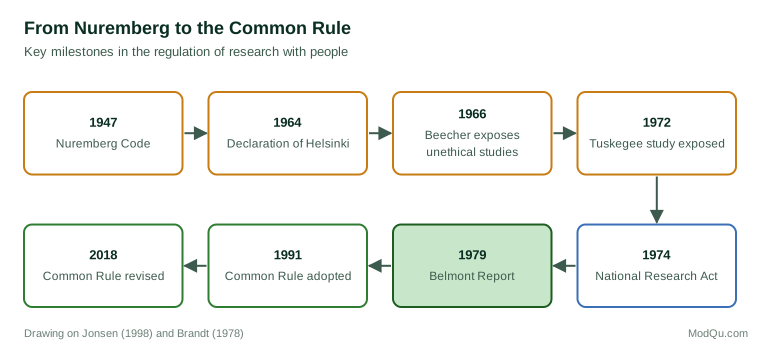
The Belmont Report was a response to a history of abuse. After the Second World War, the trial of Nazi doctors who had performed lethal experiments on prisoners produced the Nuremberg Code, ten principles for permissible medical experiments, beginning with the statement that the voluntary consent of the human subject is absolutely essential (Nuremberg Code, 1949). Shuster (1997) described how the Code became a foundation for later ethics guidance, although at first many researchers in democratic countries saw it as a code for barbarians rather than one that applied to them. In 1964 the World Medical Association adopted the Declaration of Helsinki, which set out ethical principles for medical research and has been revised many times since (World Medical Association, 2013).
These codes did not prevent abuse. Beecher (1966) described 22 studies published in reputable journals in which patients had been exposed to risk without their knowledge. In the United States, the Tuskegee study of untreated syphilis, which ran from 1932 to 1972, followed hundreds of poor Black men who were not told their diagnosis and were not offered penicillin even after it became the standard treatment (Brandt, 1978; Reverby, 2009). Cells taken from Henrietta Lacks in 1951, without her knowledge, became one of the most widely used cell lines in research, raising lasting questions about consent and the use of human tissue (Skloot, 2010). Social research too had its controversies, from Milgram's (1963) obedience experiments, which caused visible distress to participants, to studies involving deception and covert observation.
Public exposure of the Tuskegee study in 1972 led Congress to pass the National Research Act in 1974. The Act created the National Commission for the Protection of Human Subjects of Biomedical and Behavioral Research and asked it to identify the basic ethical principles that should govern research with human participants. After several years of work, including a meeting at the Belmont Conference Center in Maryland that gave the report its name, the Commission published its report in 1979 (National Commission, 1979). Jonsen (1998), who served on the Commission, described how its members, drawn from medicine, law, philosophy and other fields, reached agreement on principles despite differing views on many specific cases.
Research and practice
The report begins by distinguishing research from practice. Practice refers to interventions designed solely to benefit an individual patient or client, with a reasonable expectation of success. Research refers to activities designed to test a hypothesis and contribute to generalisable knowledge. The distinction matters because research may expose people to risks for the sake of knowledge that benefits others, which is what makes special protections necessary. The report recognised that the two often overlap, and stated that any activity with an element of research should be reviewed.
The three principles
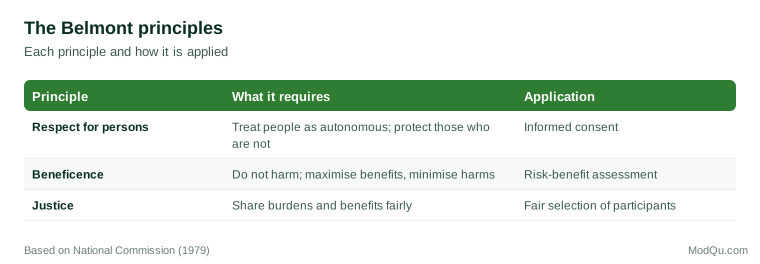
The heart of the report is a statement of three principles, each linked to a practical application.
Respect for persons
Respect for persons contains two ethical convictions: individuals should be treated as autonomous agents, and people with diminished autonomy are entitled to protection. Treating someone as autonomous means respecting their considered choices and not withholding information they need to make them. Some people, such as children, people with certain illnesses or disabilities, and people in restrictive settings such as prisons, may not be able to exercise full self-determination and need additional protection. The report acknowledged that judging the degree of protection required can be difficult, and that excessive protection can itself be a form of disrespect.
The main application of this principle is informed consent. The report identified three elements. Information: participants should be told the research procedure, its purposes, risks and anticipated benefits, any alternatives, and that they may ask questions and withdraw at any time. Comprehension: the information must be presented in a way that participants can understand, taking into account their capacities. Voluntariness: consent must be given freely, without coercion or undue influence, such as excessive payments or pressure from people in positions of authority.
Faden and Beauchamp (1986), in a detailed history of informed consent, argued that consent is meaningful only when it involves substantial understanding and the absence of controlling influence, not merely a signature on a form.
Beneficence
Beneficence means not only refraining from harm but also making efforts to secure people's well-being. The report expressed this in two rules: do not harm, and maximise possible benefits while minimising possible harms. Because research can involve risk to individuals for the sake of benefits to others, beneficence requires a careful weighing of risks against benefits.
Its application is the systematic assessment of risks and benefits. Researchers and review committees should consider the nature, probability and size of possible harms, whether physical, psychological, legal, social or economic, and whether the risks are justified by the expected benefits to participants or to society. Risks should be reduced to those necessary to achieve the research objective, and alternatives with lower risk should be considered.
Justice
Justice concerns the fair distribution of the burdens and benefits of research. The report asked who ought to receive the benefits of research and who ought to bear its burdens, and noted that injustice arises when some groups, such as welfare patients, particular racial or ethnic minorities, or people confined to institutions, are selected because they are easily available or easily manipulated rather than for reasons directly related to the research question. The Tuskegee study was the clearest example: the burdens fell on a disadvantaged group, while the benefits of medical knowledge flowed elsewhere.
The application of justice is the fair selection of research participants, at both the individual level, where researchers should not offer potentially beneficial research only to favoured individuals or risky research only to undesirable ones, and the social level, where some groups should not bear a disproportionate share of research burdens.
Vulnerability
The report's treatment of people with diminished autonomy has developed into a broader concept of vulnerability. A person may be vulnerable not only because of limited capacity to consent, but because of their circumstances: dependence on the researcher, poverty that makes payments hard to refuse, insecure legal status or membership of a stigmatised group. Current guidance generally asks researchers to identify the specific ways in which participants might be vulnerable and to put targeted protections in place, rather than simply excluding whole categories of people (Council for International Organizations of Medical Sciences, 2016).
When principles conflict
The three principles often point in the same direction, but not always. Two common tensions illustrate the difficulty.
Respect for persons versus beneficence. A competent adult may wish to join a study that carries significant risk, perhaps because they hope to benefit from an experimental treatment. Respect for their autonomy suggests allowing them to choose; beneficence suggests protecting them from harm. Review committees usually resolve the tension by requiring that risks be reasonable in relation to anticipated benefits before people are offered the choice at all, and then respecting the choices of those who are informed.
Justice as protection versus justice as access. After Tuskegee, justice was understood mainly as protecting vulnerable groups from being exploited by research. Over time, it became clear that excluding groups such as women, older people, children and ethnic minorities from research could also be unjust, because treatments and policies were then developed without evidence about how they affected those groups. Justice therefore requires not only that burdens be shared fairly, but also that the benefits of research reach everyone who needs them.
Belmont and social research
The Belmont Report was written mainly with biomedical and behavioural experiments in mind, but its principles apply to social research as well, sometimes in ways that require careful interpretation.
Humphreys (1970) studied men who met for sex in public toilets, acting as a lookout to observe them, noting their car licence plates, and later interviewing some of them at home under the pretext of a health survey. The study produced findings that challenged stereotypes, but it involved deception, covert observation and the collection of information that could have caused serious harm if disclosed. It is often used to show how respect for persons, through consent and privacy, can conflict with the pursuit of knowledge about hidden or stigmatised behaviour.
In social research, the most common risks are not physical but involve privacy, confidentiality, embarrassment and distress. Applying beneficence means paying close attention to how data are collected, stored and reported, so that individuals cannot be identified from published findings. Applying respect for persons means considering whether people can genuinely refuse, for example when a survey is distributed by an employer or when participants depend on the organisation running the research.
From principles to rules
The Belmont Report itself is not a regulation. Its principles were translated into rules through federal regulations, later known as the Common Rule, which require review by institutional review boards, informed consent and additional protections for vulnerable groups. The Common Rule was revised in 2018, partly to reduce burdens on low-risk research and to update consent requirements (U.S. Department of Health and Human Services, 2018).
Other countries developed their own frameworks, often drawing on similar principles. Canada's Tri-Council Policy Statement is built on three core principles, respect for persons, concern for welfare and justice, which closely parallel Belmont while placing particular emphasis on welfare and on research involving Indigenous peoples (Canadian Institutes of Health Research et al., 2022). The international guidelines of the Council for International Organizations of Medical Sciences (2016) apply similar principles to health research in lower-resource settings.
The principles beyond research regulation
The Belmont principles also shaped the wider field of bioethics. Beauchamp, who helped draft the report, and Childress set out four principles of biomedical ethics: respect for autonomy, non-maleficence, beneficence and justice (Beauchamp & Childress, 2019). Their framework, often called principlism, separated the duty not to harm from the duty to do good and became one of the most widely taught approaches to ethics in medicine and health care.
The same principles have been adapted to new kinds of research. Dittrich and Kenneally (2012), in the Menlo Report, applied Belmont's principles to research in information and communication technology, adding a fourth principle of respect for law and public interest to address issues such as cybersecurity research and the use of network data.
Criticisms and debates
The Belmont Report has been widely praised for its clarity and durability, but it has also attracted criticism.
Abstraction. Principles stated at a high level do not settle hard cases. Critics argue that they can be balanced in different ways to reach opposite conclusions, and that the report gives little guidance on what to do when principles conflict, for example when respecting a person's choice to take part in risky research conflicts with protecting their welfare. Childress et al. (2005), reflecting on the report a quarter of a century later, brought together a range of views on how well its principles had worked and where they needed development.
Focus on the individual. The report concentrates on protecting individual participants. Some critics argue that it pays too little attention to communities, which can be harmed by research even when each individual has consented, for example when findings stigmatise a group.
Consent as a formality. Corrigan (2003) studied how consent was obtained in practice and argued that it had become an empty ritual in many settings: patients signed forms without engaging with the information, often because they trusted their doctors. This critique does not reject the principle of respect for persons, but questions whether current consent procedures honour it.
The research-practice distinction. As learning health systems, quality improvement and data-driven services blur the boundary between research and routine activity, the distinction on which the report rests has become harder to apply. Friesen et al. (2017) argued that the report needs revisiting to address such developments, as well as questions of data, privacy and the inclusion of under-represented groups.
New forms of research. Large-scale online studies raise questions the report did not foresee. Kramer et al. (2014) altered the content of the news feeds of nearly 700,000 social media users to study emotional contagion, relying on the platform's general data use policy rather than specific consent, which prompted widespread criticism. Metcalf and Crawford (2016) argued that much research using large data sets falls outside existing ethics review because it does not fit traditional definitions of human subjects research, even though it can affect people in significant ways.
Applying the principles in practice
For researchers in any field, including business and market research, the three principles translate into practical questions:
- Respect for persons. Do participants know what they are taking part in? Can they say no, or withdraw, without penalty? Are they free from pressure, for example from an employer or a client?
- Beneficence. What could go wrong for participants, including distress, embarrassment or breaches of privacy? Have these risks been reduced as far as possible? Are the remaining risks justified by what the research will achieve?
- Justice. Why were these participants chosen? Are some groups being asked to bear the burdens of research while others reap the benefits? Are groups who would benefit from the research being excluded without good reason?
Consider an illustrative example. A company plans to survey its own customers about their financial worries, to design a new savings product. Respect for persons suggests telling customers clearly who is running the survey and why, making clear that taking part is optional and will not affect their accounts, and allowing them to skip questions. Beneficence suggests asking whether questions about money might cause distress, offering information about sources of help, and keeping answers secure and separate from account records. Justice suggests checking whether the sample includes customers on low incomes, who may have the most to gain from a better product, rather than only the easiest customers to reach. None of these steps is complicated, but each follows directly from one of the three principles.
Freedman (1987) added an important principle for comparative studies: a trial comparing treatments is ethical only when there is genuine uncertainty in the expert community about which is better, a condition he called clinical equipoise. The same logic applies to tests of products or services: it is hard to justify assigning people to an option the researcher already knows to be worse.
Conclusion
The Belmont Report distilled decades of hard experience into three principles that remain the foundation of research ethics. Respect for persons requires informed and voluntary consent; beneficence requires careful weighing of risks and benefits; justice requires fair selection of participants. The principles do not resolve every hard case, and new forms of research continue to test them. But they provide a shared language for asking whether research treats people as they deserve to be treated, and that question applies as much to a commercial survey as to a clinical trial.
References
Beauchamp, T. L., & Childress, J. F. (2019). Principles of biomedical ethics (8th ed.). Oxford University Press.
Beecher, H. K. (1966). Ethics and clinical research. New England Journal of Medicine, 274(24), 1354–1360. https://doi.org/10.1056/NEJM196606162742405
Brandt, A. M. (1978). Racism and research: The case of the Tuskegee syphilis study. Hastings Center Report, 8(6), 21–29. https://doi.org/10.2307/3561468
Canadian Institutes of Health Research, Natural Sciences and Engineering Research Council of Canada, & Social Sciences and Humanities Research Council of Canada. (2022). Tri-Council policy statement: Ethical conduct for research involving humans – TCPS 2 (2022). Government of Canada.
Childress, J. F., Meslin, E. M., & Shapiro, H. T. (Eds.). (2005). Belmont revisited: Ethical principles for research with human subjects. Georgetown University Press.
Corrigan, O. (2003). Empty ethics: The problem with informed consent. Sociology of Health & Illness, 25(7), 768–792. https://doi.org/10.1046/j.1467-9566.2003.00369.x
Council for International Organizations of Medical Sciences. (2016). International ethical guidelines for health-related research involving humans (4th ed.). CIOMS.
Dittrich, D., & Kenneally, E. (2012). The Menlo Report: Ethical principles guiding information and communication technology research. U.S. Department of Homeland Security.
Faden, R. R., & Beauchamp, T. L. (1986). A history and theory of informed consent. Oxford University Press.
Freedman, B. (1987). Equipoise and the ethics of clinical research. New England Journal of Medicine, 317(3), 141–145. https://doi.org/10.1056/NEJM198707163170304
Friesen, P., Kearns, L., Redman, B., & Caplan, A. L. (2017). Rethinking the Belmont Report? The American Journal of Bioethics, 17(7), 15–21. https://doi.org/10.1080/15265161.2017.1329482
Humphreys, L. (1970). Tearoom trade: Impersonal sex in public places. Aldine.
Jonsen, A. R. (1998). The birth of bioethics. Oxford University Press.
Kramer, A. D. I., Guillory, J. E., & Hancock, J. T. (2014). Experimental evidence of massive-scale emotional contagion through social networks. Proceedings of the National Academy of Sciences, 111(24), 8788–8790. https://doi.org/10.1073/pnas.1320040111
Metcalf, J., & Crawford, K. (2016). Where are human subjects in Big Data research? The emerging ethics divide. Big Data & Society, 3(1). https://doi.org/10.1177/2053951716650211
Milgram, S. (1963). Behavioral study of obedience. Journal of Abnormal and Social Psychology, 67(4), 371–378. https://doi.org/10.1037/h0040525
National Commission for the Protection of Human Subjects of Biomedical and Behavioral Research. (1979). The Belmont report: Ethical principles and guidelines for the protection of human subjects of research. U.S. Department of Health, Education, and Welfare.
Nuremberg Code. (1949). In Trials of war criminals before the Nuernberg military tribunals under Control Council Law No. 10 (Vol. 2, pp. 181–182). U.S. Government Printing Office.
Reverby, S. M. (2009). Examining Tuskegee: The infamous syphilis study and its legacy. University of North Carolina Press.
Shuster, E. (1997). Fifty years later: The significance of the Nuremberg Code. New England Journal of Medicine, 337(20), 1436–1440. https://doi.org/10.1056/NEJM199711133372006
Skloot, R. (2010). The immortal life of Henrietta Lacks. Crown.
U.S. Department of Health and Human Services. (2018). Protection of human subjects (45 C.F.R. pt. 46).
World Medical Association. (2013). World Medical Association Declaration of Helsinki: Ethical principles for medical research involving human subjects. JAMA, 310(20), 2191–2194. https://doi.org/10.1001/jama.2013.281053