
Research · Qualitative research
Online Qualitative Research: Communities, Forums and Asynchronous Groups
How qualitative research is carried out online, covering video and text interviews, live and asynchronous focus groups, research communities and diaries, the effects of the online setting on what people say, moderation, analysis, ethics of online data and when online methods are the better choice.
Much qualitative research now takes place online. Interviews are held by video call, focus groups meet on screen or on discussion boards, and research communities run for weeks, with participants posting photographs, diary entries and replies to one another. The shift accelerated sharply during the COVID-19 pandemic, when face-to-face fieldwork stopped almost overnight, but it was well under way before then and has persisted since. Online methods are not simply in-person methods moved to a screen. They change who can take part, how people express themselves and what kind of data is produced. This article describes the main online qualitative methods, how they differ from their offline equivalents, and how to use them well.
The main forms
Online qualitative methods vary along two dimensions: whether interaction happens in real time (synchronous) or over an extended period (asynchronous), and whether communication is mainly text or audio and video.
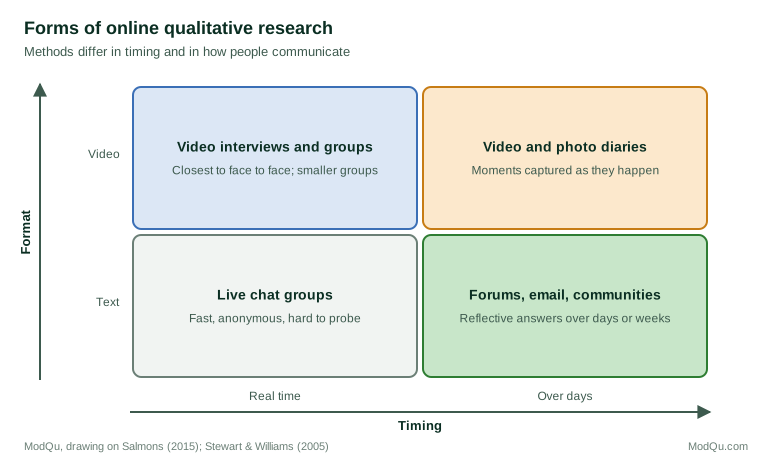
Video interviews and groups are the closest to face-to-face research. Live text groups, using chat software, were common before video became reliable and are still used for some topics. Asynchronous methods include email interviews, in which questions and answers are exchanged over days or weeks (Meho, 2006), online forums or bulletin board groups, and research communities, in which a group of participants takes part in a series of activities over an extended period. Video and photo diaries ask participants to record moments of their lives as they happen.
Video interviews and groups
Video interviews became standard during the pandemic, and research on them has grown. Archibald et al. (2019) found that participants and researchers rated video interviews highly for convenience, cost and ability to build rapport, although technical problems such as poor connections were common. Gray et al. (2020) similarly reported that participants valued being able to take part from their own homes and that the quality of the interviews was comparable to face-to-face interviews. Lobe et al. (2020) reviewed practical issues, including choosing platforms, securing recordings and managing consent remotely.
Video groups work best with fewer participants than in-person groups, typically four to six, because turn-taking is harder on screen and non-verbal cues are weaker. Moderators need to invite contributions by name more often and to check that everyone can be heard and seen. Salmons (2015) emphasised that researchers should choose the online setting deliberately, considering how its features, such as visual presence or the ability to share screens and documents, fit the research question.
Text-based and asynchronous methods
Text-based methods produce a different kind of data. Bampton and Cowton (2002) noted that email interviews give participants time to reflect before answering, which can produce more considered and detailed responses, and remove the need for transcription. They also lose the spontaneity of conversation, and probing takes longer because each exchange may take a day. Meho (2006) reviewed studies using email interviews and concluded that they can yield data of similar quality to face-to-face interviews, particularly with participants who are comfortable writing, but that response rates can drop as exchanges continue.
Online focus groups in text form have their own dynamics. Stewart and Williams (2005) found that participants in text-based groups often wrote more freely about some sensitive topics, but that the absence of tone and facial expression could lead to misunderstanding. Fox et al. (2007) ran synchronous online groups with young people with chronic skin conditions and found that the format allowed participants who would have been reluctant to meet face to face to take part, although the fast pace of live chat made it hard to follow threads and probe in depth. Tates et al. (2009) found asynchronous online groups useful for including hard-to-reach groups, such as children with cancer and their parents, who could take part at times that suited them.
Research communities
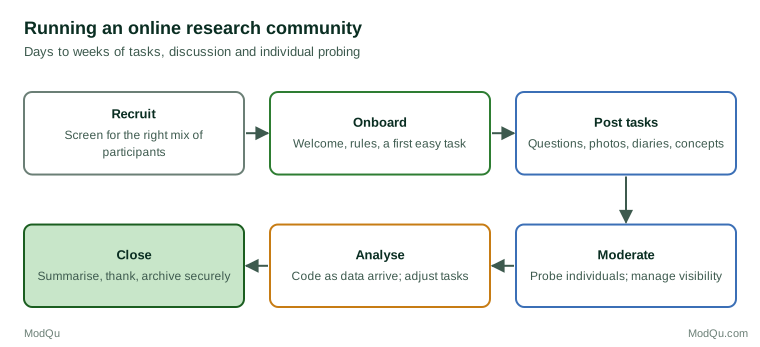
A research community, sometimes called an insight community or online qualitative board, brings together a group of participants, often between 20 and 100, on a private platform for a period of days to months. Each day or week, the moderator posts tasks: questions to answer, photographs to upload, short diaries, reactions to concepts, or polls. Participants respond individually and can often see and comment on each other's responses. The moderator follows up with individual probes.
Communities combine features of several methods. They allow depth over time, like a diary study; interaction among participants, like a focus group; and individual probing, like an interview. They are particularly useful for studying experiences that unfold over days or weeks, such as trying a new product, preparing for a major purchase or adjusting to a change in routine. Bolger et al. (2003) showed that diary methods capture experience close to the time it happens, reducing the recall errors that affect retrospective interviews, and research communities apply the same principle.
The main stages of running a community are shown below.
Communities also have risks. Participants who remain in a community for a long time can become conditioned, learning what the researcher wants or becoming more expert and enthusiastic than ordinary customers. Engagement usually falls over time, so tasks need to be varied and the duration matched to the question.
Studying existing online communities
A different approach studies online communities that already exist, such as brand forums, patient support groups or hobby sites, rather than creating them for research. Hine (2000) developed virtual ethnography, which treats the internet both as a culture in its own right and as a cultural product shaped by how people use it. Kozinets (2002) developed netnography, an adaptation of ethnography for studying online communities, initially for marketing research. These methods observe naturally occurring interaction, which can reveal how people talk about products and experiences when no researcher is asking.
Research on brand communities shows what such study can reveal. Muniz and O'Guinn (2001) identified three markers of brand community: a shared consciousness of belonging, rituals and traditions, and a sense of moral responsibility to other members. Schau et al. (2009) identified a set of practices through which brand community members create value, such as welcoming newcomers, sharing tips and documenting their experiences.
How the online setting changes what people say
The online setting affects disclosure. Joinson (2001) found in experiments that people disclosed more about themselves in text-based computer-mediated communication than face to face, and that visual anonymity increased disclosure. Suler (2004) described an online disinhibition effect: people may say things online that they would not say in person, sometimes more openly and honestly, sometimes more aggressively. For researchers, this can be an advantage on sensitive topics, but it also means that online responses may differ systematically from those given in person.
The setting also shapes who takes part. Online methods can include people who are geographically dispersed, have mobility difficulties, have caring responsibilities or prefer not to meet strangers. They can also exclude people with limited internet access, low digital confidence or poor literacy, depending on the format. The sample should be planned with these effects in mind.
Planning an online study
Planning starts with the platform. Video platforms differ in how they handle recording, security, breakout rooms and screen sharing; discussion and community platforms differ in how tasks are posted, whether participants can see each other's answers, how images and video are uploaded and how data are exported. The platform should be tested with a pilot participant on the kinds of device participants will use, including phones, because many participants will take part on a small screen.
Timing needs more thought than in face-to-face work. Synchronous sessions must suit participants' time zones and routines. Asynchronous tasks should be short enough to complete in a few minutes on a phone, with longer tasks spread over several days. Lobe et al. (2020) recommend preparing participants in advance with simple instructions and a test call, and having a backup plan, such as a telephone number, for when connections fail.
Consent also changes. Participants should understand what will be recorded, who will see their posts or videos, whether other participants will see their contributions, and how long data will be kept. Electronic consent forms and a short spoken confirmation at the start of a recorded session are common.
Data quality and fraudulent participants
Online recruitment brings a risk that is rare in face-to-face research: participants who are not who they claim to be. Incentives attract people who misrepresent themselves to qualify, and automated programs can complete screening questionnaires. Pozzar et al. (2020) found that an online survey promoted through social media attracted a large number of fraudulent and automated responses within hours, and that many could only be identified through careful checks. Qualitative studies are not immune: people may join video interviews with cameras off and give vague, generic answers about experiences they have never had.
Practical safeguards include screening questions that require specific knowledge, checking for duplicate or inconsistent details, asking participants to turn on their cameras at least briefly, and reviewing early responses for signs of invented accounts. These checks should be proportionate and respectful, and explained in the consent information, because genuine participants may have good reasons for privacy.
Moderation and probing online
The basic skills of qualitative moderation apply online, but they need adapting. In asynchronous methods, the moderator cannot react in the moment, so tasks and questions must be written clearly enough to stand alone, and probes must be sent promptly so that participants do not lose interest. Krueger and Casey (2015) emphasise that online groups need more careful preparation of questions and closer attention to participation, because silence online is harder to interpret than silence in a room.
Practical techniques include:
- writing a short, friendly welcome and clear instructions for how the platform works;
- asking for concrete examples and, where useful, photographs or screenshots;
- probing individuals privately when a response is brief or intriguing;
- controlling whether participants see each other's answers before posting their own, to reduce conformity;
- keeping a log of probes and responses for analysis.
Accessibility and inclusion
Online methods can widen participation, but only if they are designed for the people being studied. Older participants, people with visual or hearing impairments, and people with limited literacy may find some platforms difficult. Simple steps help: offering a choice between video, telephone and text; providing captions or written versions of spoken prompts; allowing responses by voice note as well as by typing; and keeping tasks short and clearly worded. Tates et al. (2009) showed that well-designed online formats can include people who would otherwise be left out of research altogether, such as seriously ill children and their parents.
Equipment and connection costs also matter. Video participation uses mobile data, which some participants pay for. Offering to cover data costs, or providing a lower-bandwidth option, avoids excluding people on limited budgets. In international studies, platform availability, language settings and local norms about being recorded at home should be checked in each country before fieldwork begins.
Analysis
Online methods produce data that are already in text, image or video form, often time-stamped and linked to individual participants. This makes organisation easier, but the volume can be large. The same analytic approaches used offline, such as thematic analysis, apply. Analysts should note the format in which each response was given, because a typed answer written after reflection differs from a spontaneous spoken remark. In research communities, it is useful to analyse both individual trajectories over time and the interaction among participants. Braun et al. (2017) discuss how textual, media and virtual data can be collected and analysed using established qualitative methods.
Ethics of online research
Online research raises specific ethical questions. In created spaces, such as research communities, the usual principles of informed consent, confidentiality and secure storage apply, with added care for the platform's data handling and for images that may identify participants or others.
In existing online spaces, the question of whether posts are public or private is more difficult. Eysenbach and Till (2001) argued that researchers should consider how members perceive the space, not only whether it is technically accessible: a support forum for people with a health condition may be open to anyone, but its members may experience it as private. Quoting posts verbatim can make them traceable through search engines. The Association of Internet Researchers' guidelines recommend that researchers weigh the expectations of the people involved, the vulnerability of the group and the potential for harm, rather than applying a single rule (franzke et al., 2020).
When to choose online methods
Online methods are the better choice when participants are dispersed, when the experience being studied happens online, when an extended period of observation is needed, or when participants are more comfortable discussing a topic from a distance. In-person methods remain better when the physical setting matters, when the research needs to observe behaviour with objects or spaces, or when participants are unlikely to engage with a digital platform. Many projects combine the two. Fielding et al. (2017) provide a broad overview of online research methods for those planning such designs.
A hypothetical example illustrates the strengths of a research community. A food company launching a meal kit recruits 40 households to a two-week community. Each evening, participants upload a photograph of the meal they cooked and answer three short questions. Twice a week, the moderator posts a discussion topic. The community shows that enthusiasm fades by the second week, not because of taste but because preparation time competes with children's bedtimes, a pattern that a single interview or group, held at one moment, would have missed. A short set of follow-up video interviews with families who stopped cooking the kits then explores the evening routine in more depth, combining the breadth of the community with the depth of individual conversation.
Conclusion
Online qualitative methods extend the reach of qualitative research and make new forms of data possible, from asynchronous discussion to diaries captured in the moment. They also change what people say and who takes part. Choosing the right online method for the question, adapting moderation to the medium, analysing data with attention to its format and handling online data ethically allow these methods to produce insight as rich as, and sometimes richer than, their face-to-face counterparts.
References
Archibald, M. M., Ambagtsheer, R. C., Casey, M. G., & Lawless, M. (2019). Using Zoom videoconferencing for qualitative data collection: Perceptions and experiences of researchers and participants. International Journal of Qualitative Methods, 18. https://doi.org/10.1177/1609406919874596
Bampton, R., & Cowton, C. J. (2002). The e-interview. Forum Qualitative Sozialforschung / Forum: Qualitative Social Research, 3(2), Article 9. https://doi.org/10.17169/fqs-3.2.848
Bolger, N., Davis, A., & Rafaeli, E. (2003). Diary methods: Capturing life as it is lived. Annual Review of Psychology, 54, 579–616. https://doi.org/10.1146/annurev.psych.54.101601.145030
Braun, V., Clarke, V., & Gray, D. (Eds.). (2017). Collecting qualitative data: A practical guide to textual, media and virtual techniques. Cambridge University Press. https://doi.org/10.1017/9781107295094
Eysenbach, G., & Till, J. E. (2001). Ethical issues in qualitative research on internet communities. BMJ, 323(7321), 1103–1105. https://doi.org/10.1136/bmj.323.7321.1103
Fielding, N. G., Lee, R. M., & Blank, G. (Eds.). (2017). The SAGE handbook of online research methods (2nd ed.). SAGE. https://doi.org/10.4135/9781473957992
Fox, F. E., Morris, M., & Rumsey, N. (2007). Doing synchronous online focus groups with young people: Methodological reflections. Qualitative Health Research, 17(4), 539–547. https://doi.org/10.1177/1049732306298754
franzke, a. s., Bechmann, A., Zimmer, M., Ess, C., & the Association of Internet Researchers. (2020). Internet research: Ethical guidelines 3.0. Association of Internet Researchers. https://aoir.org/reports/ethics3.pdf
Gray, L. M., Wong-Wylie, G., Rempel, G. R., & Cook, K. (2020). Expanding qualitative research interviewing strategies: Zoom video communications. The Qualitative Report, 25(5), 1292–1301. https://doi.org/10.46743/2160-3715/2020.4212
Hine, C. (2000). Virtual ethnography. SAGE. https://doi.org/10.4135/9780857020277
Joinson, A. N. (2001). Self-disclosure in computer-mediated communication: The role of self-awareness and visual anonymity. European Journal of Social Psychology, 31(2), 177–192. https://doi.org/10.1002/ejsp.36
Kozinets, R. V. (2002). The field behind the screen: Using netnography for marketing research in online communities. Journal of Marketing Research, 39(1), 61–72. https://doi.org/10.1509/jmkr.39.1.61.18935
Krueger, R. A., & Casey, M. A. (2015). Focus groups: A practical guide for applied research (5th ed.). SAGE.
Lobe, B., Morgan, D., & Hoffman, K. A. (2020). Qualitative data collection in an era of social distancing. International Journal of Qualitative Methods, 19. https://doi.org/10.1177/1609406920937875
Meho, L. I. (2006). E-mail interviewing in qualitative research: A methodological discussion. Journal of the American Society for Information Science and Technology, 57(10), 1284–1295. https://doi.org/10.1002/asi.20416
Muniz, A. M., Jr., & O'Guinn, T. C. (2001). Brand community. Journal of Consumer Research, 27(4), 412–432. https://doi.org/10.1086/319618
Pozzar, R., Hammer, M. J., Underhill-Blazey, M., Wright, A. A., Tulsky, J. A., Hong, F., Gundersen, D. A., & Berry, D. L. (2020). Threats of bots and other bad actors to data quality following research participant recruitment through social media: Cross-sectional questionnaire. Journal of Medical Internet Research, 22(10), Article e23021. https://doi.org/10.2196/23021
Salmons, J. (2015). Qualitative online interviews: Strategies, design, and skills (2nd ed.). SAGE.
Schau, H. J., Muñiz, A. M., Jr., & Arnould, E. J. (2009). How brand community practices create value. Journal of Marketing, 73(5), 30–51. https://doi.org/10.1509/jmkg.73.5.30
Stewart, K., & Williams, M. (2005). Researching online populations: The use of online focus groups for social research. Qualitative Research, 5(4), 395–416. https://doi.org/10.1177/1468794105056916
Suler, J. (2004). The online disinhibition effect. CyberPsychology & Behavior, 7(3), 321–326. https://doi.org/10.1089/1094931041291295
Tates, K., Zwaanswijk, M., Otten, R., van Dulmen, S., Hoogerbrugge, P. M., Kamps, W. A., & Bensing, J. M. (2009). Online focus groups as a tool to collect data in hard-to-include populations: Examples from paediatric oncology. BMC Medical Research Methodology, 9, Article 15. https://doi.org/10.1186/1471-2288-9-15