
Research · Qualitative research
Narrative Research and the Analysis of Stories
How narrative research studies the stories people tell about their lives and work, covering why stories matter, how to collect them, the main forms of narrative analysis from thematic to structural and performative, Labov's model, quality and ethics, and uses in organisational and consumer research.
People make sense of their lives by telling stories. Asked why they changed careers, left a supplier or started a business, they rarely give a list of reasons. They describe what happened, in order, with characters, turning points and a point to the telling. Narrative research treats these stories as data in their own right. It studies not only what happened, but how people organise events into a story, what they emphasise, how they present themselves, and what the story is meant to do for its audience. This article explains why narratives matter, how they are collected and the main ways of analysing them.
Why stories matter
Bruner (1986) distinguished two modes of thought. The paradigmatic mode seeks general laws through argument and evidence, as in science. The narrative mode seeks to make sense of particular human actions and intentions by placing them in a sequence that has meaning. Both are ways of knowing, but they answer different questions. Bruner (1991) argued that narrative is the main way in which people construct their understanding of social reality.
Polkinghorne (1988) argued that narrative is the primary form through which human experience is made meaningful, because it links events into a whole with a beginning, middle and end, and gives them a point. McAdams (2001) proposed that adults develop a life story, an internalised and evolving narrative of the self that provides a sense of unity and purpose. McAdams and McLean (2013) summarised research showing that features of these stories, such as whether bad events are followed by redemption or good events are spoiled, are associated with wellbeing and adjustment.
For researchers, stories offer access to how people interpret events, not just to the events themselves. Two employees who experienced the same restructuring may tell very different stories: one of betrayal, the other of release. The difference is part of what needs to be understood.
What counts as a narrative?
Definitions vary. Labov and Waletzky (1967) defined a narrative narrowly as a sequence of clauses that recount past events in the order they occurred. Riessman (2008) adopted a broader view, in which narratives include extended accounts of lives or episodes, linked by sequence and consequence, and selected and organised for an audience. Squire et al. (2014) note that narrative research is diverse, ranging from studies of brief stories in conversation to whole life histories, and that researchers should state which definition they are using. Bamberg and Georgakopoulou (2008) drew attention to small stories: brief, fragmented accounts told in everyday talk, such as a quick anecdote in a meeting or a passing remark about something that happened yesterday. They argued that these small stories, often overlooked in favour of extended life histories, are where much everyday identity work takes place.
Collecting narratives
Narratives can be collected in several ways. The most common is the narrative interview, in which the researcher asks an open question that invites a story and then listens with minimal interruption. Mishler (1986) argued that conventional interviews, with their fixed questions and short answers, often suppress stories, and that interviewers should allow and encourage participants to tell their experiences in their own way. Wengraf (2001) developed a biographic narrative interpretive method that begins with a single question inviting the whole life story, followed by later sessions that ask for more detail about particular episodes in the order the participant first mentioned them.
Narratives can also be drawn from written sources such as diaries, letters, memoirs, online posts and customer reviews, and from observation of stories told in natural settings, such as meetings or service encounters. Clandinin and Connelly (2000) describe narrative inquiry as a relationship between researcher and participants over time, in which stories are collected through conversation, observation, field notes and documents, and the researcher's own story becomes part of the inquiry.
Forms of narrative analysis
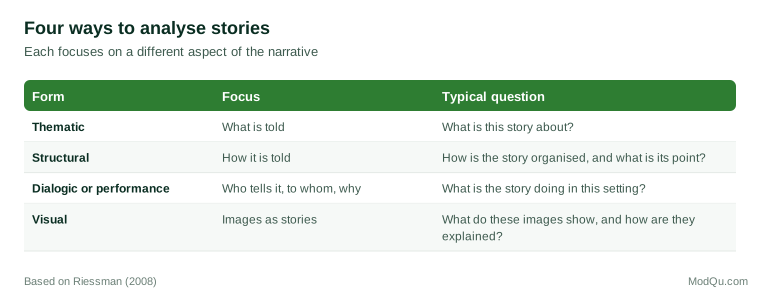
Riessman (2008) distinguished several forms of narrative analysis, each focusing on a different aspect of the story.
Thematic analysis of narratives
Thematic narrative analysis focuses on what is told. It identifies themes across stories, but unlike general thematic analysis it keeps each story intact as a unit, rather than breaking it into fragments coded across the dataset. The analyst asks what each story is about and how its themes relate to the sequence of events. Polkinghorne (1995) distinguished the analysis of narratives, which looks for common themes across stories, from narrative analysis, in which the researcher configures data into a story that explains how an outcome came about.
Structural analysis
Structural analysis focuses on how the story is told: its organisation, sequence and linguistic features. The best-known model is that of Labov and Waletzky (1967), later developed by Labov (1972), shown below.
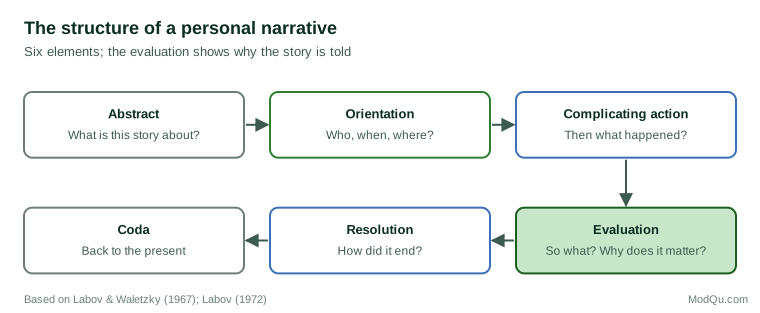
In this model, a fully formed narrative may contain an abstract that summarises the point of the story, an orientation that sets out who, when and where, a complicating action that recounts what happened, an evaluation that conveys why the story is worth telling and what it means to the teller, a resolution describing how it ended, and a coda that returns to the present. The evaluation is often the most revealing element, because it shows what the teller wants the listener to take from the story. Structural analysis can show, for example, that a customer's complaint story spends far more time on how they were treated than on the fault itself, which suggests what really mattered to them.
Dialogic and performance analysis
Dialogic or performance analysis focuses on the context in which a story is told: who is telling it, to whom, for what purpose and in what setting. Stories are not neutral reports; they perform identities and do social work. A manager telling a story about a past crisis to new staff may be presenting themselves as competent, conveying the organisation's values, or warning against certain behaviour. Holstein and Gubrium (2000) argue that the self is constructed through such storytelling, shaped by the settings and relationships in which stories are told.
Visual narrative analysis
Riessman (2008) also discussed the analysis of visual material, such as photographs, drawings and videos, as narratives, either alone or alongside spoken accounts. Participants may be asked to take photographs of their daily lives and then tell the stories behind them.
Designing a narrative study
A narrative study begins with a question about how people make sense of an experience over time: how they understand a transition, a crisis, a relationship or a decision. Questions about what proportion of people had an experience, or about the general features of an experience at one moment, are better suited to other methods.
Samples are usually small, because each story is long and analysed in depth. A study may include between five and thirty participants, chosen because they have lived through the experience and can tell it. Some studies focus on a single extended life story. Sampling can deliberately include people whose stories are likely to differ, such as those whose outcomes were good and those whose outcomes were poor, so that the analysis can compare how different outcomes are narrated.
The researcher should also decide in advance which form of analysis will be used, because this affects how stories are collected and transcribed. Structural analysis needs detailed transcripts that preserve the teller's wording, pauses and sequence. Performance analysis needs information about the setting and the audience, including the researcher's own questions and reactions.
Carrying out a structural analysis
A structural analysis usually proceeds in steps. First, the analyst identifies the stories within each transcript, marking where each begins and ends. A single interview may contain several stories, along with explanations, arguments and descriptions that are not narratives. Second, each story is divided into clauses or short segments, and each segment is labelled with its function: orientation, complicating action, evaluation and so on (Labov, 1972). Third, the analyst examines the pattern: how much of the story is given to each element, where the evaluation is placed, which events are told in detail and which are passed over quickly.
Finally, the analyst compares stories. Do participants with similar experiences structure their stories in similar ways? Do certain evaluations recur, such as claims of having been treated unfairly or of having learned something? Patterns of this kind show what participants regard as the point of their experience, which is often different from what the researcher expected to find.
Narratives and truth
A common concern about narrative research is whether stories are true. Riessman (2008) argued that this is the wrong question for most narrative studies. Stories are always selective and shaped by the teller's purposes, memory and audience. Their value lies in what they reveal about how people understand and present their experience. A customer's story of a failed service, told months later, may get details wrong but accurately conveys what the customer now believes happened and how they feel about it, which is what drives their future behaviour.
When a study needs to establish what actually happened, narratives should be combined with other evidence, such as documents, records or the accounts of other people involved. Differences between accounts are then themselves informative.
Typologies of stories
Some narrative research identifies recurring types of story. Frank (1995), studying people with serious illness, described three narrative types: the restitution narrative ("I was ill, I was treated, I am well again"), the chaos narrative, in which the teller cannot find order or meaning in events, and the quest narrative, in which illness becomes a journey through which the teller gains something. These types help explain how people cope, and why some forms of support suit some people better than others. Similar typologies have been developed for career transitions, migration and organisational change.
Narrative research in organisations
Organisations are full of stories: about founders, crises, successes and failures, and about "how things are done here". Boje (1991) studied storytelling in an office supply firm and found that stories were told in fragments, often by several people at once, and were used to make sense of events, to persuade and to negotiate interpretations. Gabriel (2000) examined how organisational stories express emotions, values and resistance, often presenting a different picture from official accounts. Czarniawska (2004) showed how narrative approaches can be applied across social science research, treating organisations themselves as constructed through stories.
Narrative methods are useful for studying organisational culture, change and identity. Collecting stories from staff about a merger, a new leader or a failed project can reveal how these events are understood, which interpretations dominate and where there is conflict, information that formal surveys of attitudes rarely capture.
Narrative research in consumer and market research
Consumers also understand their relationships with products and brands through stories. Escalas (2004) found that when people think about brands in narrative form, linking them to their own experiences and goals, they form stronger connections with those brands. Woodside et al. (2008) reviewed research on storytelling in psychology and marketing and argued that consumers use brands as props and anchors in the stories they tell about their own lives.
Research on narrative transportation shows why stories persuade. Green and Brock (2000) found that people who became absorbed in a story were more likely to change their beliefs in line with it, and less likely to notice false notes. For marketers, this explains the power of stories in advertising; for researchers, it is a reminder that stories told to them may be shaped by stories the teller has absorbed elsewhere.
A hypothetical example illustrates the use of narrative methods in commercial research. A home insurer wants to understand how customers experience making a claim. Instead of a survey, it collects 30 claim stories in narrative interviews. Structural analysis shows that the stories hinge on a single moment: the first phone call after the incident. In stories with good outcomes, the evaluation focuses on being reassured; in stories with bad outcomes, it focuses on being doubted. The insurer's own data had focused on settlement times, but the stories show that the emotional tone of the first call shapes how the whole experience is told, and retold to others.
Quality in narrative research
Narrative research raises particular questions of quality. Riessman (2008) noted that narratives are not straightforward records of what happened; they are interpretations, shaped by the teller's purposes and the audience. The researcher's claims should therefore be about how events are understood and presented, unless other evidence supports claims about the events themselves.
Riessman suggested several criteria for judging narrative studies. Persuasiveness concerns whether the interpretation is plausible and supported by evidence from the stories. Correspondence concerns whether participants recognise the analysis, while recognising that participants and researchers may legitimately interpret stories differently. Coherence concerns whether the analysis fits together, linking the parts of each story and the stories to one another. Pragmatic use concerns whether the work can be built upon by others. Transparent presentation of the stories, often with long extracts and the researcher's questions included, allows readers to judge the analysis.
Elliott (2005) showed that narrative approaches can be applied to quantitative as well as qualitative data, for example by analysing the sequence of events in longitudinal survey data, and argued that the two traditions can inform each other.
Presenting narrative findings
Narrative findings are usually presented with long extracts, because the meaning of a story depends on its sequence and wording, which short quotations lose. Some reports present one or two stories in full, with commentary, to show the analysis in detail, and then summarise how other stories compare. Others present a typology, with an example of each type. Including the interviewer's questions in extracts helps readers see how the story was prompted and shaped. Tables summarising each participant's story, its main events and its evaluation help readers compare stories without losing the link to the individual teller.
Ethics
Narrative research often involves personal and detailed stories. Because stories are distinctive, participants may be identifiable even when names are removed, particularly in small organisations or communities. Researchers need to consider how much detail to retain and whether to change identifying features. Clandinin and Connelly (2000) emphasise that narrative inquiry is relational: participants share stories within a relationship of trust, and researchers have a responsibility to represent those stories fairly and to consider how participants will feel when they read the analysis.
Conclusion
Narrative research studies the stories through which people make sense of their experience. It treats the form, sequence and context of a story as data, alongside its content, and asks not only what happened but how it is told, to whom and for what purpose. Its methods range from thematic and structural analysis to the study of storytelling as performance. In organisations and markets, where decisions are explained, cultures are shaped and brands are experienced through stories, narrative research offers insight that other methods cannot provide.
References
Bamberg, M., & Georgakopoulou, A. (2008). Small stories as a new perspective in narrative and identity analysis. Text & Talk, 28(3), 377–396. https://doi.org/10.1515/TEXT.2008.018
Boje, D. M. (1991). The storytelling organization: A study of story performance in an office-supply firm. Administrative Science Quarterly, 36(1), 106–126. https://doi.org/10.2307/2393432
Bruner, J. (1986). Actual minds, possible worlds. Harvard University Press.
Bruner, J. (1991). The narrative construction of reality. Critical Inquiry, 18(1), 1–21. https://doi.org/10.1086/448619
Clandinin, D. J., & Connelly, F. M. (2000). Narrative inquiry: Experience and story in qualitative research. Jossey-Bass.
Czarniawska, B. (2004). Narratives in social science research. SAGE.
Elliott, J. (2005). Using narrative in social research: Qualitative and quantitative approaches. SAGE.
Escalas, J. E. (2004). Narrative processing: Building consumer connections to brands. Journal of Consumer Psychology, 14(1–2), 168–180. https://doi.org/10.1207/s15327663jcp1401&2_19
Frank, A. W. (1995). The wounded storyteller: Body, illness, and ethics. University of Chicago Press.
Gabriel, Y. (2000). Storytelling in organizations: Facts, fictions, and fantasies. Oxford University Press.
Green, M. C., & Brock, T. C. (2000). The role of transportation in the persuasiveness of public narratives. Journal of Personality and Social Psychology, 79(5), 701–721. https://doi.org/10.1037/0022-3514.79.5.701
Holstein, J. A., & Gubrium, J. F. (2000). The self we live by: Narrative identity in a postmodern world. Oxford University Press.
Labov, W. (1972). Language in the inner city: Studies in the Black English vernacular. University of Pennsylvania Press.
Labov, W., & Waletzky, J. (1967). Narrative analysis: Oral versions of personal experience. In J. Helm (Ed.), Essays on the verbal and visual arts (pp. 12–44). University of Washington Press.
McAdams, D. P. (2001). The psychology of life stories. Review of General Psychology, 5(2), 100–122. https://doi.org/10.1037/1089-2680.5.2.100
McAdams, D. P., & McLean, K. C. (2013). Narrative identity. Current Directions in Psychological Science, 22(3), 233–238. https://doi.org/10.1177/0963721413475622
Mishler, E. G. (1986). Research interviewing: Context and narrative. Harvard University Press.
Polkinghorne, D. E. (1988). Narrative knowing and the human sciences. State University of New York Press.
Polkinghorne, D. E. (1995). Narrative configuration in qualitative analysis. International Journal of Qualitative Studies in Education, 8(1), 5–23. https://doi.org/10.1080/0951839950080103
Riessman, C. K. (2008). Narrative methods for the human sciences. SAGE.
Squire, C., Andrews, M., Davis, M., Esin, C., Harrison, B., Hydén, L.-C., & Hydén, M. (2014). What is narrative research? Bloomsbury.
Wengraf, T. (2001). Qualitative research interviewing: Biographic narrative and semi-structured methods. SAGE.
Woodside, A. G., Sood, S., & Miller, K. E. (2008). When consumers and brands talk: Storytelling theory and research in psychology and marketing. Psychology & Marketing, 25(2), 97–145. https://doi.org/10.1002/mar.20203