
Research · Qualitative research
Archival and Historical Research Methods in Reconstructing Knowledge Trajectories
How archival and historical research methods are used to reconstruct how knowledge, practices and organisations developed over time, covering types of sources, source criticism, the silences of archives, tracing knowledge through documents and citations, and practical uses in business research.
Some questions can only be answered by looking backwards. How did a company arrive at its current strategy? How did an idea move from a laboratory into common practice? Why did an industry adopt one standard rather than another? Archival and historical research answers such questions by locating, evaluating and interpreting records created in the past: letters, reports, minutes, memos, publications, data and images. The method allows researchers to reconstruct knowledge trajectories: the paths by which ideas, practices and institutions developed, were contested and changed. This article explains the main sources, how they are evaluated, and how the approach can be used in applied research.
Why historical evidence matters
Most social and business research studies the present. Historical research adds time. It can show how present arrangements came about, which alternatives were considered and rejected, and how decisions that now seem obvious were once uncertain. Kuhn (1962) used the history of science to show that scientific knowledge does not simply accumulate but develops through periods of stability interrupted by revolutions, a picture that only historical evidence could reveal.
In business research, Chandler (1962) used the internal records of four large American firms to show how they developed the multidivisional structure in response to new strategies of growth and diversification, an argument summarised as "structure follows strategy". Yates (1989) used surviving memos, forms, reports and filing systems to show how written internal communication became a tool of managerial control in American firms in the late nineteenth and early twentieth centuries. In both cases, documents created for practical purposes became evidence of how organisational knowledge and practice changed.
Types of sources
Historians distinguish primary sources, created at the time by participants or witnesses, from secondary sources, later accounts that interpret the primary record (Tosh, 2015). Primary sources for organisational and knowledge history include:
- internal records, such as board minutes, memos, correspondence, reports and plans;
- published materials, such as annual reports, catalogues, advertisements and trade journals;
- scientific and technical publications, patents and standards;
- official records, such as court cases, regulatory filings and statistics;
- personal papers, diaries and oral history interviews.
Archives may be held by organisations themselves, public record offices, universities, libraries or private collectors. Hill (1993) provides practical guidance on locating archives, negotiating access and working efficiently once there. Many sources are now digitised, which widens access but can also narrow research to what happens to be online.
Evaluating sources
Documents do not speak for themselves. Each was created by someone, for a purpose, in a particular context, and has survived for particular reasons. Scott (1990) proposed four criteria for assessing documents: authenticity, whether the document is genuine and of known origin; credibility, whether it is free from error and distortion; representativeness, whether it is typical of the documents that once existed; and meaning, whether its content is clear and understood in context.
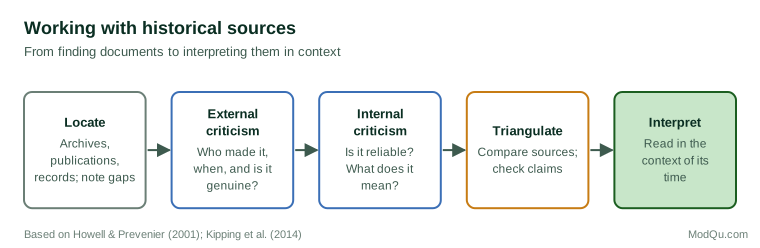
Historians have long divided this work into external criticism, concerning the origin and authenticity of a source, and internal criticism, concerning the reliability and meaning of its content (Howell & Prevenier, 2001). Kipping et al. (2014) set out a basic methodology for organisational researchers in three steps: source criticism, to assess each document; triangulation, to compare sources and check claims against one another; and hermeneutic interpretation, to understand texts in the context in which they were produced.
Bowen (2009) noted that documents have several advantages as data: they are stable, unobtrusive, often precise about names and dates, and cover long periods. They also have limitations: they may lack detail on the questions the researcher cares about, may be hard to retrieve, and may reflect the biases of those who created and kept them.
The silences of archives
What survives in an archive is not a neutral sample of what happened. Records are kept because someone decided they were worth keeping, and many are lost, destroyed or never created. Decker (2013) described the silences of business archives: the voices of workers, customers, colonised peoples and others with little power are often absent, because the archive was built to serve the organisation's own purposes. Researchers need to read archives for what they omit as well as what they contain, and to seek other sources, such as oral histories or external records, that can fill the gaps.
Tracing knowledge trajectories
Historical methods can trace how ideas spread and change. In science and technology, publications and patents leave a record of who built on whose work. Garfield (1955) proposed a citation index that would allow researchers to follow the links between papers, and Price (1965) showed that papers form networks in which recent work cites a relatively small, active research front. Citation and patent analyses now allow researchers to map the development of fields and the diffusion of ideas over decades.
Documentary and citation evidence can be combined. A study of how a management practice, such as lean production, spread from one industry to others might use trade journals to track when and how the term was used, company records to see when firms adopted it, and interviews to understand how it was interpreted locally.
History and organisational research
Rowlinson et al. (2014) argued that organisational researchers often treat history as a source of data to test general theories, while historians emphasise the particularity of events and the interpretation of sources. They proposed that the two traditions can be combined if researchers are explicit about their strategy: whether they use history to explain, to tell a narrative or to analyse long-term processes. Ventresca and Mohr (2002) reviewed the range of archival methods used in organisation studies, from interpretive reading of documents to formal coding and statistical analysis of large archival datasets.
Combining documents with other evidence
Documents are often strongest when read alongside other evidence. Oral history interviews with people who took part in events can explain decisions that the written record only states, and can recover the views of groups whose voices are missing from official files (Decker, 2013). Interviews have their own weaknesses: memory is selective, and participants may reinterpret the past in the light of what happened later. The usual solution is triangulation, checking what people recall against what was written at the time, and treating disagreements between the two as findings rather than errors (Kipping et al., 2014).
Digital archives and their limits
Digitisation has made millions of newspapers, journals, patents and company reports searchable from a desk. Keyword searches can show when a term first appeared and how often it was used, which suits the study of knowledge trajectories. Digital collections bring their own risks. What has been digitised reflects decisions about funding and priority, so some periods, languages and organisations are far better covered than others. Text recognition errors can hide relevant documents, and a search returns passages without the surrounding file that gives them meaning. The criterion of representativeness proposed by Scott (1990) applies to the digital collection as much as to the original archive.
Ethics and access
Archival research raises practical and ethical questions. Company archives are private property, and access is usually granted on conditions, such as review of publications or restrictions on naming individuals (Hill, 1993). Researchers should agree these conditions in writing before they begin. Records may contain personal information about employees or customers who are still alive, which calls for the same care over confidentiality as any other research involving people. Researchers commissioned by the organisation that owns the archive should also state this openly, so that readers can judge whether the account might favour its sponsor.
Practical uses
For businesses, historical research can support strategy, brand heritage, product development and the understanding of organisational culture. A hypothetical example: a firm wants to know why its product development process is slow. A review of project files over twenty years shows that each major failure led to an added approval step, none of which was later removed. The history explains the present process and shows which steps responded to risks that no longer exist.
Conclusion
Archival and historical research reconstructs how present knowledge and practices came to be. It depends on locating sources, assessing their authenticity, credibility, representativeness and meaning, comparing them, and interpreting them in context, while paying attention to what the archive leaves out. Used carefully, it adds the dimension of time to research that otherwise sees only the present.
References
Bowen, G. A. (2009). Document analysis as a qualitative research method. Qualitative Research Journal, 9(2), 27–40. https://doi.org/10.3316/QRJ0902027
Chandler, A. D., Jr. (1962). Strategy and structure: Chapters in the history of the industrial enterprise. MIT Press.
Decker, S. (2013). The silence of the archives: Business history, post-colonialism and archival ethnography. Management & Organizational History, 8(2), 155–173. https://doi.org/10.1080/17449359.2012.761491
Garfield, E. (1955). Citation indexes for science: A new dimension in documentation through association of ideas. Science, 122(3159), 108–111. https://doi.org/10.1126/science.122.3159.108
Hill, M. R. (1993). Archival strategies and techniques. SAGE. https://doi.org/10.4135/9781412983471
Howell, M., & Prevenier, W. (2001). From reliable sources: An introduction to historical methods. Cornell University Press.
Kipping, M., Wadhwani, R. D., & Bucheli, M. (2014). Analyzing and interpreting historical sources: A basic methodology. In M. Bucheli & R. D. Wadhwani (Eds.), Organizations in time: History, theory, methods (pp. 305–329). Oxford University Press.
Kuhn, T. S. (1962). The structure of scientific revolutions. University of Chicago Press.
Price, D. J. de S. (1965). Networks of scientific papers. Science, 149(3683), 510–515. https://doi.org/10.1126/science.149.3683.510
Rowlinson, M., Hassard, J., & Decker, S. (2014). Research strategies for organizational history: A dialogue between historical theory and organization theory. Academy of Management Review, 39(3), 250–274. https://doi.org/10.5465/amr.2012.0203
Scott, J. (1990). A matter of record: Documentary sources in social research. Polity Press.
Tosh, J. (2015). The pursuit of history: Aims, methods and new directions in the study of history (6th ed.). Routledge.
Ventresca, M. J., & Mohr, J. W. (2002). Archival research methods. In J. A. C. Baum (Ed.), The Blackwell companion to organizations (pp. 805–828). Blackwell.
Yates, J. (1989). Control through communication: The rise of system in American management. Johns Hopkins University Press.