
Research · Qualitative research
The Use of Member Checking and Respondent Validation for Knowledge Confirmation
What member checking and respondent validation are, the main forms they take, what they can and cannot confirm, the debates about their value, and how to use and report them well.
Qualitative researchers interpret what people say and do. A natural question follows: would the people studied recognise the interpretation? Member checking, also called respondent validation or participant validation, is the practice of returning data or findings to participants so that they can comment on accuracy, completeness and interpretation. It is one of the most widely cited techniques for establishing the credibility of qualitative research, and also one of the most debated. This article explains the main forms of member checking, what they can confirm, the criticisms they have attracted and how to use them well.
Origins and purpose
Lincoln and Guba (1985) called member checking the most crucial technique for establishing credibility, the qualitative counterpart of internal validity. Their reasoning was that the people whose lives are being described are best placed to judge whether the description is accurate. Creswell and Miller (2000) placed member checking among several validity procedures and noted that it shifts the test of validity from the researcher to the participants, reflecting a view that participants have a right to shape how they are represented.
Bloor (1978) gave one of the earliest careful accounts of respondent validation in sociology. He returned his analyses of medical decision-making to the doctors he had observed and found that their responses were informative but not simple confirmations: some accepted the analysis, some disagreed with parts of it, and some showed little interest. His conclusion, that respondent validation produces new data rather than a verdict on the analysis, has been repeated by many researchers since.
Forms of member checking
Member checking can take several forms, which differ in what is returned to participants and what they are asked to judge. The table below summarises the main forms.
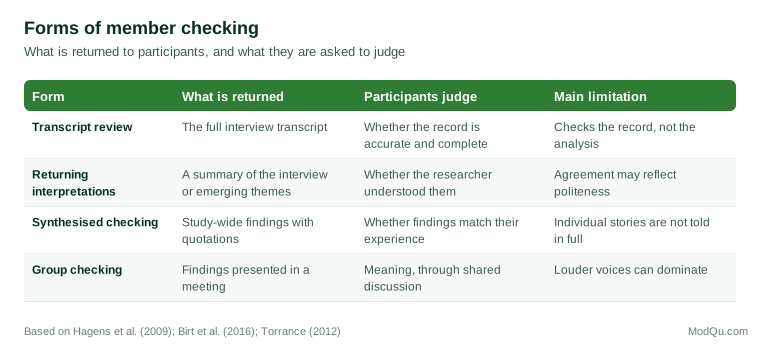
Transcript review returns the interview transcript to the participant, who checks that it records what they said and may correct, clarify or add to it. Hagens et al. (2009) tested this practice and found that most participants made few changes, and that the changes rarely affected the analysis. Transcript review checks the record, not the interpretation.
Returning interpretations shares the researcher's summary of an individual interview or the emerging themes, usually soon after data collection. It allows participants to say whether the researcher has understood them.
Synthesised member checking was developed by Birt et al. (2016). Participants receive a summary of the synthesised findings from the whole study, with illustrative quotations, and are asked whether the results match their experience and whether anything is missing. Their responses are then analysed and added to the findings. This form recognises that a thematic analysis combines many voices, so no single participant will see their story told in full.
Group or dialogic checking presents findings to participants in a meeting or workshop, where they discuss them together. Torrance (2012) described respondent validation in this form as a way of opening research to democratic participation, in which participants and researchers negotiate the meaning of findings rather than simply confirming them.
What member checking can and cannot confirm
Member checking is useful for some purposes and weak for others. It can:
- correct factual errors in a transcript or description;
- reveal misunderstandings of what a participant meant;
- add detail or context that the participant did not give at the time;
- show whether findings resonate with the people they describe;
- build trust and show respect for participants' contribution.
It is less able to confirm the analysis itself. Participants may not share the researcher's analytic aims. A theoretical interpretation that links an individual's account to wider social processes may be accurate even if the participant does not see their experience that way. Sandelowski (1993) argued that treating participants' agreement as the test of truth is a mistake, because experience is told and retold differently over time, and a participant's later view is not necessarily more accurate than their earlier one.
There are also practical reasons why agreement can mislead. Participants may agree to be polite, may defer to the researcher's authority, or may not read the material carefully. Disagreement is also hard to interpret: it may show that the researcher is wrong, that the participant has changed their mind, or that the finding is uncomfortable. Carlson (2010) described several traps, such as sending lengthy verbatim transcripts that embarrass participants with how their spoken words look on paper, and recommended preparing participants for what they will receive.
Debates about its value
Morse et al. (2002) argued that rigour should be built into the research process through verification during the study, and that checks applied at the end, including member checking, cannot rescue a study that was poorly done. Morse (2015) went further, arguing that member checking of the analysis is inappropriate in many designs, because the researcher's synthesis is meant to go beyond any one person's account.
Thomas (2017) reviewed published studies that reported member checks and found little evidence that they changed findings or improved credibility in a measurable way. He concluded that member checking may still be useful for ethical reasons or for specific purposes, but that it should not be treated as an automatic marker of quality. Varpio et al. (2017) made a similar argument, warning that member checking, saturation and triangulation are often cited as if they guarantee quality, when their meaning depends on the research tradition and on how they are carried out.
Mays and Pope (2000) took a middle position. They described respondent validation as a useful way of reducing error, while noting that the researcher remains responsible for the final analysis and that participants' reactions should be treated as further evidence rather than a test the analysis must pass.
Ethical considerations
Returning findings to participants can raise ethical issues. Goldblatt et al. (2011) described the dilemmas that arose when they shared findings with participants: some participants were distressed by how they were represented, some felt their individual stories had been lost in the analysis, and the researchers had to balance honesty with care. Participants may also recognise themselves or others in quotations, which can threaten confidentiality in small communities or organisations. Researchers should consider in advance what will be shared, in what form, and how participants will be supported if the material is upsetting.
Using member checking well
A careful approach to member checking includes several steps:
- Decide the purpose. Is the aim to correct the record, test understanding, add depth or involve participants in interpretation? The form should follow from the purpose.
- Choose the form. Transcript review suits factual accuracy; synthesised or group checking suits interpretation.
- Prepare participants. Explain what they will receive, what they are asked to do, and that they may decline.
- Make it accessible. Send short summaries in plain language rather than long technical documents.
- Treat responses as data. Record what participants say, analyse it, and show how it was used, including where the researcher kept an interpretation that a participant questioned.
- Report honestly. State how many participants took part in the check, what they said and what changed as a result.
Member checking in applied research
The same logic applies outside academic research. In customer, employee or stakeholder studies, findings are often presented back to a sample of the people who took part before a final report is written. A hypothetical example: a study of why staff leave a service organisation identifies workload as the main theme. When the summary is shared with a group of participants, several point out that workload became a problem only after a change in scheduling, a detail none had mentioned in interviews. The finding is refined from "workload is too high" to "the new scheduling system concentrates workload", which points to a different remedy. The check did not confirm the original finding; it improved it. As in academic work, the researcher should record what changed and why, so that readers can see how participants' feedback shaped the conclusions.
Conclusion
Member checking returns data or findings to the people who provided them. It can correct errors, deepen understanding, show respect for participants and test whether findings resonate. It cannot prove that an interpretation is correct, and participants' agreement or disagreement needs to be interpreted like any other data. Used with a clear purpose, in a suitable form and reported openly, it strengthens qualitative research; used as a box to tick, it adds little.
References
Birt, L., Scott, S., Cavers, D., Campbell, C., & Walter, F. (2016). Member checking: A tool to enhance trustworthiness or merely a nod to validation? Qualitative Health Research, 26(13), 1802–1811. https://doi.org/10.1177/1049732316654870
Bloor, M. (1978). On the analysis of observational data: A discussion of the worth and uses of inductive techniques and respondent validation. Sociology, 12(3), 545–552. https://doi.org/10.1177/003803857801200307
Carlson, J. A. (2010). Avoiding traps in member checking. The Qualitative Report, 15(5), 1102–1113. https://doi.org/10.46743/2160-3715/2010.1332
Creswell, J. W., & Miller, D. L. (2000). Determining validity in qualitative inquiry. Theory Into Practice, 39(3), 124–130. https://doi.org/10.1207/s15430421tip3903_2
Goldblatt, H., Karnieli-Miller, O., & Neumann, M. (2011). Sharing qualitative research findings with participants: Study experiences of methodological and ethical dilemmas. Patient Education and Counseling, 82(3), 389–395. https://doi.org/10.1016/j.pec.2010.12.016
Hagens, V., Dobrow, M. J., & Chafe, R. (2009). Interviewee transcript review: Assessing the impact on qualitative research. BMC Medical Research Methodology, 9, Article 47. https://doi.org/10.1186/1471-2288-9-47
Lincoln, Y. S., & Guba, E. G. (1985). Naturalistic inquiry. SAGE.
Mays, N., & Pope, C. (2000). Assessing quality in qualitative research. BMJ, 320(7226), 50–52. https://doi.org/10.1136/bmj.320.7226.50
Morse, J. M. (2015). Critical analysis of strategies for determining rigor in qualitative inquiry. Qualitative Health Research, 25(9), 1212–1222. https://doi.org/10.1177/1049732315588501
Morse, J. M., Barrett, M., Mayan, M., Olson, K., & Spiers, J. (2002). Verification strategies for establishing reliability and validity in qualitative research. International Journal of Qualitative Methods, 1(2), 13–22. https://doi.org/10.1177/160940690200100202
Sandelowski, M. (1993). Rigor or rigor mortis: The problem of rigor in qualitative research revisited. Advances in Nursing Science, 16(2), 1–8. https://doi.org/10.1097/00012272-199312000-00002
Thomas, D. R. (2017). Feedback from research participants: Are member checks useful in qualitative research? Qualitative Research in Psychology, 14(1), 23–41. https://doi.org/10.1080/14780887.2016.1219435
Torrance, H. (2012). Triangulation, respondent validation, and democratic participation in mixed methods research. Journal of Mixed Methods Research, 6(2), 111–123. https://doi.org/10.1177/1558689812437185
Varpio, L., Ajjawi, R., Monrouxe, L. V., O'Brien, B. C., & Rees, C. E. (2017). Shedding the cobra effect: Problematising thematic emergence, triangulation, saturation and member checking. Medical Education, 51(1), 40–50. https://doi.org/10.1111/medu.13124