
Investigation · Foundations
Evidence, Leads, and Claims: Keeping Their Roles Distinct
Investigations go wrong when a tip is treated as proof or an allegation is treated as a finding. This article explains the different roles of leads, evidence and claims, and how keeping them apart produces sounder conclusions.
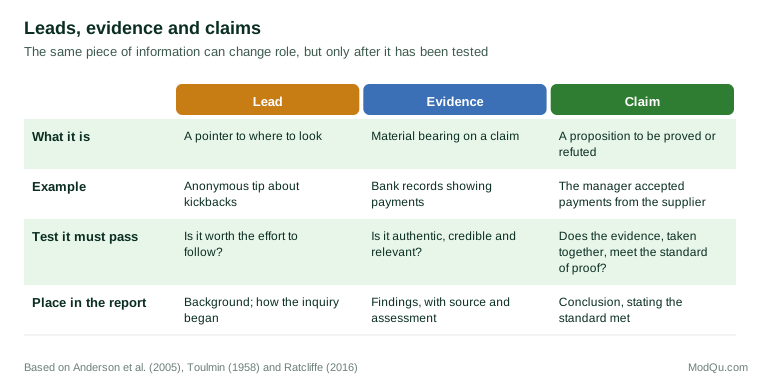
An anonymous caller says a manager has been taking kickbacks. A spreadsheet shows payments to a supplier that nobody in purchasing recognises. A report concludes that the manager breached the company's code of conduct. These three statements look similar on the page, but they play entirely different roles. The first is a lead: it tells the investigator where to look. The second is evidence: it is material that bears on whether something happened. The third is a claim: a proposition that the investigation sets out to establish or refute. Many investigative failures begin when these roles are confused, so that a lead is treated as proof, a claim is repeated until it sounds like a fact, or evidence is gathered only for the claim that someone already believes.
This article defines the three roles, explains why the distinctions matter, and sets out practical ways to keep them apart.
Three roles
A claim is a statement about the world that the investigation must decide is true, false or unresolved. "The manager accepted payments from the supplier" is a claim. Toulmin (1958), in his analysis of practical argument, distinguished the claim from the data offered in support of it and from the warrant that connects them. In an investigation, the claims are usually set by the allegation, the mandate or the legal elements of an offence or breach. Each claim should be stated precisely enough to be tested.
Evidence is material that makes a claim more or less probable: documents, records, physical items, digital data and testimony. Evidence has a source, a history and a degree of credibility, and its relevance depends on the claim it is offered to support. Anderson et al. (2005), building on Wigmore's (1913) method of charting proof, show how each item of evidence can be linked through a chain of inferences to the claim it bears on. Schum (1994) emphasises that the credibility of the source and the strength of each inferential step must be assessed separately.
A lead is information that suggests where evidence might be found or which claim might be worth testing. Tips, rumours, intelligence reports, anomalies in data and hunches are leads. A lead is valuable because it directs effort, but it does not itself prove anything. Police practice in many countries keeps intelligence, which guides operations, separate from evidence, which is presented in court, precisely because much intelligence is unverified, comes from sources who cannot be tested, or would be inadmissible (Ratcliffe, 2016).
How the roles get confused
Leads treated as evidence
The most common confusion is treating a lead as if it were proof. An anonymous allegation, a pattern in data or an informant's report can feel convincing, especially if it fits what the investigator already suspects. But the allegation has not been tested, and its source may be mistaken, malicious or unknown. Findley and Scott (2006) describe how early tips and suspicions in criminal cases have hardened into a fixed belief about a suspect, so that later evidence was interpreted in their light. The tip was never proved; it simply came first.
In intelligence work, the same risk is managed by grading. The widely used Admiralty or NATO system rates each report separately for the reliability of the source and the credibility of the information. Irwin and Mandel (2019) note that analysts often conflate the two ratings and that the scales themselves are interpreted inconsistently, which shows how hard it is to keep a lead's provenance in view as it passes from person to person.
Claims treated as findings
A second confusion occurs when a claim is repeated so often that it begins to sound established. An allegation in a complaint is restated in a terms of reference, then in an interview plan, then in a briefing to senior management, and by the time the report is written it is described as "the fraud" rather than "the alleged fraud". Language matters here. Investigators should describe claims as allegations or hypotheses until the evidence has been assessed.
Evidence collected for one claim only
A third problem arises when evidence is sought only for the claim that someone believes. Because evidence takes its meaning from the claim it is offered to support, an investigator who has only one claim in mind will see only the significance that the evidence has for that claim. The same bank transfer that looks like a kickback may also be consistent with a legitimate commission, a personal loan or an accounting error. Listing alternative claims, and asking how each item of evidence bears on each one, is the best protection (Heuer, 1999). Without it, people tend to look for and interpret information in ways that confirm what they expect (Nickerson, 1998).
Keeping the roles distinct in practice
Log leads separately
Many investigation teams keep a separate log for leads, recording the source, date, content, an assessment of reliability and what was done to follow it up. This makes it clear which information has been tested and which has not. When a lead produces evidence, the evidence is recorded in the evidence register with its own source; the lead stays in the lead log. A reader of the file can then see that the tip prompted an inquiry, and that the inquiry found the bank records, without confusing the two.
State the claims explicitly
At the start of the investigation, and again when the scope changes, the claims to be tested should be written down. For a disciplinary case these are usually the specific allegations. For a criminal case, they are the elements of the offence. Writing them down allows each item of evidence to be linked to the claims it supports or undermines, and shows clearly which claims still lack evidence.
Verify before relying
Journalists face the same problem with information from sources, documents and social media. Kovach and Rosenstiel (2014) describe journalism as a discipline of verification, and practical guides set out steps for confirming the origin, date and authenticity of material before it is published (Silverman, 2014). Investigative journalism methods treat the story as a hypothesis and require each factual claim to be backed by a documented source (Hunter et al., 2011). The spread of false and misleading content online has made these steps more important, since material can be fabricated, altered or taken out of context (Wardle & Derakhshan, 2017).
Separate the record from the conclusion
The final report should make the distinction visible. Leads belong in the account of how the investigation began and developed. Evidence belongs in the findings, each item with its source and an assessment of its credibility. Claims belong in the conclusions, each with a statement of whether it has been established and to what standard. A report that mixes the three, for example by citing the original anonymous allegation as support for the conclusion, invites challenge.
Respect rules on unused material
In criminal cases, the distinction has legal consequences. Information gathered during an investigation that is not used as evidence may still have to be recorded, retained and disclosed to the defence if it might undermine the prosecution case. In England and Wales, the Criminal Procedure and Investigations Act 1996 imposes these duties. Leads that pointed elsewhere, or tips that proved false, may be exactly the material the defence is entitled to see. Rules on hearsay and on the credibility of witnesses also shape what can be used as evidence (Roberts & Zuckerman, 2010).
When information changes role
The same piece of information can move between roles, but only through a deliberate step. A colleague's remark that the manager "always seems to have cash" is a lead. If the investigator obtains the manager's expense claims and finds cash withdrawals that match supplier payment dates, those records are evidence. If the remark itself is later given in a signed statement by a witness who can be questioned, it may become testimonial evidence, but with all the limitations of a second-hand impression. The point is not that leads can never become evidence, but that the change must be marked and the new item assessed on its own terms.
Why it matters
Keeping leads, evidence and claims distinct is not a matter of tidy filing. It protects people who are the subject of allegations from being judged on rumour. It protects investigators from building a case on untested foundations. And it allows the people who rely on the findings to see exactly what was established and how. Brodeur (2010) and Innes (2003) both describe much detective work as information work: sorting, assessing and connecting large amounts of material. The quality of that work depends on knowing, at every point, whether a piece of information is pointing the way, proving a point or stating what still has to be proved.
The same discipline applies outside formal investigations. When a business receives a complaint, a social media post or an unexpected survey result, the first question is what role it plays. It is usually a lead. Treating it as one, and gathering evidence before reaching a claim, leads to better decisions.
References
Anderson, T., Schum, D., & Twining, W. (2005). Analysis of evidence (2nd ed.). Cambridge University Press. https://doi.org/10.1017/CBO9780511610585
Brodeur, J.-P. (2010). The policing web. Oxford University Press.
Criminal Procedure and Investigations Act 1996, c. 25 (UK).
Findley, K. A., & Scott, M. S. (2006). The multiple dimensions of tunnel vision in criminal cases. Wisconsin Law Review, 2006(2), 291–397.
Heuer, R. J., Jr. (1999). Psychology of intelligence analysis. Center for the Study of Intelligence, Central Intelligence Agency.
Hunter, M. L., Hanson, N., Sabbagh, R., Sengers, L., Sullivan, D., & Svith, F. T. (2011). Story-based inquiry: A manual for investigative journalists. UNESCO.
Innes, M. (2003). Investigating murder: Detective work and the police response to criminal homicide. Oxford University Press.
Irwin, D., & Mandel, D. R. (2019). Improving information evaluation for intelligence production. Intelligence and National Security, 34(4), 503–525. https://doi.org/10.1080/02684527.2019.1569343
Kovach, B., & Rosenstiel, T. (2014). The elements of journalism: What newspeople should know and the public should expect (3rd ed.). Three Rivers Press.
Nickerson, R. S. (1998). Confirmation bias: A ubiquitous phenomenon in many guises. Review of General Psychology, 2(2), 175–220. https://doi.org/10.1037/1089-2680.2.2.175
Ratcliffe, J. H. (2016). Intelligence-led policing (2nd ed.). Routledge.
Roberts, P., & Zuckerman, A. (2010). Criminal evidence (2nd ed.). Oxford University Press.
Schum, D. A. (1994). The evidential foundations of probabilistic reasoning. Wiley.
Silverman, C. (Ed.). (2014). Verification handbook: A definitive guide to verifying digital content for emergency coverage. European Journalism Centre.
Toulmin, S. E. (1958). The uses of argument. Cambridge University Press.
Wardle, C., & Derakhshan, H. (2017). Information disorder: Toward an interdisciplinary framework for research and policymaking (Council of Europe Report DGI(2017)09). Council of Europe.
Wigmore, J. H. (1913). The principles of judicial proof. Little, Brown.