
Investigation · Foundations
Confirmation Bias and Tunnel Vision in Investigations
Tunnel vision is the most frequently cited cause of failed investigations and wrongful convictions. This article explains the psychology behind it, how it spreads through teams and institutions, what landmark cases revealed, and which safeguards research supports.
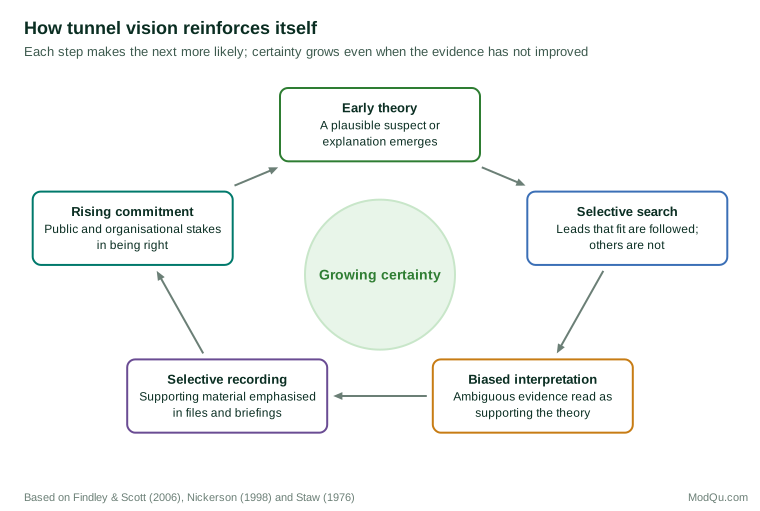
When public inquiries examine how an innocent person came to be convicted, or how an obvious suspect was overlooked for years, the same diagnosis appears again and again: tunnel vision. Investigators settled on a theory early, gathered evidence that supported it, explained away evidence that did not, and became more certain as the case went on. The individuals involved were usually neither corrupt nor incompetent. They were subject to tendencies that affect all human reasoning, operating in organisations that amplified those tendencies rather than checking them.
This article explains the psychological roots of tunnel vision in confirmation bias, describes how it spreads from individuals to teams and institutions, reviews some of the cases that brought it to public attention, considers the argument that it is sometimes overstated, and sets out the safeguards that research supports.
Definitions
Confirmation bias is the tendency to seek, interpret and remember information in ways that support what one already believes or expects. Nickerson (1998) describes it as one of the most pervasive problems in human reasoning, appearing in forms ranging from the way people choose which questions to ask to the way they weigh evidence once it arrives.
Tunnel vision is the term used in criminal justice for the investigative consequence. Findley and Scott (2006) define it as a collection of common heuristics and logical errors that lead actors in the justice system to focus on a suspect, select and filter the evidence that will build a case against that person, and ignore or suppress evidence that points away from guilt. Tunnel vision is not a single bias but a process in which several biases reinforce one another over time.
The psychology behind tunnel vision
Several well-established findings explain why tunnel vision is so common.
Positive testing. People tend to test a hypothesis by looking for cases where it predicts something will be present, rather than cases where it predicts absence (Klayman & Ha, 1987). In an investigation, this means asking "what links the suspect to the crime?" more readily than "what evidence would show the suspect was not involved?"
Biased assimilation. People evaluate evidence that supports their view less critically than evidence that challenges it. Lord et al. (1979) gave supporters and opponents of the death penalty the same mixed evidence about its deterrent effect. Each side rated the studies supporting its own position as more convincing, and both sides became more extreme. Investigators shown an alibi for a suspect they believe guilty may scrutinise it far more harshly than they would scrutinise an incriminating statement.
Need for closure. Under time pressure, fatigue or public scrutiny, people want a firm answer and are inclined to seize on early information and then freeze on the conclusion it suggests (Kruglanski & Webster, 1996). Ask and Granhag (2005) found that investigators with a higher need for closure were less likely to revise an initial hypothesis about a case.
Early commitment. Once a person has publicly committed to a course of action, they are inclined to continue it even when evidence turns against it. Staw (1976) demonstrated this escalation of commitment in a study of investment decisions, and the same dynamic affects an investigator who has told colleagues, prosecutors or the media that they have the right person.
Expectation effects in interviews. Kassin et al. (2003) found that interviewers who presumed guilt asked more guilt-presumptive questions, used more pressure and judged suspects as more likely to be guilty, while observers who listened to the recordings perceived the innocent suspects in those interviews as more defensive. The investigator's belief shapes the evidence it then appears to confirm.
From individuals to institutions
Tunnel vision is not only a matter of individual psychology. Organisational features can spread and harden it.
Information flow. In a large inquiry, few people see all the evidence. Briefings, summaries and case files are prepared by people who already hold a view, so later readers receive a filtered picture. Fahsing and Ask (2013) found that detectives in homicide inquiries described particular pieces of information as tipping points that shifted the whole team's focus.
Group dynamics. Teams under pressure tend to converge on a shared view and discourage dissent. Janis (1982) described this as groupthink, observing that cohesive groups facing high-stakes decisions can develop an illusion of unanimity and self-censorship among members who have doubts. A junior investigator who questions the senior officer's theory may stay silent.
Contamination of experts. Forensic scientists, accountants and other experts are often told the investigators' theory before they examine the evidence. Kassin et al. (2013) review studies showing that contextual information can influence the interpretation of fingerprints, handwriting, DNA mixtures and other evidence. Kukucka and Kassin (2014) found that people told a suspect had confessed were more likely to judge that the suspect's handwriting matched a robbery note. When the expert's conclusion is then presented as independent corroboration, it adds more apparent weight than it should.
Institutional incentives. Performance measures that reward charging decisions or clearance rates, public pressure to solve high-profile cases, and adversarial systems that encourage each side to build the strongest possible case can all make tunnel vision more likely (Findley & Scott, 2006).
Lessons from landmark cases
The Morin case in Canada
In 1984, nine-year-old Christine Jessop was abducted and murdered in Ontario. Her neighbour, Guy Paul Morin, was charged, acquitted, then convicted at a retrial in 1992. He was exonerated by DNA evidence in 1995. The public inquiry that followed, led by Fred Kaufman, found that investigators had focused on Morin early on weak grounds, interpreted innocent behaviour as suspicious, relied on unreliable jailhouse informants and on forensic hair and fibre evidence whose limitations were not properly reported. The inquiry identified tunnel vision as a central cause and recommended training and policies to address it (Kaufman, 1998). A national report by Canadian prosecutors later made tunnel vision the first of the causes of wrongful convictions it addressed (FPT Heads of Prosecutions Committee Working Group, 2004).
The Mayfield fingerprint case
After the Madrid train bombings in March 2004, Spanish police sent images of a latent fingerprint found on a bag of detonators to the United States Federal Bureau of Investigation. An FBI examiner identified the print as belonging to Brandon Mayfield, a lawyer in Oregon, and two other experienced examiners verified the identification. Spanish investigators later identified the print as belonging to an Algerian national, and Mayfield, who had been detained, was released. The Department of Justice's Office of the Inspector General (2006) found that the examiners had been influenced by the unusual similarity of the prints, had reasoned backwards from features of Mayfield's print to find corresponding features in the latent print, and had been reluctant to reconsider once the identification was made. The verification process had not been independent, because the verifiers knew the original conclusion.
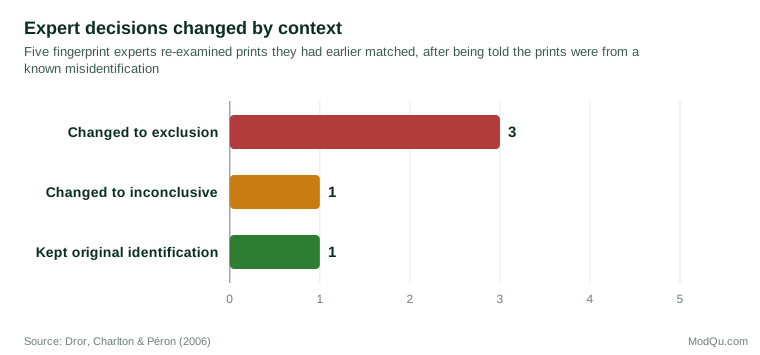
The case prompted a striking experiment. Dror et al. (2006) asked five experienced fingerprint examiners to examine pairs of prints that each had previously judged to be a match in real casework, after telling them that the prints were from the Mayfield case and were known to be a mismatch. Four of the five changed their earlier decision.
What the exoneration data show
Garrett (2011) examined the trial records of the first 250 people exonerated by DNA testing in the United States. Many cases combined several kinds of flawed evidence: mistaken eyewitnesses, unreliable forensic testimony, false confessions and informants. In many, evidence pointing to innocence was available but was discounted at the time. Rossmo (2009) collects case studies from several countries showing similar patterns of early focus, overconfidence and failure to revisit assumptions.
Is tunnel vision overstated?
Not everyone accepts that tunnel vision is simply an error. Snook and Cullen (2008) argue that the heuristics underlying it are often efficient. Investigators have limited time and resources, and focusing on the most likely suspect is usually rational and usually correct. Studies of wrongful convictions look only at cases that went wrong, and in hindsight any focus that turned out to be mistaken looks like tunnel vision. Without knowing how often the same reasoning led to correct outcomes, it is hard to say how damaging it is overall.
This argument is an important corrective. Investigators must prioritise, and an investigation that gives equal attention to every conceivable explanation will not finish. The question is not whether to focus but how: whether the focus is based on evidence, whether alternatives remain open until they are properly eliminated, and whether the investigation has mechanisms for noticing when the focus is wrong. Tunnel vision, in this view, is focus without those safeguards.
Safeguards
Because tunnel vision arises from normal cognitive processes amplified by organisational pressures, safeguards need to work at both levels.
For individual investigators:
- Write down alternative explanations at the outset and at each review, including innocent ones, and record what evidence would distinguish them (Heuer, 1999).
- Actively look for evidence that would disprove the main theory. Lord et al. (1984) found that asking people to "consider the opposite" reduced biased assessment of evidence.
- Delay naming a suspect where possible. O'Brien (2009) found that naming a suspect early increased bias, and that asking participants to explain why the suspect might be innocent reduced it.
- Record reasons for decisions, including decisions not to pursue leads.
For teams and organisations:
- Build in independent review of major cases by people who were not involved, with authority to question the direction of the inquiry.
- Assign a person to argue for alternative explanations, so that dissent is a role rather than a risk.
- Share full information with the whole team, not only summaries filtered through the lead theory.
- Train investigators in the psychology of bias, using real cases, while recognising that awareness alone has limited effect (Rassin et al., 2010).
For experts:
- Shield forensic and other examiners from case information they do not need. Linear sequential unmasking, in which examiners document their analysis of the evidence before being exposed to the reference material or context, is one structured approach (Dror et al., 2015).
- Make verification blind, so that the second examiner does not know the first examiner's conclusion.
- Report the limits and uncertainty of findings, not just the conclusion.
An illustration from a corporate setting
Tunnel vision is easier to see in a concrete case. Consider a hypothetical investigation at a mid-sized manufacturer after confidential pricing information appears in a competitor's tender. Suspicion falls quickly on a sales manager who resigned the previous month to join that competitor. The managing director tells the board that the leak "obviously" came from the departing manager, and an external investigator is asked to "confirm how the information was taken".
The framing of the mandate already narrows the inquiry: it asks how, not whether, and assumes who. The investigator examines the sales manager's laptop and finds that the pricing file was opened two days before the resignation. That fact is consistent with the theory, but it is also consistent with the manager's ordinary work, since the manager used that file every week. Without a comparison with normal access patterns, it has little diagnostic value. The investigator also learns that a former IT contractor had administrator access to the shared drive and left on poor terms, but this lead is noted and not pursued, because the case against the sales manager already "looks strong".
At a review meeting, the investigator presents the file access as a key finding. Nobody asks how often other staff opened the same file, whether the competitor could have obtained the figures from a customer who received both tenders, or whether the departing manager's new employer had any opportunity to use the information in the time available. The board is told the investigation supports the original suspicion, and the company begins legal action.
Months later, during disclosure, it emerges that the pricing was sent in error to a shared customer contact who forwarded it. The company withdraws its claim, pays costs and damages its relationship with a former employee and a customer. No one involved acted dishonestly. The failure lay in an early theory, a mandate that assumed it, evidence that fitted but did not discriminate, an unexamined alternative lead and a review that asked no hard questions.
Each of the safeguards described below would have changed the outcome: a neutral mandate, a written list of alternative explanations, a comparison of access patterns, an independent reviewer and a deliberate search for evidence that the main theory was wrong.
Reviewing a case for tunnel vision
Supervisors and independent reviewers can test an investigation for signs of tunnel vision by asking a short set of questions. When did the investigation first focus on its main suspect or explanation, and what evidence did it have at that point? Which alternative explanations were recorded, and how was each one eliminated? Were any leads closed without being followed, and why? Has any evidence been reinterpreted after the fact to fit the theory? Were experts told the investigators' view before they examined the evidence? Has the investigation sought evidence that would disprove its main theory, and what happened when it did? A case that cannot answer these questions clearly is not necessarily wrong, but it has not yet shown that it is right. Asking them routinely, rather than only after a failure, turns review from a formality into a real check.
Tunnel vision outside criminal justice
The same dynamics affect corporate, regulatory and journalistic investigations. A company investigating suspected fraud may fix on an unpopular employee. A regulator may assume that a firm with a history of breaches is responsible for a new one. A journalist with a strong story may discount the source who undermines it. In research and analytics, the equivalent is the analyst who searches for the result the client expects and stops when it appears. The remedies are the same: state alternatives, seek disconfirmation, separate the people who interpret evidence from the people with a stake in the answer, and review important conclusions independently.
Conclusion
Tunnel vision is not a character flaw. It is the predictable result of normal reasoning under pressure, in organisations that reward speed and certainty. The cases that brought it to public attention show how much damage it can do. The research shows that it can be reduced, not by asking investigators to try harder, but by designing procedures that keep alternatives alive, protect experts from contamination and give someone the job of asking whether the team is wrong.
References
Ask, K., & Granhag, P. A. (2005). Motivational sources of confirmation bias in criminal investigations: The need for cognitive closure. Journal of Investigative Psychology and Offender Profiling, 2(1), 43–63. https://doi.org/10.1002/jip.19
Dror, I. E., Charlton, D., & Péron, A. E. (2006). Contextual information renders experts vulnerable to making erroneous identifications. Forensic Science International, 156(1), 74–78. https://doi.org/10.1016/j.forsciint.2005.10.017
Dror, I. E., Thompson, W. C., Meissner, C. A., Kornfield, I., Krane, D., Saks, M., & Risinger, M. (2015). Context management toolbox: A linear sequential unmasking (LSU) approach for minimizing cognitive bias in forensic decision making. Journal of Forensic Sciences, 60(4), 1111–1112. https://doi.org/10.1111/1556-4029.12805
Fahsing, I., & Ask, K. (2013). Decision making and decisional tipping points in homicide investigations: An interview study of British and Norwegian detectives. Journal of Investigative Psychology and Offender Profiling, 10(2), 155–165. https://doi.org/10.1002/jip.1384
Findley, K. A., & Scott, M. S. (2006). The multiple dimensions of tunnel vision in criminal cases. Wisconsin Law Review, 2006(2), 291–397.
FPT Heads of Prosecutions Committee Working Group. (2004). Report on the prevention of miscarriages of justice. Department of Justice Canada.
Garrett, B. L. (2011). Convicting the innocent: Where criminal prosecutions go wrong. Harvard University Press.
Heuer, R. J., Jr. (1999). Psychology of intelligence analysis. Center for the Study of Intelligence, Central Intelligence Agency.
Janis, I. L. (1982). Groupthink: Psychological studies of policy decisions and fiascoes (2nd ed.). Houghton Mifflin.
Kassin, S. M., Dror, I. E., & Kukucka, J. (2013). The forensic confirmation bias: Problems, perspectives, and proposed solutions. Journal of Applied Research in Memory and Cognition, 2(1), 42–52. https://doi.org/10.1016/j.jarmac.2013.01.001
Kassin, S. M., Goldstein, C. C., & Savitsky, K. (2003). Behavioral confirmation in the interrogation room: On the dangers of presuming guilt. Law and Human Behavior, 27(2), 187–203. https://doi.org/10.1023/A:1022599230598
Kaufman, F. (1998). Report of the Kaufman Commission on Proceedings Involving Guy Paul Morin. Ontario Ministry of the Attorney General.
Klayman, J., & Ha, Y.-W. (1987). Confirmation, disconfirmation, and information in hypothesis testing. Psychological Review, 94(2), 211–228. https://doi.org/10.1037/0033-295X.94.2.211
Kruglanski, A. W., & Webster, D. M. (1996). Motivated closing of the mind: "Seizing" and "freezing." Psychological Review, 103(2), 263–283. https://doi.org/10.1037/0033-295X.103.2.263
Kukucka, J., & Kassin, S. M. (2014). Do confessions taint perceptions of handwriting evidence? An empirical test of the forensic confirmation bias. Law and Human Behavior, 38(3), 256–270. https://doi.org/10.1037/lhb0000066
Lord, C. G., Lepper, M. R., & Preston, E. (1984). Considering the opposite: A corrective strategy for social judgment. Journal of Personality and Social Psychology, 47(6), 1231–1243. https://doi.org/10.1037/0022-3514.47.6.1231
Lord, C. G., Ross, L., & Lepper, M. R. (1979). Biased assimilation and attitude polarization: The effects of prior theories on subsequently considered evidence. Journal of Personality and Social Psychology, 37(11), 2098–2109. https://doi.org/10.1037/0022-3514.37.11.2098
Nickerson, R. S. (1998). Confirmation bias: A ubiquitous phenomenon in many guises. Review of General Psychology, 2(2), 175–220. https://doi.org/10.1037/1089-2680.2.2.175
O'Brien, B. (2009). Prime suspect: An examination of factors that aggravate and counteract confirmation bias in criminal investigations. Psychology, Public Policy, and Law, 15(4), 315–334. https://doi.org/10.1037/a0017881
Office of the Inspector General. (2006). A review of the FBI's handling of the Brandon Mayfield case. U.S. Department of Justice.
Rassin, E., Eerland, A., & Kuijpers, I. (2010). Let's find the evidence: An analogue study of confirmation bias in criminal investigations. Journal of Investigative Psychology and Offender Profiling, 7(3), 231–246. https://doi.org/10.1002/jip.126
Rossmo, D. K. (2009). Criminal investigative failures. CRC Press.
Snook, B., & Cullen, R. M. (2008). Bounded rationality and criminal investigations: Has tunnel vision been wrongfully convicted? In D. K. Rossmo (Ed.), Criminal investigative failures (pp. 71–98). CRC Press.
Staw, B. M. (1976). Knee-deep in the big muddy: A study of escalating commitment to a chosen course of action. Organizational Behavior and Human Performance, 16(1), 27–44. https://doi.org/10.1016/0030-5073(76)90005-2