
Investigation · Foundations
The Cognitive Interview: Improving Witness Recall
The cognitive interview uses findings from memory research to help witnesses remember more without making more mistakes. This article explains how it works, what four decades of research show, and where its limits lie.
Witnesses are often the most important source of information in an investigation, and also one of the most fragile. Memory is not a recording that can be played back on demand. It is reconstructed each time it is retrieved, and the way a witness is questioned can help them recall more or can push them towards errors. In the early 1980s two American psychologists, Ronald Fisher and Edward Geiselman, set out to design an interview procedure based on what memory research had shown about how people remember. The result, the cognitive interview, has become one of the most widely studied and most effective tools in investigative psychology (Fisher & Geiselman, 1992). This article explains the method, the evidence behind it and the practical obstacles to using it well.
Why ordinary interviews lose information
Studies of police interviews with witnesses in the 1980s and 1990s found a consistent pattern. Interviewers asked many short, closed questions, interrupted witnesses' answers, followed a fixed checklist regardless of how the witness had experienced the event, and did most of the talking (Fisher et al., 1989; Milne & Bull, 1999). This style is efficient for filling in a form, but it wastes the witness's memory. Each closed question retrieves only the item asked about. Interruptions break the witness's concentration. And questions that suggest an answer can introduce information that the witness later remembers as their own.
The danger of suggestion is well established. In a classic experiment, Loftus and Palmer (1974) showed people a film of a car accident and asked how fast the cars were going when they "smashed into" or "hit" each other. People asked with the word "smashed" gave higher speed estimates and, a week later, were more likely to report seeing broken glass that was not in the film. Loftus (2005) summarises three decades of research showing that misleading information supplied after an event can be incorporated into memory. An interview that leads the witness can therefore create evidence rather than gather it.
The principles behind the method
The cognitive interview draws on two ideas from memory research. The first is encoding specificity: a memory is most easily retrieved when the cues present at retrieval match those present when the memory was formed (Tulving & Thomson, 1973). Godden and Baddeley (1975) famously showed that divers who learned words underwater recalled them better underwater than on land, and vice versa. Recreating the context of an event, even mentally, can therefore make memories more accessible.
The second idea is that memories have multiple retrieval routes. Information that cannot be reached by one route may be reached by another. Asking a witness to approach the event from different starting points, in different orders or from different perspectives can bring out details that a single straightforward recall misses.
The original four techniques
The first version of the cognitive interview consisted of four instructions given to the witness (Geiselman et al., 1985):
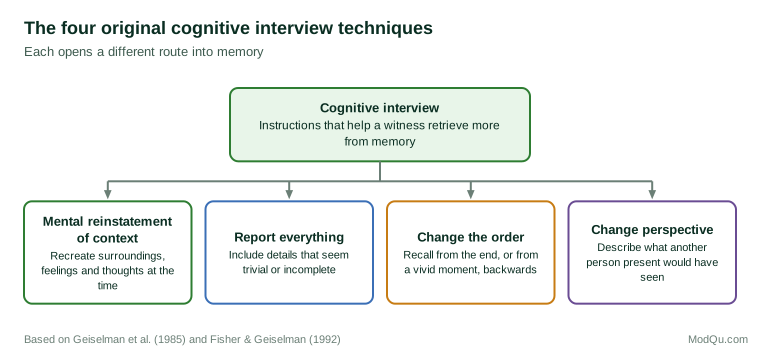
- Mental reinstatement of context. The witness is asked to think back to the event and picture the surroundings, the weather, the lighting, what they were doing and how they felt. This recreates retrieval cues.
- Report everything. The witness is encouraged to report every detail, even if it seems unimportant or they are only partly sure. Witnesses often hold back information they think is irrelevant, yet one small detail may connect to other evidence. Investigators, not witnesses, should decide what matters.
- Change the order. The witness is asked to recall the event in a different order, for example backwards from the end. This disrupts the tendency to recall a familiar "script" of what usually happens and can reveal details that were skipped.
- Change perspective. The witness is asked to describe the event from the position of someone else who was there. This technique has been used less in practice, because some witnesses find it confusing and there is a risk that they will guess rather than remember.
Geiselman et al. (1985) compared the cognitive interview with a standard police interview and with interviews under hypnosis. Both the cognitive interview and hypnosis produced more correct information than the standard interview, without a significant increase in errors. The cognitive interview was much easier to apply.
The enhanced cognitive interview
Fisher and colleagues soon realised that the memory techniques worked best when combined with better social and communication practices (Fisher et al., 1987). The enhanced cognitive interview added several elements (Fisher & Geiselman, 1992):
- Rapport building. A relaxed witness who trusts the interviewer remembers and reports more.
- Transfer of control. The interviewer explicitly tells the witness that they hold the information and should do most of the talking. Witnesses who expect to be questioned tend to wait for questions; witnesses who are told they are in control give fuller accounts.
- Free recall first. The witness gives an uninterrupted narrative before any questions are asked.
- Witness-compatible questioning. The interviewer follows the order of the witness's own memory rather than a fixed checklist, and probes each part of the account while it is active in the witness's mind.
- Open questions and pauses. Open questions invite longer answers; pauses give the witness time to search memory.
- Focused retrieval. The witness is encouraged to close their eyes or look at a blank surface to reduce distraction while recalling.
The enhanced cognitive interview fits into the account stage of the PEACE model used by police in England and Wales and elsewhere (Milne & Bull, 1999; Shepherd & Griffiths, 2013).
What the research shows
The cognitive interview has been tested in laboratories and in the field with adults, children, older people and people with learning disabilities. In a field study with detectives in Miami, Fisher et al. (1989) trained some detectives in the method and compared their interviews of real victims and witnesses before and after training and with untrained colleagues. Trained detectives obtained about 47% more information after training, and where information could be checked against other sources, the great majority was corroborated.
Two meta-analyses summarise the wider evidence. Köhnken et al. (1999) combined results from more than 50 studies and found a large increase in correct details recalled with the cognitive interview compared with control interviews, and a smaller increase in incorrect details, so that the overall accuracy rate was similar in both conditions. Memon et al. (2010), reviewing 25 years of research, found an even larger effect on correct details and a small effect on errors.
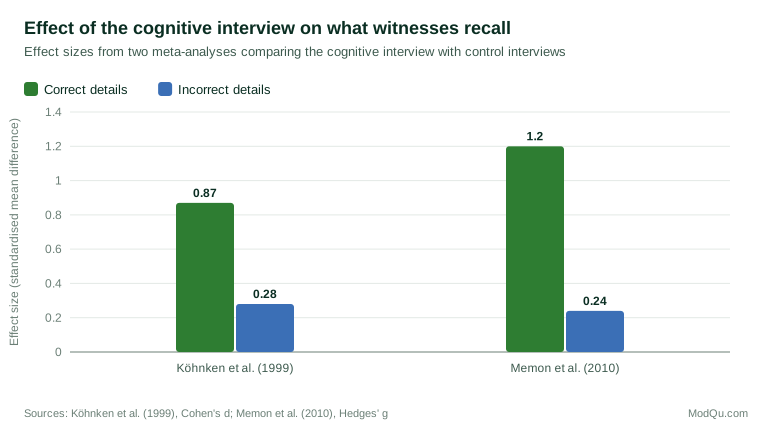
The small rise in errors means that information from a cognitive interview, like any witness evidence, must be checked against other sources. But because the increase in correct information is much greater, the method gives investigators more to work with without reducing the overall reliability of the account. Research with children suggests the cognitive interview can also reduce the effect of misleading questions (Holliday, 2003).
A short example
Imagine a hypothetical witness to a theft from a delivery van outside a shop. In a conventional interview, the officer might ask: "What time was it? What did the man look like? Was he tall? What was he wearing? Did he have a bag?" Each question retrieves one item, the word "man" assumes the thief's sex, and the question about height invites a guess.
In a cognitive interview, the officer would first explain that the witness has the information and should say everything that comes to mind, without worrying about whether it seems important. The officer would then ask the witness to think back to that afternoon: where they were standing, what they were doing, the noise of the street, the weather, how they felt when they noticed something was wrong. After an uninterrupted account, the officer would take each part of the account in turn, asking open questions such as "Tell me more about the person you saw by the van". Later, the witness might be asked to recall the event backwards, starting from the moment the van drove away.
In this example, the reverse-order recall might bring out a detail that the first account missed, for instance that the person had walked to a parked car with a distinctive roof rack. That detail is something the investigator can check against CCTV, so it adds real value even if the witness is unsure about it.
Vulnerable witnesses
Children, older adults and people with learning disabilities can be particularly susceptible to suggestion and to the pressure of an unfamiliar interview. The core principles of the cognitive interview, rapport, free recall, open questions and the avoidance of leading questions, are especially important with these groups, although some techniques need adaptation. Very young children may struggle with instructions to change perspective or recall in reverse, so interviewers rely more on context reinstatement and on patient, open prompting.
Obstacles in practice
Despite strong evidence, the cognitive interview is used less often and less fully than research suggests it should be. Surveys of police officers find that the full procedure is seen as time-consuming and that officers select some techniques and omit others (Kebbell et al., 1999). Dando et al. (2008) found that newly trained officers reported using few of the cognitive techniques with witnesses, mainly because of time pressure and a belief that they were unnecessary for routine cases.
Researchers have responded by developing shorter versions. Dando et al. (2009) tested a modified procedure suitable for frontline officers that kept the most effective elements, notably context reinstatement and free recall, and found that it produced more correct information than a structured interview in less time than the full cognitive interview. Gabbert et al. (2009) developed a self-administered interview, a booklet in which witnesses record their account using cognitive interview principles soon after an incident, before memory fades or is contaminated by conversations with others.
Skilled delivery matters. The method relies on the interviewer's ability to listen, hold back from interrupting and follow the witness's account flexibly. Fisher et al. (2011) stress that interviewers should treat the witness as the expert on the event and adapt their questions to each witness's memory rather than to a form.
Uses beyond police work
Because the cognitive interview is based on general principles of memory, it has been applied in other settings where accurate recall matters. Workplace and safety investigators use it to obtain accounts of accidents and near misses. Public health researchers have used cognitive interview techniques to improve people's recall of what they ate before a food poisoning outbreak (Fisher & Quigley, 1992). The same principles can improve survey and research interviews: setting the context before asking about past behaviour, allowing respondents to report in their own order, and avoiding leading wording all help people retrieve and report what actually happened. Vrij et al. (2014) note that interviews which encourage people to talk freely also make it easier to tell truthful from deceptive accounts, because truthful accounts tend to contain more checkable detail.
Key points
The cognitive interview shows how research can change investigative practice. It works because it follows how memory operates: retrieval depends on cues, memories can be reached by several routes, and witnesses report more when they are relaxed, in control and not interrupted. Its main lessons are simple. Let the witness talk first. Help them recreate the context. Encourage them to report everything. Ask open questions in the order of their memory, not the order of a form. And avoid any question that suggests an answer. Investigators who follow these rules gather more information, and more reliable information, than those who do not.
References
Dando, C. J., Wilcock, R., Milne, R., & Henry, L. (2009). A modified cognitive interview procedure for frontline police investigators. Applied Cognitive Psychology, 23(5), 698–716. https://doi.org/10.1002/acp.1501
Dando, C., Wilcock, R., & Milne, R. (2008). The cognitive interview: Inexperienced police officers' perceptions of their witness/victim interviewing practices. Legal and Criminological Psychology, 13(1), 59–70. https://doi.org/10.1348/135532506X162498
Fisher, R. P., Geiselman, R. E., & Amador, M. (1989). Field test of the cognitive interview: Enhancing the recollection of actual victims and witnesses of crime. Journal of Applied Psychology, 74(5), 722–727. https://doi.org/10.1037/0021-9010.74.5.722
Fisher, R. P., & Geiselman, R. E. (1992). Memory-enhancing techniques for investigative interviewing: The cognitive interview. Charles C Thomas.
Fisher, R. P., Geiselman, R. E., Raymond, D. S., Jurkevich, L. M., & Warhaftig, M. L. (1987). Enhancing enhanced eyewitness memory: Refining the cognitive interview. Journal of Police Science and Administration, 15(4), 291–297.
Fisher, R. P., Milne, R., & Bull, R. (2011). Interviewing cooperative witnesses. Current Directions in Psychological Science, 20(1), 16–19. https://doi.org/10.1177/0963721410396826
Fisher, R. P., & Quigley, K. L. (1992). Applying cognitive theory in public health investigations: Enhancing food recall with the cognitive interview. In J. M. Tanur (Ed.), Questions about questions: Inquiries into the cognitive bases of surveys (pp. 154–169). Russell Sage Foundation.
Gabbert, F., Hope, L., & Fisher, R. P. (2009). Protecting eyewitness evidence: Examining the efficacy of a self-administered interview tool. Law and Human Behavior, 33(4), 298–307. https://doi.org/10.1007/s10979-008-9146-8
Geiselman, R. E., Fisher, R. P., MacKinnon, D. P., & Holland, H. L. (1985). Eyewitness memory enhancement in the police interview: Cognitive retrieval mnemonics versus hypnosis. Journal of Applied Psychology, 70(2), 401–412. https://doi.org/10.1037/0021-9010.70.2.401
Godden, D. R., & Baddeley, A. D. (1975). Context-dependent memory in two natural environments: On land and underwater. British Journal of Psychology, 66(3), 325–331. https://doi.org/10.1111/j.2044-8295.1975.tb01468.x
Holliday, R. E. (2003). Reducing misinformation effects in children with cognitive interviews: Dissociating recollection and familiarity. Child Development, 74(3), 728–751. https://doi.org/10.1111/1467-8624.00565
Kebbell, M. R., Milne, R., & Wagstaff, G. F. (1999). The cognitive interview: A survey of its forensic effectiveness. Psychology, Crime & Law, 5(1–2), 101–115. https://doi.org/10.1080/10683169908414996
Köhnken, G., Milne, R., Memon, A., & Bull, R. (1999). The cognitive interview: A meta-analysis. Psychology, Crime & Law, 5(1–2), 3–27. https://doi.org/10.1080/10683169908414991
Loftus, E. F., & Palmer, J. C. (1974). Reconstruction of automobile destruction: An example of the interaction between language and memory. Journal of Verbal Learning and Verbal Behavior, 13(5), 585–589. https://doi.org/10.1016/S0022-5371(74)80011-3
Loftus, E. F. (2005). Planting misinformation in the human mind: A 30-year investigation of the malleability of memory. Learning & Memory, 12(4), 361–366. https://doi.org/10.1101/lm.94705
Memon, A., Meissner, C. A., & Fraser, J. (2010). The cognitive interview: A meta-analytic review and study space analysis of the past 25 years. Psychology, Public Policy, and Law, 16(4), 340–372. https://doi.org/10.1037/a0020518
Milne, R., & Bull, R. (1999). Investigative interviewing: Psychology and practice. Wiley.
Shepherd, E., & Griffiths, A. (2013). Investigative interviewing: The conversation management approach (2nd ed.). Oxford University Press.
Tulving, E., & Thomson, D. M. (1973). Encoding specificity and retrieval processes in episodic memory. Psychological Review, 80(5), 352–373. https://doi.org/10.1037/h0020071
Vrij, A., Hope, L., & Fisher, R. P. (2014). Eliciting reliable information in investigative interviews. Policy Insights from the Behavioral and Brain Sciences, 1(1), 129–136. https://doi.org/10.1177/2372732214548592