
Investigation · Foundations
Planning an Investigation: Scope, Objectives and Resources
Most investigations that fail do so because of weak planning, not weak investigators. This article sets out how to define the mandate, scope and objectives of an investigation, plan lines of inquiry, allocate resources and build in review points.
Investigations often begin in a rush. A complaint arrives, money is missing, an accident has happened or a journalist receives a tip, and the instinct is to start gathering information at once. Some early actions are indeed urgent: evidence can disappear, witnesses' memories fade and suspects can destroy records. But an investigation that runs without a plan tends to drift. It collects too much of some evidence and too little of the rest, overruns its budget, misses deadlines and, most dangerously, follows the first theory that appears. Planning is what turns activity into inquiry.
This article sets out the main elements of investigation planning: the mandate, scope and objectives; the hypotheses and lines of inquiry that follow from them; the evidence and resources required; legal and ethical constraints; risk; and review. The principles come mainly from criminal and corporate investigation, but they apply to any structured inquiry.
Why planning matters
Research on police investigation provides a sobering starting point. A RAND Corporation study of criminal investigation in the United States in the 1970s concluded that the information available at the outset, especially what victims and witnesses told the first officers on the scene, was the most important factor in whether a case was solved, and that much detective work added relatively little (Greenwood et al., 1977). Later work refined this view. Eck (1983) found that cases fell into three broad groups: those that would be solved with little effort, those that would almost certainly not be solved whatever was done, and a middle group in which follow-up investigation made a real difference. Coupe and Griffiths (1996) reached similar conclusions for residential burglary in England. The implication is that investigative effort has the greatest value when it is planned and directed at the cases and lines of inquiry where it can change the outcome.
Planning also protects against cognitive error. Investigators who commit early to a single explanation tend to seek evidence that confirms it (Findley & Scott, 2006; Nickerson, 1998). Interview research with experienced detectives shows that decisions in homicide inquiries often turn on early "tipping points", after which the focus narrows (Fahsing & Ask, 2013). A written plan that lists alternative explanations and the evidence needed to test them makes that narrowing visible and deliberate.
Finally, planning is a matter of accountability. Police doctrine in England and Wales describes investigation as a process that must be planned, recorded and reviewed so that decisions can be explained afterwards (Association of Chief Police Officers [ACPO], 2005). A corporate investigation that leads to dismissal, or a regulatory inquiry that leads to a penalty, will be judged by whether its process was fair and proportionate. A plan, and a record of how it changed, is the best evidence of that.
Step 1: Establish the mandate
Every investigation is conducted on someone's authority. The mandate states who commissioned the investigation, what they want to know, what powers and access the investigator has, who the findings will be reported to, and what decisions will be made on the basis of them. In a corporate setting, the mandate may come from the board, the audit committee, the general counsel or a senior manager. Its source matters: an investigation commissioned by managers who may themselves be implicated lacks independence, and one directed by legal counsel may attract legal privilege over some of its work (Upjohn Co. v. United States, 1981).
A clear mandate also defines the investigator's independence. If findings could embarrass the people who commissioned the work, the mandate should say how the investigator will report, and to whom, if that happens.
Step 2: Define scope and objectives
The scope sets the boundaries of the investigation: the events, period, people, business units, locations and types of conduct it covers. The objectives state the specific questions it must answer. For example:
- Scope: payments to suppliers by the regional procurement office between January 2022 and June 2024.
- Objectives: to establish whether payments were made for goods or services that were not received; if so, the amount, the people involved and how controls were circumvented; and to recommend improvements to controls.
Well-written objectives are specific enough to tell the investigator when the work is finished and neutral enough not to presuppose the answer. "Establish whether payments were made for goods not received" is better than "establish how the procurement manager stole from the company", which assumes both that theft occurred and who did it.
Scope is often the hardest element to hold. As evidence emerges, related issues appear, and the temptation is to follow all of them. Project managers call this scope creep, and it is a common cause of overrun in projects of all kinds (Project Management Institute, 2021). The answer is not to ignore new issues, but to decide explicitly whether to expand the scope, start a separate inquiry or record the issue for later, and to agree any change with whoever holds the mandate.
Step 3: Develop hypotheses and lines of inquiry
Once the questions are clear, the investigator sets out the possible explanations. For a reconciliation discrepancy, these might include theft, error, system failure, timing differences or legitimate transactions that were poorly recorded. For each, the investigator asks what evidence would exist if it were true, and what evidence would rule it out. The investigative journalism method known as story-based inquiry makes this explicit: the journalist frames the story as a hypothesis that can be verified or disproved, and plans the research needed to test it (Hunter et al., 2011). Intelligence analysts use a similar approach, the analysis of competing hypotheses, which focuses attention on evidence that discriminates between explanations (Heuer, 1999).
From the hypotheses come lines of inquiry: specific tasks such as obtaining bank statements, imaging a computer, interviewing a witness or checking delivery records. Police doctrine in the United Kingdom groups lines of inquiry into investigative strategies, such as scene examination, witness identification, forensic, financial, communications and media strategies, each with its own plan (ACPO, 2005, 2006). Corporate investigators often organise their work in similar categories: documents, data, interviews, external sources and forensic analysis.
Step 4: Prioritise
No investigation can follow every possible lead. Prioritising lines of inquiry involves judging the value of the information each could provide against the effort, cost and risk of obtaining it. Some actions are urgent because evidence may be lost: securing devices before data are deleted, obtaining CCTV before it is overwritten, or taking witness accounts while memories are fresh. Murder investigation guidance in England and Wales emphasises "fast-track actions" in the early hours of an inquiry for exactly this reason (ACPO, 2006).
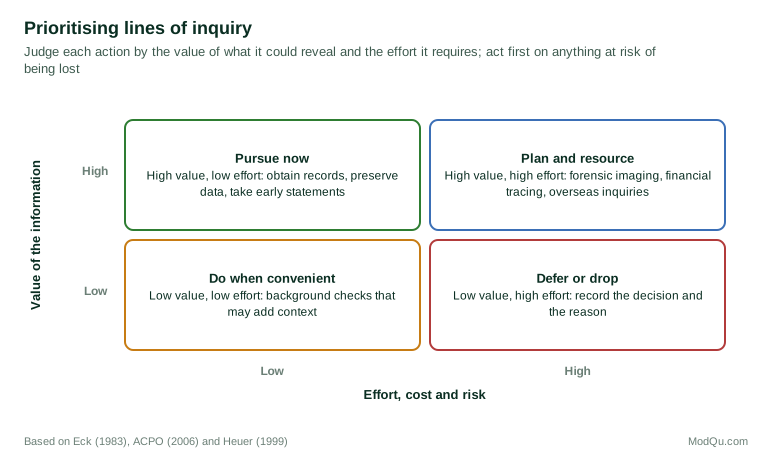
Prioritising also means deciding the order of actions. A common rule in workplace and fraud investigations is to gather documents and data before interviewing, and to interview witnesses before the subject. This allows the investigator to put relevant evidence to the subject and test their account, and it reduces the risk that the subject, once alerted, destroys or alters evidence. Guidance for workplace investigations stresses that the person under investigation should nonetheless be given a fair opportunity to respond to the allegations and evidence before conclusions are reached (Acas, 2019).
Planning interviews and information flow
Interviews deserve their own plan within the wider investigation plan. The PEACE model of investigative interviewing, used by police in England and Wales and widely adopted elsewhere, begins with "planning and preparation" for this reason (Milne & Bull, 1999). Before each interview, the investigator should know what the interview is meant to establish, what is already known from documents and other witnesses, which topics must be covered, what evidence will be disclosed and when, and how the account will be recorded. An unplanned interview tends to wander, misses important topics and may disclose evidence in a way that allows a dishonest interviewee to tailor their account.
Textbooks on criminal investigation describe the investigator's core task as managing information: gathering it from many sources, recording it, assessing it and passing it to the people who need it (Stelfox, 2009; Tong et al., 2009). Planning should therefore cover how information will flow within the team. Who records new information, who reads it, and how is it linked to the hypotheses and actions in the plan? In small inquiries this may be a single spreadsheet. In large ones, it requires a dedicated system and staff whose job is to read every document and raise follow-up actions. Brodeur (2010) notes that much detective work consists of processing information already held by the police and other agencies, which makes the organisation of that information central to success.
A plan should also say how the investigation will communicate with people outside the team: the person who raised the concern, the subject, managers who need to act on interim findings, and in some cases regulators, insurers or the police. Deciding in advance what can be shared, and when, avoids both damaging leaks and the unfairness of leaving people uninformed for long periods.
Step 5: Plan resources and time
An investigation plan should state who will do the work, what skills are needed, what it will cost and how long it should take. Specialist skills, such as forensic accounting, digital forensics, language skills or legal advice, often need to be arranged in advance. Resource planning also covers access: to premises, systems, records and people, some of which may require legal authority or the cooperation of third parties.
Estimates of time and cost are notoriously optimistic. Research on the "planning fallacy" shows that people systematically underestimate how long tasks will take, even when they know that similar tasks have overrun in the past (Buehler et al., 1994; Kahneman, 2011). Flyvbjerg (2006) recommends "reference class forecasting", which bases estimates on the actual outcomes of comparable past projects rather than on the details of the current one. For investigations, that means looking at how long similar cases have taken and building in contingency, especially for actions that depend on others, such as banks responding to requests for records or overseas authorities responding to requests for assistance.
Step 6: Identify legal and ethical constraints
Investigators must work within the law, and the methods available differ greatly by setting. Police investigators may have powers of arrest, search and seizure, and access to communications data, subject to authorisation. In the United Kingdom, the use of covert surveillance and informants by public authorities is regulated by the Regulation of Investigatory Powers Act 2000, which requires that intrusive methods be necessary and proportionate. Private and corporate investigators have no such powers and must rely on consent, contractual rights and lawful access to information.
Data protection law applies to almost every investigation that involves personal information. In the European Union and the United Kingdom, the General Data Protection Regulation requires a lawful basis for processing personal data, limits processing to what is necessary for the purpose, and gives individuals rights over their data (Regulation (EU) 2016/679, 2016). Planning should identify the lawful basis, consider what personal data will be collected, and set out how it will be secured and when it will be deleted.
Ethical questions go beyond legal compliance: how to treat witnesses who fear retaliation, how to protect the reputation of people under investigation who may be innocent, and how to handle information about third parties. These should be considered at the planning stage rather than improvised later.
Step 7: Assess risk
Every investigation carries risks: that evidence will be destroyed, that the subject will be tipped off, that a witness will be intimidated, that the investigation will become public prematurely, that the organisation will face legal claims, or that investigators will be exposed to physical or psychological harm. Risk management standards recommend identifying risks, assessing their likelihood and consequences, and deciding how to treat them (International Organization for Standardization [ISO], 2018). In an investigation plan, this typically appears as a short risk register with mitigation measures, such as restricting knowledge of the investigation to a small group, preserving data before any interviews, or arranging support for witnesses.
Step 8: Build in review
A plan is a starting point, not a contract. Evidence will change the picture, and the plan should change with it. Formal review points, at which the investigator and a supervisor or steering group consider what has been found, which hypotheses remain open, and whether the scope or priorities should change, help prevent drift and tunnel vision. Major police inquiries in the United Kingdom use structured reviews by officers independent of the investigation team, particularly when a case has not been solved within a set period (ACPO, 2006). In corporate settings, a short periodic update to the person who holds the mandate serves a similar purpose.
Every significant decision, including decisions not to pursue a line of inquiry, should be recorded with the reasons. This decision log protects the investigation if it is later challenged, and it makes it easier for someone else to take over the case.
The plan should also state in advance what will count as a finished investigation. Closure criteria might be that each objective has been answered to the required standard of proof, that each hypothesis has been either supported or eliminated, or that remaining lines of inquiry are unlikely to change the outcome in proportion to their cost. Setting these criteria at the start makes it harder to stop simply because time or money has run out, and easier to explain the decision to stop when it is made. Where an investigation must close with questions unanswered, the final report should say so plainly and list what further work could resolve them.
A planning template
The elements above can be brought together in a short planning document. A typical structure is shown below.
| Section | Contents |
|---|---|
| Mandate | Who commissioned the work, authority and access, reporting line |
| Background | What is known so far and how it came to light |
| Scope | Events, period, people, units and conduct covered; what is excluded |
| Objectives | The specific questions to be answered |
| Hypotheses | Possible explanations, including innocent ones |
| Lines of inquiry | Actions, evidence sought, priority, owner and deadline |
| Resources | Team, specialist support, budget and time estimate |
| Legal and ethical | Lawful basis, privilege, data protection, fairness to subjects |
| Risks | Main risks and mitigation |
| Review | Review dates, decision log, criteria for closing the case |
| Reporting | Format, audience and standard of proof for the findings |
The planning document need not be long. For a straightforward workplace complaint, two pages may be enough. For a complex fraud or major incident, the plan may be a living document running to many pages, supported by a case management system that tracks every action.
Common planning failures
Experience across fields suggests a handful of recurring failures:
- No written objectives. The investigation answers a question nobody asked, or never establishes when it is finished.
- Single-hypothesis planning. All lines of inquiry are designed to prove one explanation, so evidence for alternatives is never sought.
- Interviewing too early. The subject is interviewed before documents are secured, and evidence is lost or the account cannot be tested.
- Unrealistic timescales. Estimates ignore delays from third parties, and the investigation is rushed to a conclusion when the deadline arrives.
- Unmanaged scope. New issues are absorbed without decision, and the core questions are left unanswered.
- No review. The plan written on the first day is never revisited, even after the evidence has changed the picture.
Each of these failures can be avoided through modest effort at the outset and at regular intervals. Innes (2003), studying homicide inquiries, showed how much of investigative work is shaped by organisational routines; a good planning routine is among the most valuable.
Planning beyond investigation
The same discipline applies to research projects. A survey or study that begins with clear objectives, a statement of the hypotheses to be tested, a realistic plan for data collection and analysis, and agreed review points is far more likely to produce useful findings than one that collects data first and decides what it means later. As in investigation, the plan does not have to be followed rigidly, but changes to it should be deliberate, recorded and explained. That is what allows the people who rely on the findings to trust them.
References
Acas. (2019). Conducting workplace investigations. Advisory, Conciliation and Arbitration Service.
Association of Chief Police Officers. (2006). Murder investigation manual. National Centre for Policing Excellence.
Association of Chief Police Officers. (2005). Practice advice on core investigative doctrine. National Centre for Policing Excellence.
Brodeur, J.-P. (2010). The policing web. Oxford University Press.
Buehler, R., Griffin, D., & Ross, M. (1994). Exploring the "planning fallacy": Why people underestimate their task completion times. Journal of Personality and Social Psychology, 67(3), 366–381. https://doi.org/10.1037/0022-3514.67.3.366
Coupe, T., & Griffiths, M. (1996). Solving residential burglary (Crime Detection and Prevention Series Paper 77). Home Office Police Research Group.
Eck, J. E. (1983). Solving crimes: The investigation of burglary and robbery. Police Executive Research Forum.
Fahsing, I., & Ask, K. (2013). Decision making and decisional tipping points in homicide investigations: An interview study of British and Norwegian detectives. Journal of Investigative Psychology and Offender Profiling, 10(2), 155–165. https://doi.org/10.1002/jip.1384
Findley, K. A., & Scott, M. S. (2006). The multiple dimensions of tunnel vision in criminal cases. Wisconsin Law Review, 2006(2), 291–397.
Flyvbjerg, B. (2006). From Nobel Prize to project management: Getting risks right. Project Management Journal, 37(3), 5–15. https://doi.org/10.1177/875697280603700302
Greenwood, P. W., Chaiken, J. M., & Petersilia, J. (1977). The criminal investigation process. D. C. Heath.
Heuer, R. J., Jr. (1999). Psychology of intelligence analysis. Center for the Study of Intelligence, Central Intelligence Agency.
Hunter, M. L., Hanson, N., Sabbagh, R., Sengers, L., Sullivan, D., & Svith, F. T. (2011). Story-based inquiry: A manual for investigative journalists. UNESCO.
Innes, M. (2003). Investigating murder: Detective work and the police response to criminal homicide. Oxford University Press.
International Organization for Standardization. (2018). Risk management — Guidelines (ISO Standard No. 31000:2018).
Kahneman, D. (2011). Thinking, fast and slow. Farrar, Straus and Giroux.
Milne, R., & Bull, R. (1999). Investigative interviewing: Psychology and practice. Wiley.
Nickerson, R. S. (1998). Confirmation bias: A ubiquitous phenomenon in many guises. Review of General Psychology, 2(2), 175–220. https://doi.org/10.1037/1089-2680.2.2.175
Project Management Institute. (2021). A guide to the project management body of knowledge (PMBOK guide) (7th ed.). Project Management Institute.
Regulation (EU) 2016/679 of the European Parliament and of the Council of 27 April 2016 on the protection of natural persons with regard to the processing of personal data and on the free movement of such data (General Data Protection Regulation). (2016). Official Journal of the European Union, L 119, 1–88.
Regulation of Investigatory Powers Act 2000, c. 23 (UK).
Stelfox, P. (2009). Criminal investigation: An introduction to principles and practice. Willan.
Tong, S., Bryant, R. P., & Horvath, M. A. H. (2009). Understanding criminal investigation. Wiley-Blackwell. https://doi.org/10.1002/9780470749616
Upjohn Co. v. United States, 449 U.S. 383 (1981).