
Investigation · Foundations
Evidence: Types, Weight and Admissibility
A short guide to the main types of evidence, the difference between how much evidence proves and whether it can be used at all, and why both questions matter outside the courtroom.
Every investigation, whether criminal, corporate or journalistic, ends with a claim about what happened. Evidence is the material that supports or undermines that claim. Investigators need to understand three things about it: what kind of evidence they have, how much it proves, and whether it can be used in the setting where the findings will be judged.
Types of evidence
Evidence is commonly classified in two ways. The first concerns how it relates to the fact in question. Direct evidence proves a fact without any inference, such as a witness who saw the act. Circumstantial evidence proves other facts from which the fact in question can be inferred, such as a suspect's fingerprints on a window. Circumstantial evidence is often described as weaker, but that is a misconception: several independent strands of circumstantial evidence can be more reliable than a single eyewitness (Anderson et al., 2005).
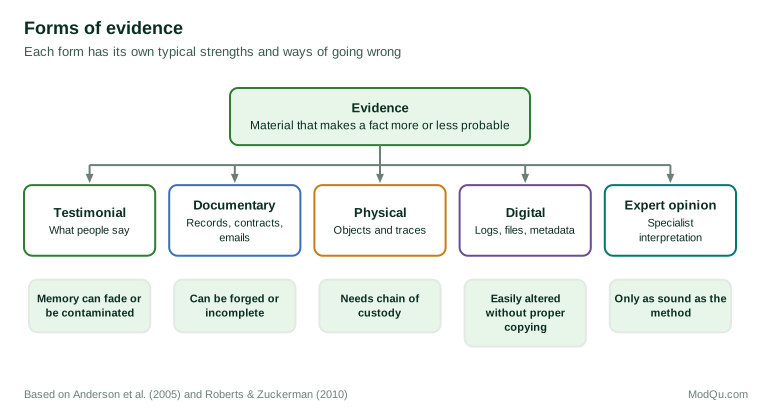
The second classification concerns the form evidence takes.
Weight: how much evidence proves
The weight of evidence is the degree to which it makes a fact more or less likely. Schum (1994) breaks this down into relevance (does it bear on the question at all?), credibility (can the source be trusted?) and inferential force (how strongly does it distinguish one explanation from another?). A confession is highly relevant, but its credibility depends on how it was obtained. A bank record may be highly credible but have little force if many people had access to the account. Weight is always a matter of judgment, and it is assessed for the evidence as a whole, not item by item. Two investigators can agree on every fact and still disagree about weight, which is why the reasoning behind each assessment should be written down.
Admissibility: whether evidence can be used
Admissibility is a legal question: is the evidence allowed to be considered at all? Courts exclude some evidence that may be relevant because it is unfair, unreliable or obtained improperly. Common grounds include hearsay (a second-hand account offered to prove its contents), evidence obtained in breach of legal rights, and expert evidence that does not meet a threshold of reliability. In the United States, Daubert v. Merrell Dow Pharmaceuticals, Inc. (1993) asks judges to consider whether an expert's method has been tested, peer reviewed and has a known error rate. In Canada, R. v. Mohan (1994) sets out criteria including relevance, necessity and a properly qualified expert.
Admissibility and weight are separate. Evidence can be admissible but carry little weight, and highly persuasive evidence can be excluded (Roberts & Zuckerman, 2010).
Combining evidence
Investigators rarely rely on a single item. They build a case from many pieces, and the way those pieces combine matters as much as their individual strength. Two items that agree add real weight only if they are independent. Two witnesses who discussed the event before giving statements, or two documents produced from the same flawed database, may look like corroboration while adding little. Conversely, a small fact that is hard to explain on any account except one can carry great weight. Anderson et al. (2005) recommend mapping how each item supports or undermines each proposition in the case, so that gaps and dependencies become visible.
Missing evidence also counts. If a theory predicts that a record should exist and it does not, that absence is itself evidence. Good investigators note what they looked for and did not find, as well as what they found.
Why this matters outside court
Most investigations never reach a courtroom, yet the same distinctions apply, and organisations that ignore them are often surprised when a dismissal, a regulatory finding or a published allegation is overturned on review. A workplace inquiry, a regulatory review or a published report will be judged by people asking whether the evidence was obtained fairly and whether it really supports the conclusion. Investigators who collect evidence as though it might one day be tested in court, by documenting its source, preserving it properly and recording how they weighed it, produce findings that survive scrutiny in any setting.
References
Anderson, T., Schum, D., & Twining, W. (2005). Analysis of evidence (2nd ed.). Cambridge University Press. https://doi.org/10.1017/CBO9780511610585
Daubert v. Merrell Dow Pharmaceuticals, Inc., 509 U.S. 579 (1993).
Roberts, P., & Zuckerman, A. (2010). Criminal evidence (2nd ed.). Oxford University Press.
R. v. Mohan, [1994] 2 S.C.R. 9 (Supreme Court of Canada).
Schum, D. A. (1994). The evidential foundations of probabilistic reasoning. Wiley.